x

 Preview
 Bestel schilderij Koop afbeelding in hoge resolutie
 Verstuur
 Details bekijken
 Toevoegen aan favorieten
 Download
 Vergelijkbare werken
 Röntgenonderzoek
 Diavoorstelling
 Oil On CanvasWallArtSymbolist Movement
 188619th Century
 141.0 x 110.0 cm
 Tate Britain
Giclée- of canvasafdruk van museumkwaliteit met snelle productie en flexibele afwerkingsopties.





























Kies uit onze vooraf ingestelde maten die overeenkomen met de originele verhoudingen van het kunstwerk.

U kunt uw eigen afmetingen opgeven om in een specifieke lijst of ruimte te passen. Als de door u gekozen maat niet overeenkomt met de proporties van het originele kunstwerk, zullen wij de afbeelding bijsnijden of uitbreiden met een gespiegelde of effen rand. Een digitaal mockup wordt ter goedkeuring naar u verzonden voordat de productie begint.
Houd er rekening mee dat de preview op het scherm de werkelijke bijsneding of uitbreiding niet weergeeft. Alleen de mockup toont de uiteindelijke compositie nauwkeurig.
Hoewel aangepaste maten beschikbaar zijn, raden wij aan een afmeting uit de vooraf bepaalde lijst te kiezen om de originele proporties te behouden.
Wereldwijde levering () binnen 2 weken in plaats van de standaard 4/5 weken. (23 juli)


Hope
Afmetingen reproductie
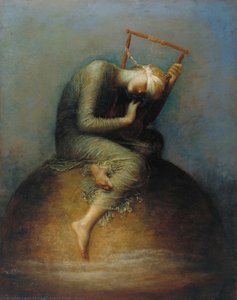
To stand before George Frederic Watts' Hope is not merely to observe paint on canvas; it is to encounter a profound meditation on the human spirit itself. Created in 1886, this painting remains one of the most emotionally resonant works of the Victorian era. The composition immediately draws the eye to the central figure—a woman seated upon a sphere, her posture conveying an exquisite blend of sorrow and tenacious endurance. Her hands are clasped near her face, suggesting a moment caught between weeping and profound contemplation. It is in this delicate tension that the viewer finds themselves drawn into the narrative Watts so masterfully constructed.
The symbolism within Hope is as rich and layered as the deep blue background against which it is set. The sphere upon which she rests can be interpreted as the world, or perhaps the cyclical nature of human experience itself. More compelling still is the subtle suggestion that she holds onto a string—a fragile tether connecting her to something unseen, something ethereal, perhaps even the heavens. This thread embodies the very concept of hope: tenuous yet utterly vital. Watts, deeply influenced by Symbolism, rarely painted simply what was visible; he painted what could not be spoken aloud. The presence of other figures in the periphery adds depth, suggesting that this personal struggle is witnessed, understood, and shared within a broader human context.
George Frederic Watts himself was a pivotal figure in the Symbolist movement, an artist whose work consistently explored weighty themes of morality and the enduring condition of man. His background, steeped in classical influences yet grappling with modern anxieties, is palpable here. The painting speaks to the Victorian preoccupation with inner life—the struggle for virtue against adversity. For the contemporary admirer or collector, this piece offers a window into an era that valued introspection above all else. It is art that does not merely decorate a wall but prompts deep, necessary conversation within the quiet sanctity of a room.
For those seeking to incorporate such potent artistry into their own spaces, reproductions of Hope offer an unparalleled opportunity. Imagine this evocative scene rendered in exquisite detail, allowing its emotional gravity to permeate your home décor. Whether placed above a mantelpiece or within a gallery setting, the painting’s narrative power elevates any interior design scheme. It serves not just as decoration, but as a constant, beautiful reminder of resilience—a visual anchor for perseverance against life's inevitable shadows.


1817 - 1904 , Verenigd Koninkrijk

Ontdek de top 25 meesterwerken uit het Metropolitan Museum of Art, New York! Van Van Gogh tot Monet – leer over kunstgeschiedenis en bewonder iconische schilderijen. Vind museumkwaliteit reproducties & interieurinspiratie op Most-Famous-Paintings.com.
Ontdek de 25 meest iconische meesterwerken van James Abbott McNeill Whistler, pionier van het esthetisme en impressionisme. Van zijn betoverende Nocturnes tot portretten vol harmonie. Vind museumkwaliteit reproducties & decoratie-inspiratie op Most-Famous-Paintings.com
Ontdek de top 25 meesterwerken van Henri Matisse! Duik in de wereld van Fauvisme, kleurrijke composities & expressieve kunst. Vind museumkwaliteit reproducties en decoratie-inspiratie op Most-Famous-Paintings.com. Exploreer de collectie online!
Ontdek de top 25 meesterwerken van National Gallery Washington! Van Cézanne tot Picasso, leer het verhaal achter iconische kunst. Vind museumkwaliteit reproducties & interieurinspiratie op Most-Famous-Paintings.com.

Ontdek de top 25 meesterwerken van Paul Klee! Duik in zijn kleurrijke wereld vol abstracte kunst, Bauhaus invloeden & expressieve composities. Vind museumkwaliteit reproducties en woondecoratie inspiratie op Most-Famous-Paintings.com.


Blijf op de hoogte van het laatste kunstnieuws, exclusieve aanbiedingen en decoratie-ideeën.
Vertel ons over uw project en onze kunstexperts geven u 3 gepersonaliseerde kunstsuggesties.
Wij stellen 3 opties speciaal voor u samen – Gratis!


 Delen
Delen

 Lees meer







 De optie voor glas is alleen beschikbaar bij een formaat kleiner dan 110 cm.