
Verlanglijstje Winkelwagen Cart
VoorvertoningVoorvertoning Bekijk in ARBekijk in AR Bestel print Bestel printKoop afbeelding Koop afbeelding VerstuurVerstuur
Details bekijkenDetails bekijken Toevoegen aan favorieten Toevoegen aan favorieten DownloadDownload Vergelijkbare itemsVergelijkbare items RöntgenonderzoekRöntgenonderzoek DiavoorstellingDiavoorstelling

Andromède

Gustave Moreau’s ‘Andromède’ presents a dramatic Symbolist scene of a woman battling a demon amidst fantastical mountains and clouds, showcasing the artist's evocative style. Explore this captivating artwork and bring its beauty into your space.

Ontdek Gustave Moreau's droomachtige Symbolisme! Zijn mythologische & religieuze schilderijen, beïnvloed door Matisse & Rouault, vertellen verhalen vol mysterie en schoonheid.

Handgemaakte olieverfreproductie

Met de hand geschilderd in olieverf op canvas in uw gewenste maat en lijst, op bestelling gemaakt door onze kunstenaars. (Bestel print Bestel printKoop afbeelding Koop afbeelding)

P118B $10
P118H $10
P118W $10
P438Z $10
P508JH $12
P508YH $12
P805H $10
P805Z $10
P919BZ $10
P919G $10
P919XJ $10
P959ZH $10
P968JZ $12
W106C $8
W218G $10
W218JH $8
W218Y $10
W307PJ $10
W316G $10
W316PJ $8
W316Y $10
W398PJ $8
W4111J $10
W500HY $15
W500JH $15
W692G $12
W849H $8
W940BG $15
W953PJ $8

Standard
custom
CM
INCH

Kies uit onze vooraf ingestelde maten die overeenkomen met de originele verhoudingen van het kunstwerk.

breedte
hoogte

U kunt uw eigen afmetingen invoeren om in een specifieke lijst of ruimte te passen. Als de door u gekozen maat niet overeenkomt met de verhoudingen van het originele beeld, zullen we het kunstwerk bijsnijden of het schilderij uitbreiden met extra handgeschilderde elementen. Een digitale mockup wordt ter goedkeuring naar u verzonden voordat de productie begint.
Houd er rekening mee dat de preview op het scherm niet de werkelijke uitsnede of uitbreiding weergeeft. Alleen de mockup toont de uiteindelijke compositie nauwkeurig.
Hoewel aangepaste afmetingen mogelijk zijn, raden we aan een maat uit de vooraf gedefinieerde lijst te selecteren om de originele verhoudingen te behouden.

Voorbeelden van aanpassingen: Vervang het gezicht met een eigen foto; Voeg een huisdier toe (bijv. vervang de kat door een hond); Verwerk een verborgen boodschap in de achtergrond; Wijzig het landschap of andere elementen in de achtergrond.
Na de bestelling zal het team van Most-Famous-Paintings.com per e-mail contact opnemen met de klant voor instructies en een mockup-voorbeeld sturen.

Wereldwijde levering () binnen 3 tot 4 weken in plaats van de standaard 5 weken. (23 augustus). Zonder concessies aan de kwaliteit.

why_choose_icon
Gratis wereldwijde expressverzending
why_choose_icon
Hoogwaardig linnen canvas
why_choose_icon
Volledige verzendverzekering
why_choose_icon
Garantie op terugbetaling van invoerrechten
why_choose_icon
Garantie op exacte kleurweergave
why_choose_icon
Retourbeleid van 60 dagen (alleen bij defecten)
why_choose_icon
100% Geld-terug-garantie
why_choose_icon
Korting bij meerdere afnames

Totaalprijs

$ 272

reproduction

Andromède

Druktechniek

Afmetingen reproductie

-

Eindtotaal

$ 272

Snelle feiten

  • Subject or theme: Mythology, conflict
  • Movement: Symbolism
  • Artistic style: Dreamlike, ornate
  • Artist: Gustave Moreau
  • Year: 1898
  • Influences:
    • Romanticism
    • Medieval art
  • Notable elements: Mythological scene, battle

Beschrijving kunstwerk

A Descent into Mythic Realms: Exploring Gustave Moreau’s “Andromède”

Gustave Moreau's "Andromède" is not merely a depiction of a biblical narrative; it’s an immersion into the richly layered, emotionally charged world of Symbolism. Painted in 1890, this work exemplifies Moreau’s profound engagement with mythology, religion, and the subconscious—themes that would define his career and establish him as one of the movement's most distinctive figures. The painting immediately arrests the viewer with its dramatic composition: a woman, Andromède, stands poised against a monstrous figure, locked in what appears to be a desperate struggle. This isn’t a straightforward retelling of the story of Andromeda chained to a rock; instead, Moreau transforms it into a potent allegory for conflict, desire, and the precarious balance between order and chaos.

  • Subject Matter: The painting draws upon the Greek myth of Andromeda, a princess chained to a rock as a sacrifice to appease Poseidon.
  • Style: Moreau’s style is quintessential Symbolism – characterized by dreamlike imagery, rich color palettes, and an emphasis on emotional expression over realistic representation.

The Language of Symbolism: Color, Texture, and Composition

Moreau's technical mastery is evident in the meticulous detail with which he renders his subjects. The palette is dominated by deep blues, purples, and ochres, creating a sense of melancholy and foreboding. These colors aren’t used to simply represent reality; they are imbued with symbolic weight, reflecting the emotional turmoil at the heart of the scene. Notice the heavy impasto – the thick application of paint – particularly in the textures of the monster's skin and the woman's garments. This technique adds a tactile quality to the work, inviting the viewer to almost feel the struggle unfolding before them. The composition itself is deliberately unbalanced, with the figures positioned off-center, contributing to the overall sense of unease and instability. Moreau’s use of pyramidal structure, a common device in academic art, is subverted here, creating a dynamic tension that draws the eye across the canvas.

Decoding the Symbolism: Demons, Goddesses, and the Human Psyche

The monstrous figure accompanying Andromède is not a literal demon but rather a projection of her inner demons—representing fear, temptation, or perhaps even the destructive forces within herself. The presence of two additional figures – one on either side – adds another layer of complexity to the narrative. Some scholars believe they represent opposing forces, while others interpret them as aspects of Andromède’s own psyche. Moreau frequently employed allegorical figures in his work, drawing inspiration from classical mythology and esoteric traditions. His goal was not to simply depict a story but to explore universal themes through symbolic imagery, tapping into the viewer's subconscious.

Historical Context and Lasting Impact

"Andromède" was created during a period of significant artistic innovation in Paris. Moreau’s work stood apart from the naturalism and realism that dominated the art world at the time. He aligned himself with other Symbolist artists, such as Odilon Redon and Pierre Puvis de Chavannes, who sought to create works that were both beautiful and deeply meaningful. Moreau's influence can be seen in subsequent generations of artists, including those associated with Art Nouveau and early Modernism. Today, "Andromède" remains a powerful example of Symbolist painting—a testament to Moreau’s ability to transform myth into a profound meditation on the human condition. Its evocative imagery continues to captivate viewers, inviting them to contemplate the timeless themes of struggle, sacrifice, and the enduring power of the imagination.
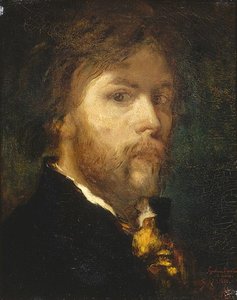

Biografie van de kunstenaar

A Dream Weaver of Symbolism: The Life and Art of Gustave Moreau

Gustave Moreau, een naam die synoniem staat voor de etherische schoonheid en de betekenisvolle diepten van symbolistische schilderkunst, kwam in de 19e eeuwse Parijs als een unieke artistieke stem tot bloei. Geboren in 1826 in een burgerlijke familie – zijn vader een architect en archivaris – was Moreau’s vroege leven doordrenkt met intellectuele nieuwsgierigheid en esthetische gevoeligheid. Vanaf jonge leeftijd toonde hij een opmerkelijk talent voor tekenen, gekneed door traditionele academische training aan de École des Beaux-Arts onder figuren als François-Édouard Picot. Echter, Moreau’s artistieke pad zou aanzienlijk afwijken van de heersende Realistische en Impressionistische stromingen van zijn tijd. Hij was niet geïnteresseerd in het vastleggen van vluchtige momenten of objectieve realiteit; in plaats daarvan zocht hij naar het ontsluiten van de verborgen rijkdommen van mythologie, religie en de menselijke psyche door middel van een diep persoonlijke en symbolische visuele taal. Zijn reis was één van interne exploratie, waarbij subjectieve emoties en spirituele verlangens werden vertaald naar doeken met obsessieve aandacht voor detail en een levendige, vaak opulence palet.

The Forge of Imagination: Influences and Artistic Development

Moreau’s artistieke ontwikkeling werd niet in een vacuüm geboren. Hoewel hij de dominante trends van zijn tijd afwees, haalde hij inspiratie uit diverse bronnen. De dramatische toepassing van kleur en exotisch onderwerpmateriaal gevonden in het werk van Eugène Delacroix wekte bij hem een diepe passie voor narratieve schilderkunst, doordrenkt met emotionele intensiteit. Hij verreefde ook de meesters van de Renaissance zoals Michelangelo en Leonardo da Vinci, bewonderend hun beheersing van compositie, anatomie en psychologische inzicht. Toch was Moreau niet simpelweg een imitator van deze kunstenaars; hij synthetiseerde hun invloeden tot iets radicaal nieuws. Zijn reizen naar Italië in de jaren 1850 droegen bij aan zijn ontwikkeling, waardoor hij werd ondergedompeld in de kunst van het oude en de Renaissance, wat een schat aan motieven en stijlelementen opleverde die zijn toekomstige werken zouden bevolken. Hij kopieerde zorgvuldig Oude werken, niet als oefening in replicatie, maar om hun technieken te absorberen en hun geheimen te ontsluiten. Deze toewijding aan vakmanschap, gecombineerd met zijn groeiende interesse in mythologie en literatuur, legde de basis voor zijn unieke artistieke visie.

A World of Symbols: Themes and Techniques

Moreau’s schilderijen zijn niet simpelweg illustraties van mythen of bijbelse verhalen; ze zijn complexe allegorieën die contemplatie en interpretatie uitnodigen. Hij duikte in verhalen zoals die van Salome, Orpheus, Jupiter en Semele, niet om ze letterlijk te vertellen, maar om hun onderliggende psychologische en spirituele waarheden te verkennen. Zijn doeken zitten vol symbolische beelden – slangen die verlangen vertegenwoordigen, juwelen die aardse verlangens symboliseren, en figuren die abstracte concepten zoals verdriet, verlies of redding uitbeelden. Hij creëerde meesterlijk een dromerige sfeer door middel van ingewikkelde details, rijke texturen en een vaak misleidende juxtapositie van licht en schaduw. Moreau’s techniek kenmerkte zich door zorgvuldige laag op laag aanbrengen van verf, waardoor oppervlakken schitteren met iriserende kleuren en een gevoel van bovennatuurlijke schoonheid oproepen. Zijn gebruik van bladgoud versterkte dit effect, waardoor zijn werken een Byzantijnse kwaliteit kregen die hun spirituele dimensie onderstreepte. Hij was niet geïnteresseerd in het vastleggen van realistische texturen of perspectieven; hij hechtte de voorkeur aan de expressieve kracht van kleur en vorm om stemming en betekenis over te brengen.

Notable Works and Legacy

Moreau’s oeuvre is remarkably diverse, encompassing a wide range of subjects and styles. Some of his most celebrated works include *Salome Dancing before Herod*, a dramatic depiction of the biblical tale that became synonymous with his artistic vision; *Jupiter and Semele*, a powerful allegory exploring themes of divine power and mortal vulnerability; *Orpheus*, a series of paintings capturing the tragic figure’s lament and musical prowess; *The Apparition*, showcasing his ability to create ethereal and otherworldly scenes, and *Desdemona*, a poignant portrayal of Shakespeare's doomed heroine. Beyond these individual works, Moreau’s influence extended far beyond his own lifetime. He played a pivotal role in shaping the Symbolist movement, encouraging artists to embrace imagination, symbolism, and individual expression. His legacy continues to inspire artists today, reminding us of the power of art to transcend the boundaries of reality. The Musée Gustave Moreau, housed in his former studio and home in Paris, stands as a testament to his enduring impact—a sanctuary where visitors can immerse themselves in the captivating world of this extraordinary artist.

Historical Significance

Gustave Moreau’s work emerged during a period of significant artistic and intellectual change in Europe. The rise of Symbolism coincided with growing interest in psychology, mythology, and the occult, reflecting a broader cultural shift away from rationalism and towards subjective experience. Moreau's exploration of the subconscious mind and his use of dreamlike imagery resonated deeply with audiences seeking alternative forms of expression. His rejection of academic conventions and his embrace of personal symbolism paved the way for subsequent artistic movements, including Art Nouveau and Expressionism. Moreau’s influence can be seen in the works of numerous artists who followed him, solidifying his place as a pivotal figure in the history of modern art.
Gustave Moreau

Gustave Moreau

1826 - 1898 , Frankrijk

Belangrijkste feiten

  • Artistic Movement Or Style: Symbolisme
  • Artists Or Movements Influenced By This Artist:
    • Matisse
    • Rouault
  • Artists Who Influenced This Artist:
    • Delacroix
    • Michelangelo
  • Date Of Birth: 6 april 1826
  • Date Of Death: 18 april 1898
  • Full Name: Gustave Moreau
  • Nationality: Frans
  • Notable Artworks:
    • Salome
    • Jupiter
    • Orpheus
  • Place Of Birth: Parijs, Frankrijk
Ontdek kunstwerken georganiseerd op thema, stijl en kenmerk.




































