x


 Bestel schilderij Koop afbeelding in hoge resolutie
 Verstuur
 Details bekijken
 Toevoegen aan favorieten
 Download
 Vergelijkbare werken
 Röntgenonderzoek
 Diavoorstelling
 Oil On CanvasWallArtExpressionistic Symbolism
 1883
1883 115.0 x 165.0 cm
Giclée- of canvasafdruk van museumkwaliteit met snelle productie en flexibele afwerkingsopties.





























Kies uit onze vooraf ingestelde maten die overeenkomen met de originele verhoudingen van het kunstwerk.

U kunt uw eigen afmetingen opgeven om in een specifieke lijst of ruimte te passen. Als de door u gekozen maat niet overeenkomt met de proporties van het originele kunstwerk, zullen wij de afbeelding bijsnijden of uitbreiden met een gespiegelde of effen rand. Een digitaal mockup wordt ter goedkeuring naar u verzonden voordat de productie begint.
Houd er rekening mee dat de preview op het scherm de werkelijke bijsneding of uitbreiding niet weergeeft. Alleen de mockup toont de uiteindelijke compositie nauwkeurig.
Hoewel aangepaste maten beschikbaar zijn, raden wij aan een afmeting uit de vooraf bepaalde lijst te kiezen om de originele proporties te behouden.
Wereldwijde levering () binnen 2 weken in plaats van de standaard 4/5 weken. (19 juli)


The Drunkards
Afmetingen reproductie
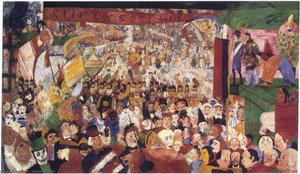
James Ensor's "The Drunkards," painted in 1883, isn’t merely a depiction of two men enjoying wine; it’s a meticulously crafted exploration of human vulnerability and the unsettling beauty found within moments of shared experience. Housed at The Minneapolis Institute of Arts, this oil on canvas offers a glimpse into the artist's uniquely dark and psychologically astute vision – a world saturated with masks, shadows, and an underlying current of melancholy. Ensor, born in Ostend, Belgium, to an English father and Belgian mother, possessed a perspective shaped by his upbringing amidst the vibrant chaos of a seaside resort town, a place brimming with theatricality and the allure of hidden identities. This early exposure undoubtedly fueled his lifelong preoccupation with disguise and the performance inherent in human interaction, themes powerfully realized within this evocative work.
“The Drunkards” is a masterclass in controlled darkness. Ensor’s deliberate choice of a predominantly black and white palette immediately establishes an atmosphere of introspection and quiet unease. The stark contrast amplifies the figures' isolation, drawing our attention to their faces – etched with weariness and perhaps a hint of resignation. The brushstrokes themselves are not smooth or polished; instead, they possess a restless energy, conveying a sense of urgency and emotional turbulence. This expressive technique is particularly evident in the rendering of the seated man’s face, where the paint seems to writhe with unspoken thoughts. The texture of the canvas itself contributes to this effect, inviting us to linger and examine the subtle shifts in tone and form.
Beyond its immediate depiction, “The Drunkards” is rich with symbolic weight. The bottle of wine, positioned centrally between the two men, can be interpreted as a potent symbol of connection – a shared ritual that momentarily bridges the gap between them. However, it also represents an escape, a temporary reprieve from the burdens of existence. The drunken state of one figure speaks to this desire for release, suggesting a yearning for oblivion or perhaps simply a rejection of societal expectations. The other man’s posture, observing his companion with a mixture of concern and perhaps even amusement, hints at the complexities of friendship and the acceptance of flawed humanity. The surrounding chairs and table further reinforce the sense of intimacy, while simultaneously highlighting the precariousness of their shared moment.
James Ensor’s work stands as a pivotal bridge between traditional academic painting and the burgeoning avant-garde movements of the late 19th century. Influenced by artists like Pierre-Auguste Renoir and Edouard Manet, yet forging his own distinct path, Ensor embraced elements of Expressionism and Surrealism – foreshadowing their later developments. His exploration of psychological themes, coupled with his unconventional use of color and composition, positioned him as a visionary artist ahead of his time. “The Drunkards” exemplifies this spirit of innovation, offering a raw and unflinching portrayal of human experience that continues to resonate with viewers today. It’s a piece that invites contemplation, prompting us to consider the hidden depths beneath the surface of everyday life and the enduring power of shared moments, however fleeting or unsettling they may be.


1860 - 1949 , België
Ontdek de 25 meest iconische meesterwerken van James Abbott McNeill Whistler, pionier van het esthetisme en impressionisme. Van zijn betoverende Nocturnes tot portretten vol harmonie. Vind museumkwaliteit reproducties & decoratie-inspiratie op Most-Famous-Paintings.com

Ontdek de top 10 witte meesterwerken uit de kunstgeschiedenis! Van Monet tot Mondriaan, bewonder abstracte vormen & serene kleuren. Vind museumkwaliteit reproducties en interieurinspiratie op Most-Famous-Paintings.com.

Ontdek de top 25 schilderijen van Sir Alfred James Munnings, meester van paardenkunst & Engelse impressionisme. Leer over zijn leven, techniek en iconische werken. Museumkwaliteit reproducties op Most-Famous-Paintings.com! Ontdek alle meesterwerken online.

Explore the unsettling yet captivating world of James Ensor, a pioneer of Expressionism. Discover his satirical masterpieces, symbolic imagery & lasting influence on modern art. High-quality reproductions available at Most-Famous-Paintings.

Ontdek de kracht van donker! Verlies jezelf in onze top 10 zwarte schilderijen, van Caravaggio tot Manet. Leer over meesterwerken, technieken & emotie. Museumkwaliteit reproducties op Most-Famous-Paintings.com – Kunst voor uw interieur.


Blijf op de hoogte van het laatste kunstnieuws, exclusieve aanbiedingen en decoratie-ideeën.
Vertel ons over uw project en onze kunstexperts geven u 3 gepersonaliseerde kunstsuggesties.
Wij stellen 3 opties speciaal voor u samen – Gratis!


 Delen
Delen

 Lees meer







 De optie voor glas is alleen beschikbaar bij een formaat kleiner dan 110 cm.