


x
Koop een digitale afbeelding in hoge resolutie met verbeterde kwaliteit, die veel superieur is aan de online voorvertoning.
Elk bestand wordt met uiterste precisie voorbereid door onze interne specialisten, met behulp van geavanceerde tools en deskundige handmatige retouche. Wij garanderen dat elke afbeelding een uitzonderlijke helderheid, nauwkeurige kleurweergave en verfijnde details bezit.
Het uiteindelijke bestand wordt binnen 72 uur per e-mail geleverd, geoptimaliseerd voor direct gebruik in professionele, redactionele en printomgevingen. Dit is dezelfde kwaliteit waarop vooraanstaande designstudio's, uitgevers en galerieën vertrouwen.
Download een bestand met hoge resolutie voor persoonlijke weergave, afdrukken en creatieve projecten. ( Bestel print Bestel handgeschilderde reproductie)
Wanneer u kiest voor Most-Famous-Paintings.com, ontvangt u niet alleen een afbeelding – u krijgt een professioneel verbeterd digitaal kunstwerk, met precisie vervaardigd en voorzien van een tevredenheidsgarantie. Dit is alles wat automatisch bij uw bestelling is inbegrepen:

Uw hoogwaardige digitale afbeeldingsbestand wordt binnen 72 uur na bestelling naar u gemaild – klaar voor direct gebruik.

Uw kunstwerk wordt professioneel geoptimaliseerd met behulp van geavanceerde AI-tools en handmatige bewerkingen, waardoor maximale details, helderheid en kleurnauwkeurigheid worden gegarandeerd.

Je bestand per ongeluk verwijderd of kwijtgeraakt? Geen zorgen – we sturen het u op elk gewenst moment gratis opnieuw toe.

Geniet direct van uw kunstwerk zonder invoerrechten, belastingen of verzendkosten – digitale downloads zijn altijd belastingvrij.

Met behulp van professionele hulpmiddelen en kleurbeheer zorgen wij ervoor dat uw digitale afbeelding de originele kleuren zo nauwkeurig mogelijk weergeeft.

Als u niet tevreden bent met uw digitale afbeelding, passen wij deze aan of storten wij 100% terug binnen 60 dagen – zonder vragen gesteld.

Niet tevreden? Ontvang binnen 60 dagen na ontvangst van uw digitale bestand uw volledige aankoopbedrag terug – zonder vragen te stellen.

Koop 3 afbeeldingen, bespaar 10% - Koop 5, bespaar 15% - Koop 10+, bespaar 20%. Ideaal voor creatieve projecten, galerieën en bureaus.
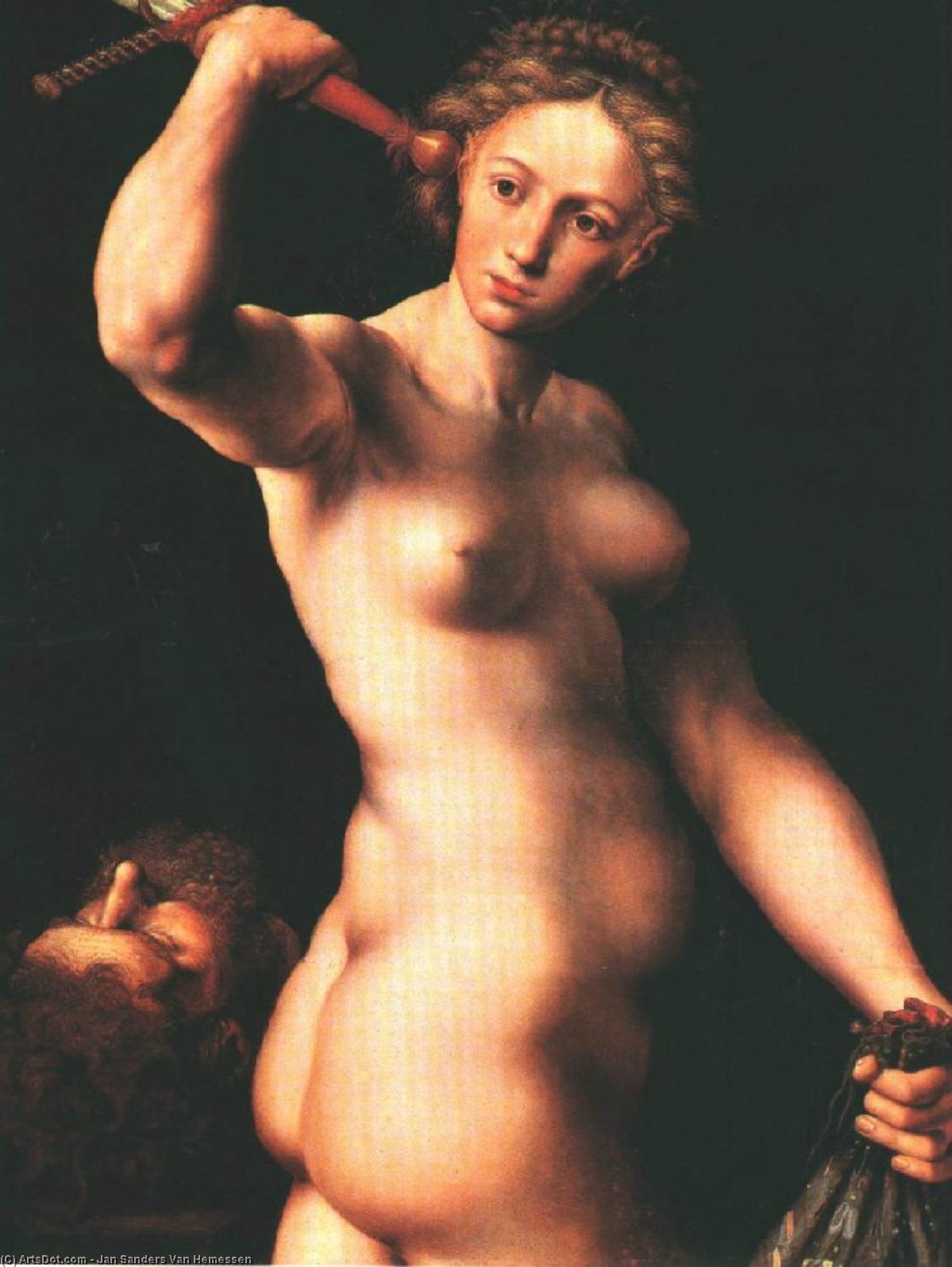
Jan Sanders van Hemessen's "Judith," painted around 1540, isn’t merely a depiction of a biblical tale; it’s a meticulously crafted moral drama rendered with the vibrant realism and psychological depth characteristic of the Northern Renaissance. This arresting image captures the pivotal moment when Judith, the courageous Jewish widow, delivers the fatal blow to Holofernes, the Assyrian general, thereby saving her besieged city. Van Hemessen, a key figure in the burgeoning Flemish genre painting movement, elevates this ancient story into a compelling meditation on female strength, strategic cunning, and divine justice – all presented with an astonishing level of detail and emotional resonance.
The composition immediately commands attention. Judith is not portrayed as a delicate heroine; instead, she’s depicted as a powerfully muscled figure, her body taut with effort and determination. Her profile, turned towards the viewer, conveys both resolve and a hint of grim satisfaction. The severed head of Holofernes, held aloft in her other hand, isn't presented in a gruesome manner but rather as a stark symbol of vanquished tyranny. Van Hemessen masterfully utilizes chiaroscuro – the dramatic interplay of light and shadow – to sculpt Judith’s form and emphasize the weight of her action. The dark background serves not as mere backdrop but as a stage upon which this decisive moment unfolds, drawing all focus onto the central figures.
Van Hemessen's style is deeply rooted in the artistic traditions of Italy, particularly the work of Michelangelo and Raphael. He absorbed their emphasis on idealized human forms, dynamic poses, and a profound understanding of anatomy. However, he skillfully adapted these influences to create a distinctly Northern Renaissance aesthetic. The painting’s realism is remarkable; from the intricate folds of Judith's dress to the texture of Holofernes’s beard and the glistening blood staining his face, every detail is rendered with painstaking precision. Van Hemessen was renowned for his ability to capture the nuances of human expression, evident in Judith’s focused gaze and the subtle hint of triumph in her posture.
The painting's technique showcases van Hemessen’s mastery of oil paint. He employed a layering approach, building up color gradually to achieve rich, luminous effects. The use of impasto – applying thick layers of paint directly onto the canvas – adds texture and depth to the figures and background. This meticulous attention to detail is further enhanced by his skillful handling of light and shadow, creating a sense of three-dimensionality that brings the scene vividly to life.
Beyond its visual beauty, “Judith” is laden with symbolic meaning. The story itself carries significant weight within Jewish tradition, representing themes of courage, faith, and resistance against oppression. Judith’s actions are not simply a violent act but an embodiment of strategic intelligence and righteous defiance. The depiction of Judith as a physically strong woman challenging a powerful male figure speaks to the Renaissance fascination with female agency – a theme that was increasingly explored in art during this period.
Furthermore, the painting can be interpreted as a broader allegory for the triumph of good over evil. Holofernes represents the forces of tyranny and corruption, while Judith embodies virtue and justice. The act of decapitation symbolizes the ultimate defeat of these forces, suggesting that moral strength and strategic action can overcome even the most formidable adversaries. The inclusion of the severed head is not intended to glorify violence but rather to underscore the consequences of injustice and the necessity of resistance.
“Judith” stands as a prime example of the moralizing art that flourished in the Netherlands during the 16th century. Artists like van Hemessen sought to create works that not only depicted biblical stories but also conveyed important ethical and religious lessons. This painting, with its compelling narrative, masterful technique, and profound symbolism, continues to resonate with viewers today – a testament to the enduring power of art to illuminate human experience and inspire reflection.


1500 - 1566 , België


Blijf op de hoogte van het laatste kunstnieuws, exclusieve aanbiedingen en decoratie-ideeën.
Vertel ons over uw project en onze kunstexperts geven u 3 gepersonaliseerde kunstsuggesties.
Wij stellen drie opties speciaal voor u samen – gratis!


 Voorvertoning
 Verstuur
 Delen
Delen
 Details bekijken

 Download
 Vergelijkbare items
 Röntgenonderzoek
 Diavoorstelling


 Lees meer


