x

 WoodSculptureBaroque
 1650Early Modern
 63.0 x 44.0 cm
 Museum of Fine Arts (Budapest)
Met de hand geschilderd in olieverf op canvas in uw gewenste maat en lijst, op bestelling gemaakt door onze kunstenaars. ( Print kopen Afbeelding kopen)
Kies uit onze vooraf ingestelde maten die overeenkomen met de originele verhoudingen van het kunstwerk.

U kunt uw eigen afmetingen invoeren om in een specifieke lijst of ruimte te passen. Als de door u gekozen maat niet overeenkomt met de verhoudingen van het originele beeld, zullen we het kunstwerk bijsnijden of het schilderij uitbreiden met extra handgeschilderde elementen. Een digitale mockup wordt ter goedkeuring naar u verzonden voordat de productie begint.
Houd er rekening mee dat de preview op het scherm niet de werkelijke uitsnede of uitbreiding weergeeft. Alleen de mockup toont de uiteindelijke compositie nauwkeurig.
Hoewel aangepaste afmetingen mogelijk zijn, raden we aan een maat uit de vooraf gedefinieerde lijst te selecteren om de originele verhoudingen te behouden.
Wereldwijde levering () binnen 3 tot 4 weken in plaats van de standaard 5 weken. (12 augustus). Zonder concessies aan de kwaliteit.


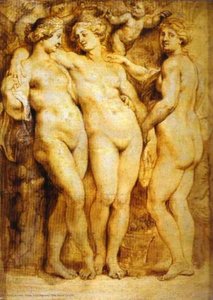
The Three Graces
Formaat reproductie
To stand before this depiction of The Three Graces is to step into a moment suspended between earthly beauty and divine contemplation. These three figures, rendered in the evocative medium of wood, do not merely occupy space; they breathe narrative. They embody an idealized vision of feminine harmony, yet within their collective poise lies a beautiful tension—a dialogue enacted through gesture and gaze. The craftsmanship speaks immediately to the viewer, revealing the meticulous skill required to capture such ephemeral qualities in solid material.
The work dates from 1650, placing it squarely within the vibrant, emotionally charged atmosphere of the late Baroque period. Leonhard Kern, the master sculptor behind this piece, was a figure whose career navigated the tumultuous waters of the Thirty Years' War. His ability to channel profound human emotion into wood, particularly in his smaller-scale works, marks him as a sensitive interpreter of the era’s spiritual and dramatic currents. Observe the material itself: carved from limewood, the sculptor has utilized variations in tone across the three statues, lending an immediate visual richness that prevents any single figure from dominating the composition. This careful handling of wood grain and color variation is a testament to Kern's technical mastery.
The grouping of three figures—the quintessential triad in Western art—is rarely accidental. In classical tradition, the Graces symbolized beauty, charm, and pleasure. Here, however, Kern elevates this symbolism by assigning distinct emotional vectors to each statue. The figure on the left, with her hands clasped near her chest, suggests piety or contained devotion. The central figure, gazing downward, invites introspection, perhaps contemplating a secret or a moment of quiet realization. Finally, the figure on the right, lifting her gaze toward an unseen zenith, points toward aspiration, divine connection, or future hope. Together, they map out a complete emotional spectrum—from humility to contemplation to transcendence.
For the collector or designer seeking an object that transcends mere decoration, this reproduction offers profound depth. The Three Graces are not simply decorative accents; they are conversation starters and sources of quiet meditation. Their inherent drama allows them to anchor a room, whether placed in a formal salon where classical echoes are desired, or within a more intimate setting that appreciates narrative artistry. Owning this piece is acquiring a tangible link to the Baroque pursuit of capturing the soul’s most delicate movements.


1588 - 1662 , Germany

Explore the profound history of sculpture, from classical realism to modern abstraction. Discover the mastery of form, texture, and medium through an expert art-historical lens designed for discerning collectors and enthusiasts.

Explore the profound differences between Baroque drama and Rococo elegance. Our expert guide delves into art history, chiaroscuro, and the evolution of European masterpieces for collectors and enthusiasts seeking deep historical context.

Explore the profound elegance of Baroque Classicism. Discover how 17th-century masters synthesized dramatic emotion with classical order through the lens of the Counter-Reformation and the works of legends like Carlo Maratta and Andrea Sacchi.


Blijf op de hoogte van het laatste kunstnieuws, exclusieve aanbiedingen en inspirerende interieurideeën.
Vertel ons over uw project en onze kunstexperts geven u 3 gepersonaliseerde kunstsuggesties.
Wij stellen 3 opties speciaal voor u samen – Gratis!


 Verstuur
 Delen
Delen
 Details bekijken

 Download
 Vergelijkbare werken
 Diavoorstelling
 Lees meer




































 De optie voor glas is alleen beschikbaar bij een formaat kleiner dan 110 cm.