x

 Acrylic On CanvasWallArtColor Field Painting
 1959
1959 256.0 x 378.0 cm
 Solomon R. Guggenheim Museum
Koop een digitale afbeelding in hoge resolutie met verbeterde kwaliteit, die veel superieur is aan de online voorvertoning.
Elk bestand wordt met uiterste precisie voorbereid door onze interne specialisten, met behulp van geavanceerde tools en deskundige handmatige retouche. Wij garanderen dat elke afbeelding een uitzonderlijke helderheid, nauwkeurige kleurweergave en verfijnde details bezit.
Het uiteindelijke bestand wordt binnen 72 uur per e-mail geleverd, geoptimaliseerd voor direct gebruik in professionele, redactionele en printomgevingen. Dit is dezelfde kwaliteit waarop vooraanstaande designstudio's, uitgevers en galerieën vertrouwen.
Download een bestand met hoge resolutie voor persoonlijke weergave, afdrukken en creatieve projecten. ( Bestel print Bestel handgeschilderde reproductie)
Wanneer u kiest voor Most-Famous-Paintings.com, ontvangt u niet alleen een afbeelding – u krijgt een professioneel verbeterd digitaal kunstwerk, met precisie vervaardigd en voorzien van een tevredenheidsgarantie. Dit is alles wat automatisch bij uw bestelling is inbegrepen:

Uw hoogwaardige digitale afbeeldingsbestand wordt binnen 72 uur na bestelling naar u gemaild – klaar voor direct gebruik.

Uw kunstwerk wordt professioneel geoptimaliseerd met behulp van geavanceerde AI-tools en handmatige bewerkingen, waardoor maximale details, helderheid en kleurnauwkeurigheid worden gegarandeerd.

Je bestand per ongeluk verwijderd of kwijtgeraakt? Geen zorgen – we sturen het u op elk gewenst moment gratis opnieuw toe.

Geniet direct van uw kunstwerk zonder invoerrechten, belastingen of verzendkosten – digitale downloads zijn altijd belastingvrij.

Met behulp van professionele hulpmiddelen en kleurbeheer zorgen wij ervoor dat uw digitale afbeelding de originele kleuren zo nauwkeurig mogelijk weergeeft.

Als u niet tevreden bent met uw digitale afbeelding, passen wij deze aan of storten wij 100% terug binnen 60 dagen – zonder vragen gesteld.

Niet tevreden? Ontvang binnen 60 dagen na ontvangst van uw digitale bestand uw volledige aankoopbedrag terug – zonder vragen te stellen.

Koop 3 afbeeldingen, bespaar 10% - Koop 5, bespaar 15% - Koop 10+, bespaar 20%. Ideaal voor creatieve projecten, galerieën en bureaus.
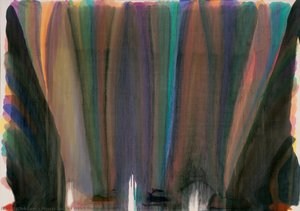
Morris Louis’s “Saraband,” painted in 1959, isn't merely a canvas adorned with color; it’s an immersive experience. This monumental work, measuring nearly 3 x 2.6 meters, immediately draws the viewer into its hazy depths – a realm where form dissolves and emotion takes precedence. Louis, a pivotal figure in Color Field painting, sought to move beyond traditional representation, aiming instead to capture the very essence of color itself. “Saraband” embodies this ambition, inviting contemplation and offering a profound connection through its atmospheric quality and subtle shifts in hue.
The genesis of this piece lies within Louis’s groundbreaking "veil" technique – a method he pioneered by pouring diluted acrylic paint directly onto unprimed canvas. This revolutionary approach allowed the paint to soak into the fabric, creating a luminous, almost ethereal surface that defies conventional brushstrokes. The absence of visible lines contributes significantly to the painting's dreamlike quality, fostering a sense of fluidity and movement reminiscent of a slow, graceful dance – hence the title itself, referencing the stately Spanish dance known for its melancholic beauty.
The color palette of “Saraband” is both complex and remarkably harmonious. Dominating the composition are washes of vibrant oranges, reds, yellows, greens, blues, and purples – a rich tapestry that seems to shift and evolve with every glance. These colors aren’t applied uniformly; instead, they bleed into one another, creating subtle gradations and transitions that suggest depth and movement. The warm beige or light brown background acts as a grounding element, providing a neutral stage for the explosion of color above. Notice how the cooler blues and greens recede slightly, while the warmer reds and yellows advance, subtly manipulating our perception of space within the painting.
Louis’s masterful control over the paint's flow is evident in the way the colors coalesce into vertical bands or columns. These aren’t sharply defined edges; rather, they dissolve at their boundaries, contributing to the overall sense of atmospheric depth and blurring the distinction between foreground and background. This deliberate ambiguity encourages the viewer to lose themselves within the painting, allowing their own emotions and associations to shape their interpretation.
“Saraband” is deliberately devoid of representational imagery – there are no figures or recognizable objects. Instead, its power lies in its ability to evoke a range of emotional responses. The title itself—a reference to a slow, melancholic dance—hints at themes of longing, nostalgia, and perhaps even loss. The flowing colors can be interpreted as representing the ebb and flow of emotions, mirroring the complexities of human experience. It’s a painting that invites introspection, prompting viewers to consider their own personal connections to color, movement, and feeling.
Furthermore, Louis's work during this period was deeply influenced by his interest in spirituality and the subconscious. He sought to create paintings that would bypass rational thought and directly engage with the viewer’s emotions. “Saraband” achieves this beautifully, offering a meditative experience that transcends mere visual pleasure.
Morris Louis was a key figure in the development of Color Field painting, an American movement that emerged in the mid-1950s. Artists like Louis, Barnett Newman, and Helen Frankenthaler sought to elevate color to the primary subject matter of their work, rejecting traditional forms and techniques. “Saraband” stands as a testament to this revolutionary approach, demonstrating Louis’s ability to create large-scale paintings that are both visually stunning and emotionally resonant. His innovative use of acrylic paint and his commitment to exploring the expressive potential of color have had a lasting impact on contemporary art.

1912 - 1962 , Verenigde Staten van Amerika


Blijf op de hoogte van het laatste kunstnieuws, exclusieve aanbiedingen en decoratie-ideeën.
Vertel ons over uw project en onze kunstexperts geven u 3 gepersonaliseerde kunstsuggesties.
Wij stellen drie opties speciaal voor u samen – gratis!


 Voorvertoning
 Verstuur
 Delen
Delen
 Details bekijken

 Download
 Vergelijkbare items
 Röntgenonderzoek
 Diavoorstelling
 Lees meer