


x

Koop een digitale afbeelding in hoge resolutie met verbeterde kwaliteit, die veel superieur is aan de online voorvertoning.
Elk bestand wordt met uiterste precisie voorbereid door onze interne specialisten, met behulp van geavanceerde tools en deskundige handmatige retouche. Wij garanderen dat elke afbeelding een uitzonderlijke helderheid, nauwkeurige kleurweergave en verfijnde details bezit.
Het uiteindelijke bestand wordt binnen 72 uur per e-mail geleverd, geoptimaliseerd voor direct gebruik in professionele, redactionele en printomgevingen. Dit is dezelfde kwaliteit waarop vooraanstaande designstudio's, uitgevers en galerieën vertrouwen.
Download een bestand met hoge resolutie voor persoonlijke weergave, afdrukken en creatieve projecten. ( Bestel print Bestel handgeschilderde reproductie)
Wanneer u kiest voor Most-Famous-Paintings.com, ontvangt u niet alleen een afbeelding – u krijgt een professioneel verbeterd digitaal kunstwerk, met precisie vervaardigd en voorzien van een tevredenheidsgarantie. Dit is alles wat automatisch bij uw bestelling is inbegrepen:

Uw hoogwaardige digitale afbeeldingsbestand wordt binnen 72 uur na bestelling naar u gemaild – klaar voor direct gebruik.

Uw kunstwerk wordt professioneel geoptimaliseerd met behulp van geavanceerde AI-tools en handmatige bewerkingen, waardoor maximale details, helderheid en kleurnauwkeurigheid worden gegarandeerd.

Je bestand per ongeluk verwijderd of kwijtgeraakt? Geen zorgen – we sturen het u op elk gewenst moment gratis opnieuw toe.

Geniet direct van uw kunstwerk zonder invoerrechten, belastingen of verzendkosten – digitale downloads zijn altijd belastingvrij.

Met behulp van professionele hulpmiddelen en kleurbeheer zorgen wij ervoor dat uw digitale afbeelding de originele kleuren zo nauwkeurig mogelijk weergeeft.

Als u niet tevreden bent met uw digitale afbeelding, passen wij deze aan of storten wij 100% terug binnen 60 dagen – zonder vragen gesteld.

Niet tevreden? Ontvang binnen 60 dagen na ontvangst van uw digitale bestand uw volledige aankoopbedrag terug – zonder vragen te stellen.

Koop 3 afbeeldingen, bespaar 10% - Koop 5, bespaar 15% - Koop 10+, bespaar 20%. Ideaal voor creatieve projecten, galerieën en bureaus.
René Magritte's "Composition with Locomotive," painted in 1923, isn’t merely a depiction of a train; it’s an invitation to question the very nature of perception and representation. This iconic work, housed within the Winterbotham Collection at the Art Institute of Chicago, exemplifies Magritte’s unique brand of surrealism – a deliberate disruption of familiar realities that compels viewers to actively engage with the artwork and their own assumptions about what they see.
The painting immediately draws the eye with its stark geometric composition. Bold, angular lines delineate planes of color—primarily shades of brown, grey, blue, white, and black—creating a fragmented cityscape or interior space. The locomotive itself is rendered in simplified forms, almost as if constructed from basic shapes rather than faithfully representing a specific machine. This abstraction isn’t arbitrary; it reflects Magritte's fascination with deconstructing objects to reveal their underlying structure and challenging the viewer’s ability to easily recognize familiar subjects. The influence of Cubism, particularly its emphasis on flattened perspective and multiple viewpoints, is undeniable, yet Magritte transcends mere imitation, imbuing these techniques with a distinctly personal and unsettling quality.
What makes “Composition with Locomotive” so compelling isn’t just the formal arrangement but also the subtle interplay of contrasting elements. The industrial power of the train—symbolic of modernity, progress, and perhaps even alienation—is juxtaposed against the domesticity of a fireplace. The billowing smoke from the locomotive is cleverly integrated with the plumes rising from the chimney, creating a visual metaphor for connection and shared experience. This pairing suggests that even seemingly disparate elements can be linked through abstract associations, prompting viewers to consider how our minds construct meaning from seemingly unrelated sensory information.
Magritte’s choice of color palette further enhances this duality. The cool blues and greys of the locomotive contrast sharply with the warmer browns and blacks of the fireplace, creating a visual tension that mirrors the conceptual one. The limited range of colors contributes to the painting's overall sense of stillness and contemplation, inviting viewers to linger and decipher the hidden connections within the composition.
To fully appreciate “Composition with Locomotive,” it’s crucial to understand Magritte’s artistic journey. Early influences included Impressionism and Cubism, but a pivotal moment arrived in 1916 when he encountered the work of Italian futurists like Gino Severini. The dynamism and rhythmic energy of Futurist painting—particularly their use of lines and color to convey movement—resonated deeply with Magritte’s own desire to break free from traditional representational conventions. He described this encounter as a revelation, stating that it opened his eyes to “thought for the first time.”
Magritte's engagement with Surrealism, spearheaded by André Breton, provided him with a framework for exploring the subconscious and challenging rational thought. However, Magritte’s surrealism wasn’t driven by dreamlike imagery or irrationality in the traditional sense. Instead, he sought to expose the inherent strangeness of everyday reality—to reveal the “hidden” aspects of our perception that we often overlook. “La duree poignadee,” as it was known at the time, exemplifies this approach, presenting a familiar scene (a train and a fireplace) in an arrangement that defies immediate comprehension.
“Composition with Locomotive” remains one of Magritte’s most enduringly enigmatic works. It's not a painting that offers easy answers or straightforward narratives; rather, it invites viewers to engage in a process of active interpretation. The ambiguity inherent in the composition—the blurred boundaries between industrial and domestic, reality and representation—is precisely what makes the painting so captivating. It’s a testament to Magritte’s genius that he could create an artwork that simultaneously challenges our assumptions about the world and invites us to contemplate the mysteries of perception itself.
Reproductions of this piece offer a remarkable opportunity to bring this surreal vision into your own space, allowing you to experience the same sense of wonder and contemplation that Magritte intended. Its geometric precision and evocative color palette make it a striking addition to any collection, sparking conversation and inviting viewers to question the familiar.

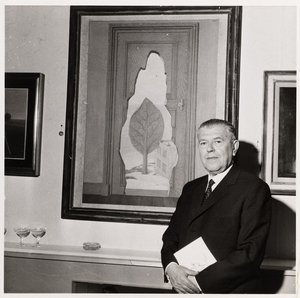
1898 - 1967 , België


Blijf op de hoogte van het laatste kunstnieuws, exclusieve aanbiedingen en decoratie-ideeën.
Vertel ons over uw project en onze kunstexperts geven u 3 gepersonaliseerde kunstsuggesties.
Wij stellen drie opties speciaal voor u samen – gratis!


 Voorvertoning
 Verstuur
 Delen
Delen
 Details bekijken

 Download
 Vergelijkbare items
 Röntgenonderzoek
 Diavoorstelling

 Lees meer


