Verkoop uw kunst
Verlanglijstje Winkelwagen Cart
VoorvertoningVoorvertoning Bekijk in ARBekijk in AR Bestel handgeschilderde reproductie Bestel handgeschilderde reproductieKoop afbeelding Koop afbeelding VerstuurVerstuur
Details bekijkenDetails bekijken Toevoegen aan favorieten Toevoegen aan favorieten DownloadDownload Vergelijkbare itemsVergelijkbare items RöntgenonderzoekRöntgenonderzoek DiavoorstellingDiavoorstelling

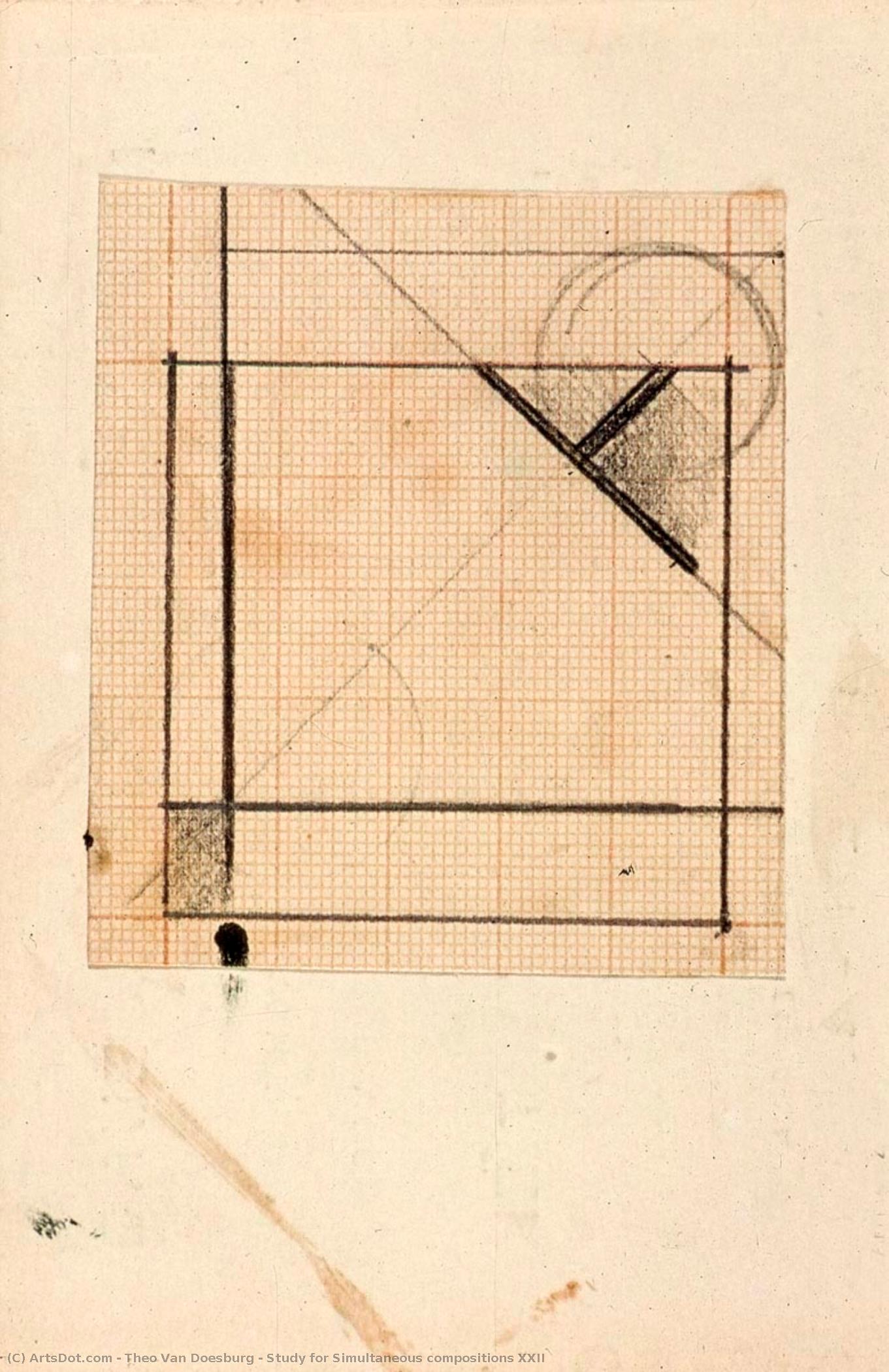
Study for Simultaneous compositions XXII

Study for Simultaneous compositions XXII by Theo van Doesburg: A rare geometric abstraction showcasing early De Stijl principles. Explore this 7cm sketch's layered lines & aged paper texture.

Theo van Doesburg (1883-1931): De Stijl's revolutionair architect! Geometrische abstractie, Bauhaus invloed & een blijvende impact op kunst, design & architectuur.

Giclée / Kunstafdrukken

Giclée- of canvasafdruk van museumkwaliteit met een snelle productie en flexibele afwerkingsmogelijkheden. (Bestel handgeschilderde reproductie Bestel handgeschilderde reproductieKoop afbeelding Koop afbeelding)

P118B $10
P118H $10
P118W $10
P438Z $10
P508JH $12
P508YH $12
P805H $10
P805Z $10
P919BZ $10
P919G $10
P919XJ $10
P959ZH $10
P968JZ $12
W106C $8
W218G $10
W218JH $8
W218Y $10
W307PJ $10
W316G $10
W316PJ $8
W316Y $10
W398PJ $8
W4111J $10
W500HY $15
W500JH $15
W692G $12
W849H $8
W940BG $15
W953PJ $8

Standard
custom
CM
INCH

Kies uit onze vooraf ingestelde maten die overeenkomen met de originele verhoudingen van het kunstwerk.

breedte
hoogte

U kunt uw eigen afmetingen opgeven om in een specifieke lijst of ruimte te passen. Als de door u gekozen maat niet overeenkomt met de proporties van het originele kunstwerk, zullen wij de afbeelding bijsnijden of uitbreiden met een gespiegelde of effen rand. Een digitaal mockup wordt ter goedkeuring naar u verzonden voordat de productie begint.
Houd er rekening mee dat de preview op het scherm de werkelijke bijsneding of uitbreiding niet weergeeft. Alleen de mockup toont de uiteindelijke compositie nauwkeurig.
Hoewel aangepaste maten beschikbaar zijn, raden wij aan een afmeting uit de vooraf bepaalde lijst te kiezen om de originele proporties te behouden.

Wereldwijde levering () binnen 2 weken in plaats van de standaard 4/5 weken. (17 augustus)

why_choose_icon
Gratis wereldwijde expressverzending
why_choose_icon
Hoogwaardig linnen canvas
why_choose_icon
Volledige verzendverzekering
why_choose_icon
Garantie op terugbetaling van invoerrechten
why_choose_icon
Garantie op exacte kleurweergave
why_choose_icon
Retourbeleid van 60 dagen (alleen bij defecten)
why_choose_icon
100% Geld-terug-garantie
why_choose_icon
Korting bij meerdere afnames

Totaalprijs

$ 69

reproduction

Study for Simultaneous compositions XXII

Giclée / Kunstafdrukken

Afmetingen reproductie

-

Eindtotaal

$ 69

Snelle feiten

  • Year: 1929
  • Subject or theme: Formal exploration
  • Artist: Theo van Doesburg
  • Location: Kröller-Müller Museum
  • Medium: Pencil on graph paper
  • Dimensions: 12,5 × 9,5 cm
  • Influences: Piet Mondrian

Kunstquiz

Er is slechts één goed antwoord op elke vraag.

Vraag 1:
What artistic movement is Theo van Doesburg’s ‘Study for Simultaneous compositions XXII’ associated with?
Vraag 2:
The predominant geometric element in the artwork is:
Vraag 3:
What material was primarily used to create this drawing?
Vraag 4:
The artwork’s background is characterized by:
Vraag 5:
Based on its style and composition, ‘Study for Simultaneous compositions XXII’ reflects the principles of which influential art movement?

Beschrijving verzamelobject

Study for Simultaneous compositions XXII

Theo van Doesburg’s “Study for Simultaneous compositions XXII” stands as a testament to the radical aesthetic principles of De Stijl – a movement that irrevocably altered the trajectory of 20th-century art. Executed in graphite on graph paper mounted on cardboard, this deceptively simple sketch encapsulates the core tenets of Neo-Plasticism: pure abstraction and geometric harmony achieved through orthogonal lines and fundamental shapes. Created around 1929, it represents a pivotal moment in Van Doesburg’s artistic evolution, marking his unwavering commitment to distilling visual experience into its purest form.
  • Subject Matter & Composition: The artwork presents a meticulously constructed grid overlaid with intersecting diagonal lines and a central square – elements characteristic of De Stijl's exploration of spatial relationships. A smaller circle is positioned strategically within the upper-left quadrant, subtly disrupting the geometric order while maintaining visual balance.
  • Style & Technique: Van Doesburg’s technique—dry media applied directly to paper—emphasizes precision and control. The graphite lines are drawn with deliberate accuracy, creating a stark contrast against the pale graph paper background. This method reflects De Stijl's rejection of illusionistic representation in favor of an intellectual engagement with form and structure.
  • Historical Context: Born Christian Emil Marie Küpper in Utrecht in 1883, Theo van Doesburg emerged from the Impressionist and Post-Impressionist traditions but swiftly rejected their subjective biases. Inspired by Kandinsky’s pioneering explorations into abstract expressionism, he founded De Stijl alongside Piet Mondrian in 1917, establishing a visual language rooted in geometric abstraction and chromatic neutrality.
  • Symbolism & Meaning: The arrangement of shapes—the square, diagonal lines, and circle—is laden with symbolic significance. These forms represent not merely visual elements but also conceptual ideas related to balance, harmony, and universality – core concepts underpinning De Stijl’s philosophical stance. It embodies the movement's aspiration to transcend earthly concerns and access a realm of pure spiritual contemplation.
  • Emotional Impact: Viewing “Study for Simultaneous compositions XXII” evokes a sense of intellectual curiosity and methodical construction. Rather than eliciting emotional response, it invites contemplation on the fundamental principles governing visual perception and artistic creation. Its austere beauty speaks to an enduring fascination with geometric abstraction as a vehicle for conveying profound ideas.
The artwork resides in the Kröller-Müller Museum in Otterlo, Netherlands (KM 112.407), where it continues to inspire admiration for its masterful execution and unwavering adherence to De Stijl’s groundbreaking aesthetic vision. Its enduring appeal lies in its ability to distill complex philosophical concepts into a visually arresting composition—a testament to Theo van Doesburg's legacy as the architect of abstraction.

Biografie van de kunstenaar

The Architect of Abstraction: A Life in Geometric Harmony

Theo van Doesburg, born Christian Emil Marie Küpper in Utrecht on August 30, 1883, wasn’t merely a painter; he was a revolutionary force who fundamentally reshaped the landscape of modern art. His journey began not within the familiar embrace of Impressionism or Post-Impressionism, but amidst their fading echoes – initially mirroring styles reminiscent of Vincent van Gogh, both in the raw emotion conveyed and the directness of his brushstrokes. However, this early phase served as a crucial, almost instinctive, prelude, a necessary stepping stone towards the radical transformation that would define his enduring legacy. A pivotal moment arrived in 1913 with an encounter that irrevocably altered his artistic trajectory: Wassily Kandinsky’s *Rückblicke*. This text, a profound exploration of spirituality and abstraction, ignited within van Doesburg a seismic realization – true artistic expression wasn't found in faithfully replicating the external world but in channeling an inner, spiritual reality through pure, unadulterated form. It was this conviction that birthed Neoplasticism, more commonly known as De Stijl – a movement he founded and fiercely championed, becoming its most ardent and uncompromising advocate.

Forging a New Visual Language: The Principles of De Stijl

De Stijl wasn’t simply an artistic style; it was a comprehensive philosophical manifesto translated into visual form, a radical attempt to distill art down to its purest essence. Van Doesburg believed in stripping away all extraneous detail, reducing painting, architecture, design, and even everyday objects to their most fundamental elements: straight lines, right angles, and the primary colors of red, yellow, and blue, alongside black, white, and gray. This austere palette wasn’t born from limitation or a desire for bleakness; rather, it represented a profound belief in universality – a conviction that these elemental forms resonated with an underlying cosmic order, a hidden harmony governing all existence. He envisioned a *total* work of art, extending far beyond the confines of the canvas to encompass architecture, furniture design, typography, and even the very fabric of daily life. Collaboration was paramount; van Doesburg worked in close partnership with architects like J.J.P. Oud and Gerrit Rietveld, designing stained glass windows for churches, meticulously crafted furniture pieces that embodied De Stijl’s principles, and entire interiors—creating spaces where form and function converged in a harmonious synthesis. His collaborations extended beyond the architectural realm, encompassing fellow artists such as Piet Mondrian, with whom he co-founded the influential journal *De Stijl*, a platform for disseminating their ideas and attracting a vibrant community of like-minded creatives. However, despite this initial shared vision, tensions gradually emerged between van Doesburg and Mondrian regarding the rigidity of Neoplasticism – a divergence that ultimately led to a significant schism within the movement, revealing van Doesburg’s restless spirit and his constant pursuit of artistic evolution.

Beyond Painting: A Multifaceted Artistic Vision

While celebrated primarily as a painter, Theo van Doesburg's artistic pursuits were remarkably diverse and far-reaching. He wasn’t content to remain confined to the canvas; he was a prolific writer, poet, critic, and theorist, meticulously articulating the theoretical underpinnings of De Stijl and challenging conventional notions of art and aesthetics. His engagement with Dadaism in the early 1920s further broadened his artistic horizons, leading him to experiment with collage, typography, and photomontage – techniques that reflected a growing interest in exploring the relationship between image and reality. This period also saw him teaching at the Bauhaus in Weimar, where he shared his radical ideas with a new generation of artists and designers, influencing their approaches to form, color, and spatial organization. He wasn’t simply imparting technical skills; van Doesburg sought to instill within his students a fundamental shift in perspective – a recognition that art could be more than just representation; it could be a powerful tool for shaping the world around us. His designs for interiors and furniture weren't merely aesthetic exercises; they were carefully considered attempts to create harmonious living spaces—spaces that reflected the principles of De Stijl and fostered a sense of balance, clarity, and spiritual connection. A prime example is his collaboration with Sophie Taeuber-Arp and Georges Vantongerloo on designing artist residences in Paris, showcasing a holistic approach to artistic creation – an attempt to build a world *in* the image of his ideals.

The Schism and Elementarism

The tensions between van Doesburg and Mondrian ultimately culminated in a significant rift within De Stijl. Van Doesburg, dissatisfied with the increasingly rigid formalism of Neoplasticism, introduced “Elementarism” in 1926 – a radical departure that sought to inject dynamism into the movement. Elementarism retained the core principles of De Stijl—straight lines, right angles, and primary colors—but crucially incorporated diagonal lines, tilted planes, and variations in tone. This subtle yet profound shift allowed for greater complexity and visual interest, moving beyond the static geometry of Neoplasticism towards a more fluid and expressive aesthetic. He argued that true abstraction wasn’t about eliminating all traces of the external world but about revealing its underlying structure through carefully controlled manipulation of form and color. This evolution didn't sit well with Mondrian, who staunchly defended the purity of Neoplasticism, leading to a permanent parting of ways.

Legacy and Enduring Influence

Despite his tragically short life – Theo van Doesburg died in Davos, Switzerland on March 7, 1931 – at the age of 47 – his impact on modern art remains profound and enduring. De Stijl, though relatively short-lived as a cohesive movement, exerted an enormous influence on subsequent artistic developments, shaping movements ranging from Bauhaus design to Minimalism and Constructivism. His emphasis on geometric abstraction, pure color, and functionalism continues to resonate with artists and designers today. Van Doesburg’s legacy extends far beyond his paintings and designs; it lies in his unwavering commitment to artistic innovation, his belief in the transformative power of abstraction, and his vision of a world where art could play a vital role in shaping human experience. His work serves as a timeless reminder that art is not merely about representation but about exploring fundamental forms, ideas, and ultimately, the very essence of beauty.

Key Works & Lasting Impact

  • Study for Simultaneous Compositions XXII (1922): A quintessential example of Neoplasticism, showcasing the movement’s signature geometric forms and limited color palette.
  • Composition with half values (1928): Demonstrates van Doesburg's exploration of tonal variations within the De Stijl aesthetic.
  • Dancers (1917-1918): Represents a transitional phase in his work, blending figurative elements with emerging abstract tendencies.
  • Collaboration on *De Stijl* journal: A crucial platform for disseminating the movement’s ideas and fostering dialogue among artists and intellectuals.
  • Elementarism (1926): Van Doesburg's attempt to inject dynamism into Neoplasticism, introducing diagonal lines and a more fluid approach to composition.
Theo van Doesburg

Theo van Doesburg

1883 - 1931 , Nederland

Belangrijkste feiten

  • Artistic Movement Or Style: De Stijl, Neoplasticisme
  • Artists Or Movements Influenced By This Artist:
    • Bauhaus
    • Minimalisme
  • Artists Who Influenced This Artist:
    • Kandinsky
    • Van Gogh
  • Date Of Birth: 30 aug 1883
  • Date Of Death: 7 mrt 1931
  • Full Name: Theo van Doesburg
  • Nationality: Nederlands
  • Notable Artworks:
    • Compositie XXII
    • Halfwaarden
    • Dansers
  • Place Of Birth: Utrecht, Nederland
Ontdek kunstwerken georganiseerd op thema, stijl en kenmerk.