


x

 Oil On CanvasWallArtRomanticism
 1835
1835 99.0 x 82.0 cm
 Louvre
Koop een digitale afbeelding in hoge resolutie met verbeterde kwaliteit, die veel superieur is aan de online voorvertoning.
Elk bestand wordt met uiterste precisie voorbereid door onze interne specialisten, met behulp van geavanceerde tools en deskundige handmatige retouche. Wij garanderen dat elke afbeelding een uitzonderlijke helderheid, nauwkeurige kleurweergave en verfijnde details bezit.
Het uiteindelijke bestand wordt binnen 72 uur per e-mail geleverd, geoptimaliseerd voor direct gebruik in professionele, redactionele en printomgevingen. Dit is dezelfde kwaliteit waarop vooraanstaande designstudio's, uitgevers en galerieën vertrouwen.
Download een bestand met hoge resolutie voor persoonlijke weergave, afdrukken en creatieve projecten. ( Bestel print Bestel handgeschilderde reproductie)
Wanneer u kiest voor Most-Famous-Paintings.com, ontvangt u niet alleen een afbeelding – u krijgt een professioneel verbeterd digitaal kunstwerk, met precisie vervaardigd en voorzien van een tevredenheidsgarantie. Dit is alles wat automatisch bij uw bestelling is inbegrepen:

Uw hoogwaardige digitale afbeeldingsbestand wordt binnen 72 uur na bestelling naar u gemaild – klaar voor direct gebruik.

Uw kunstwerk wordt professioneel geoptimaliseerd met behulp van geavanceerde AI-tools en handmatige bewerkingen, waardoor maximale details, helderheid en kleurnauwkeurigheid worden gegarandeerd.

Je bestand per ongeluk verwijderd of kwijtgeraakt? Geen zorgen – we sturen het u op elk gewenst moment gratis opnieuw toe.

Geniet direct van uw kunstwerk zonder invoerrechten, belastingen of verzendkosten – digitale downloads zijn altijd belastingvrij.

Met behulp van professionele hulpmiddelen en kleurbeheer zorgen wij ervoor dat uw digitale afbeelding de originele kleuren zo nauwkeurig mogelijk weergeeft.

Als u niet tevreden bent met uw digitale afbeelding, passen wij deze aan of storten wij 100% terug binnen 60 dagen – zonder vragen gesteld.

Niet tevreden? Ontvang binnen 60 dagen na ontvangst van uw digitale bestand uw volledige aankoopbedrag terug – zonder vragen te stellen.

Koop 3 afbeeldingen, bespaar 10% - Koop 5, bespaar 15% - Koop 10+, bespaar 20%. Ideaal voor creatieve projecten, galerieën en bureaus.
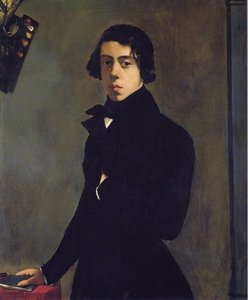
Théodore Chassériau's 1835 oil on canvas, "Self-Portrait in a Redingote," is more than just a likeness; it’s a carefully constructed tableau of restrained elegance and subtle introspection—a window into the mind of a young artist grappling with his artistic identity within the context of 19th-century Parisian society. Housed within the prestigious Musée du Louvre, this painting immediately draws the viewer in with its dark palette and the commanding presence of the subject, a young man radiating an almost melancholic intensity.
The work firmly anchors itself within the Romantic movement, yet it subtly resists simple categorization. While undeniably influenced by the dramatic flair of Eugène Delacroix – particularly evident in the dynamic lighting and the suggestion of movement – Chassériau retains a core Neoclassical discipline, meticulously rendered lines defining the sharp angles of his suit jacket and the precise contours of his face. This duality reflects the artist’s own journey: initially trained under the rigorous tutelage of Jean-Auguste-Dominique Ingres, he ultimately forged his own path, embracing a more expressive and emotionally charged style.
Chassériau's masterful technique is immediately apparent. The painting’s composition centers around the subject, occupying nearly the entire frame, creating an intimate and almost claustrophobic effect. He stands in a three-quarter pose, his gaze directed slightly to the left, inviting the viewer into his world. A subtle yet significant detail—a microphone stand discreetly positioned behind him on the left – hints at a performance context, perhaps suggesting Chassériau’s burgeoning career as a stage designer or illustrator, alongside his painting endeavors. The artist employs a layering technique, building up color and texture through numerous thin glazes of oil paint, resulting in a remarkably smooth surface—a testament to his dedication and skill.
The lighting is particularly noteworthy. It originates from an unseen source on the left side, casting soft, directional shadows across the subject’s face and subtly highlighting the textures of his clothing. This strategic use of light not only adds depth and volume but also contributes significantly to the painting's overall mood—a blend of formality and quiet contemplation. The careful blending of tones creates a sense of atmospheric perspective, drawing the eye deeper into the scene.
Beyond its technical brilliance, “Self-Portrait in a Redingote” is rich in symbolic meaning. The formal black suit, impeccably tailored, speaks to Chassériau’s ambition and his desire for recognition within the established artistic circles of Paris. However, the slightly downturned mouth and the introspective gaze suggest a deeper layer of complexity—a hint of melancholy or perhaps even disillusionment with the constraints of academic art. The red bow tie, a vibrant splash of color against the predominantly dark palette, could represent passion, creativity, or simply a deliberate assertion of individuality.
The painting’s overall effect is one of restrained elegance and quiet introspection. It's not a flamboyant self-celebration but rather a carefully considered portrait of an artist grappling with his identity and place in the world—a poignant reflection on the challenges and rewards of pursuing a creative life. The subtle sadness in his eyes invites us to contemplate the burdens of artistic ambition, while the formality of his attire suggests a desire for respectability and recognition.
Created during a period of significant social and political upheaval—the aftermath of the Napoleonic Wars and the rise of Romanticism—Chassériau’s work reflects the movement's emphasis on emotion, individualism, and the sublime. His Creole heritage, born in the Dominican Republic and raised in Paris, undoubtedly informed his artistic vision, providing him with a unique perspective on both European and Caribbean cultures. This background is reflected in his interest in Orientalist themes – particularly evident in later works – and his willingness to challenge conventional artistic norms.
Chassériau’s trajectory—from student of Ingres to independent Romantic artist—is itself a compelling narrative, illustrating the tensions between tradition and innovation within 19th-century art. “Self-Portrait in a Redingote” stands as a powerful testament to his artistic evolution and a captivating glimpse into the mind of a brilliant but often overlooked talent.

1819 - 1856 , Dominicaanse Republiek


Blijf op de hoogte van het laatste kunstnieuws, exclusieve aanbiedingen en decoratie-ideeën.
Vertel ons over uw project en onze kunstexperts geven u 3 gepersonaliseerde kunstsuggesties.
Wij stellen drie opties speciaal voor u samen – gratis!


 Voorvertoning
 Verstuur
 Delen
Delen
 Details bekijken

 Download
 Vergelijkbare items
 Röntgenonderzoek
 Diavoorstelling
 Lees meer


