x

Giclée- eller lerretsprint av museumskvalitet med rask produksjon og fleksible valgmuligheter for etterbehandling. ( Kjøp håndlaget maleri Kjøp bilde)





























Velg mellom våre forhåndsdefinerte størrelser som bevarer kunstverkets opprinnelige proporsjoner.

Du kan oppgi egne mål for å tilpasse en spesifikk ramme eller et bestemt område. Dersom den valgte størrelsen ikke samsvarer med det originale bildets proporsjoner, vil vi enten beskjære kunstverket eller utvide bildet med en speilet eller ensfarget kant. En digital mockup vil bli sendt til din godkjenning før produksjonen starter.
Vennligst merk at forhåndsvisningen på skjermen ikke gjenspeiler den faktiske beskjæringen eller utvidelsen. Kun mockuppen vil vise den endelige komposisjonen nøyaktig.
Selv om tilpassede størrelser er tilgjengelige, anbefaler vi å velge et mål fra den forhåndsdefinerte listen for å bevare de originale proporsjonene.
Verdensomspennende levering () på 2 uker i stedet for standard 4/5 uker. (15 August)


Girls under Trees
Størrelse på reproduksjon
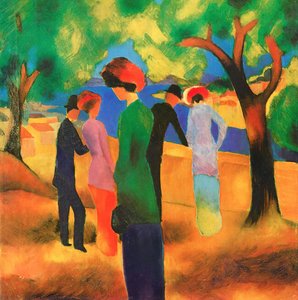
August Macke's “Girls Under Trees” (1914) isn't merely a depiction of children playing in the woods; it’s a vibrant distillation of early 20th-century optimism and a powerful expression of German Expressionism. Painted just before the artist’s tragically short life, this work captures a fleeting moment of communal joy – a scene brimming with youthful energy and a profound connection to nature. Macke masterfully employs bold color and dynamic brushstrokes to convey not just what he saw, but how he *felt* about it: a sense of unburdened happiness and the simple pleasures of life.
Born in Meschede, Germany, in 1887, August Macke was a pivotal figure within the burgeoning movement of German Expressionism. His artistic journey was marked by rapid experimentation, influenced initially by Impressionist techniques before evolving into a uniquely expressive style. The context of his work is crucial; 1914 represents a period of intense artistic innovation across Europe, with artists grappling with modernity and seeking new ways to represent the human experience. Macke’s membership in “Der Blaue Reiter” (The Blue Rider) – a group dedicated to exploring non-representational art and spiritual themes – highlights his engagement with these avant-garde currents. His brief but impactful career was cut short by the outbreak of World War I, leaving behind a legacy of intensely colored and emotionally charged paintings.
Macke’s technique is immediately striking. He utilizes loose, almost frantic brushstrokes to create a sense of movement and spontaneity. The figures aren't rendered with meticulous detail; instead, they are suggested through blocks of color and simplified forms. This approach aligns perfectly with the Expressionist desire to convey emotion rather than objective reality. Notice how he blends the children’s dresses – greens, blues, yellows – seamlessly into the surrounding foliage, dissolving the boundaries between figure and landscape. The composition itself is dynamic, drawing the viewer's eye across the canvas through a carefully orchestrated arrangement of shapes and colors. This technique reflects Macke's interest in integrating elements of the avant-garde, particularly the influence of Orphism—the use of color to create visual rhythms and harmonies.
"Girls Under Trees" resonates with a powerful sense of nostalgia and innocence. The children’s carefree laughter and joyful interaction evoke a longing for simpler times – a sentiment deeply rooted in the anxieties of a rapidly changing world. The trees themselves, rendered as monumental forms, symbolize strength, stability, and connection to nature—themes central to many Expressionist works. Macke's ability to capture this emotional core through his distinctive style elevates the painting beyond a mere depiction of children; it becomes a timeless meditation on joy, community, and the beauty of the natural world. The painting’s enduring appeal lies in its ability to tap into universal human emotions – a reminder that even amidst chaos and uncertainty, moments of pure happiness can be found.


1887 - 1914 , Tyskland

Explore the visceral power of German Expressionism. From Ernst Ludwig Kirchner to Die Brücke, discover how bold colors and distorted forms unmask raw human emotion in this expert art history guide for collectors and enthusiasts.


Hold deg oppdatert med de siste kunstnyhetene, eksklusive tilbud og dekorasjonsideer.
Fortell oss om prosjektet ditt, så vil våre kunsteksperter gi deg 3 personlige kunstforslag.
Vi velger ut 3 alternativer kun for deg – helt gratis!


 Forhåndsvisning
 Send
Send Del med andre
 Vis detaljer

 Last ned bildet
 Liknende objekter
 Røntgenundersøkelse
 Lysbildefremvisning


 Vis hele teksten







 Glassalternativet er kun tilgjengelig i størrelser under 110 cm