x
Giclée- eller lerretsprint av museumskvalitet med rask produksjon og fleksible valgmuligheter for etterbehandling. ( Bytt til håndmalt maleri Bytt til bilde)





























Velg mellom våre forhåndsdefinerte størrelser som bevarer kunstverkets opprinnelige proporsjoner.

Du kan oppgi egne mål for å tilpasse en spesifikk ramme eller et bestemt område. Dersom den valgte størrelsen ikke samsvarer med det originale bildets proporsjoner, vil vi enten beskjære kunstverket eller utvide bildet med en speilet eller ensfarget kant. En digital mockup vil bli sendt til din godkjenning før produksjonen starter.
Vennligst merk at forhåndsvisningen på skjermen ikke gjenspeiler den faktiske beskjæringen eller utvidelsen. Kun mockuppen vil vise den endelige komposisjonen nøyaktig.
Selv om tilpassede størrelser er tilgjengelige, anbefaler vi å velge et mål fra den forhåndsdefinerte listen for å bevare de originale proporsjonene.
Verdensomspennende levering () på 2 uker i stedet for standard 4/5 uker. (11 August)


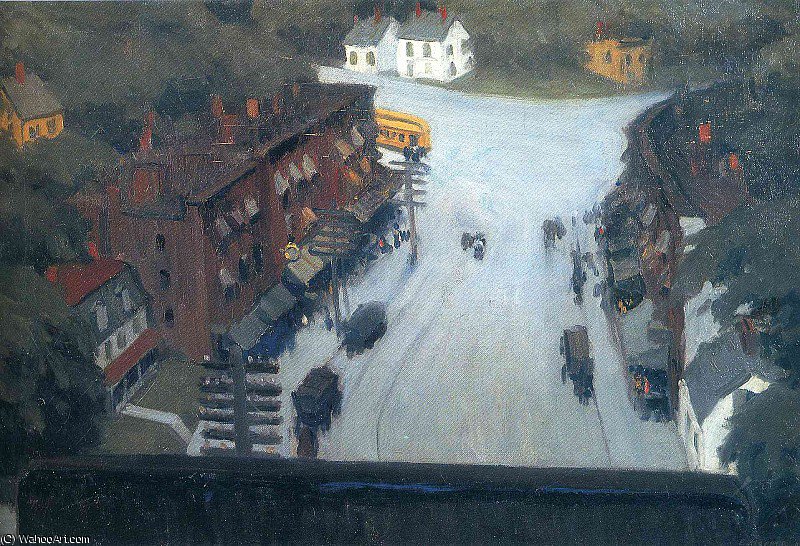
untitled (161)
Størrelse på reproduksjon
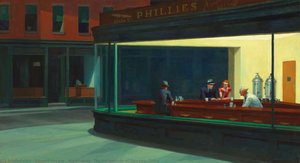
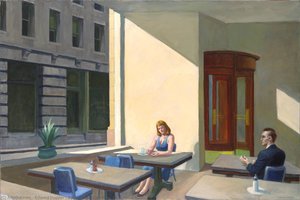
Edward Hopper's "Untitled (161)" – a deceptively simple black and white depiction of a Greenwich Village diner at night – transcends mere representation; it embodies the very essence of American modernism. Completed in 1942, amidst the anxieties of wartime America, this painting isn’t merely about what is seen but profoundly communicates what is felt—a palpable sense of solitude, longing, and unspoken connection.
The genesis of “Untitled (161)” lies in Hopper’s fascination with Ernest Hemingway's literary explorations of loneliness and disillusionment, notably "The Killers" and "A Clean, Well-Lighted Place." As Hopper himself recounted, he was drawn to the pervasive feeling of isolation present in these narratives. The painting emerged during a period marked by significant social upheaval—the Second World War casting its long shadow over American society—and Hopper’s work reflects this mood of quiet apprehension and introspection.
"Untitled (161)" is laden with symbolic significance. The diner itself represents a transient space, a momentary pause in the relentless flow of urban life—a place where individuals exist alongside each other yet remain fundamentally alone. Hopper’s masterful use of light and shadow amplifies this emotional core, highlighting the stark contrast between illumination and darkness, mirroring the internal struggles inherent in human existence.
Jo Hopper's Detailed Observations:Josephine Hopper meticulously documented her husband’s artistic process, adding invaluable insights into the painting’s conception. Her handwritten notes reveal a profound appreciation for Hopper’s technical prowess and his deliberate choices regarding composition and color palette. Notably, she emphasized that Hopper sought to capture “the loneliness of a large city,” reflecting Hemingway's thematic concerns.
"Untitled (161)" remains one of Edward Hopper’s most iconic works, celebrated for its ability to evoke profound feelings of solitude and contemplation. Its enduring appeal stems from its universality—a depiction of human experience that transcends time and place. Most-Famous-Paintings offers high-quality reproductions of this masterpiece, allowing collectors and enthusiasts alike to immerse themselves in the beauty and emotional depth of Hopper’s vision.


1931 - 1967 , USA

Explore the evolution of cityscape painting from historical maps to Impressionist masterpieces. Discover artists like Caillebotte, Utrillo & Matsumoto Shunsuke. Find museum-quality reproductions at Most-Famous-Paintings.

Explore the powerful social commentary & artistic representation of American Realism. Discover key artists like Bellows & Sloan, and understand the movement's lasting impact on 20th-century art history.

Explore the life & legacy of Robert Henri, a pivotal figure in American Realism. Discover his captivating portraits, influence on the Ashcan School, and enduring impact on art history. Learn more at Most-Famous-Paintings.

Explore the life & art of William Glackens, a pioneer of American Realism and founding member of the Ashcan School. Discover his vibrant depictions of early 20th-century New York & Paris. Learn about his influences & lasting legacy.

Explore the life & work of Thomas Pollock Anshutz, a key figure in American Realism. Discover his powerful paintings, influence on art education, and commitment to portraying everyday life with honesty and social awareness.


Hold deg oppdatert med de siste kunstnyhetene, eksklusive tilbud og dekorasjonsideer.
Fortell oss om prosjektet ditt, så vil våre kunsteksperter gi deg 3 personlige kunstforslag.
Vi velger ut 3 alternativer kun for deg – helt gratis!


 Forhåndsvisning
 Send
Send Del med andre
 Vis detaljer

 Last ned bildet
 Liknende objekter
 Røntgenundersøkelse
 Lysbildefremvisning
 Vis hele teksten







 Glassalternativet er kun tilgjengelig i størrelser under 110 cm