x

Håndmalt olje på lerret i din valgte størrelse og ramme, laget på bestilling av våre kunstnere. ( Kjøp trykk Kjøp bilde)
Velg mellom våre forhåndsdefinerte størrelser som bevarer kunstverkets opprinnelige proporsjoner.

Du kan angi egne mål for å tilpasse en spesifikk ramme eller plass. Dersom den valgte størrelsen ikke samsvarer med originalbildets proporsjoner, vil vi enten beskjære kunstverket eller utvide maleriet med ytterligere håndmalte elementer. En digital mockup vil bli sendt til din godkjenning før produksjonen starter.
Vennligst merk at forhåndsvisningen på skjermen ikke gjenspeiler den faktiske beskjæringen eller utvidelsen. Kun mockuppen vil vise den endelige komposisjonen nøyaktig.
Selv om tilpassede størrelser er tilgjengelige, anbefaler vi å velge et mål fra den forhåndsdefinerte listen for å bevare de originale proporsjonene.
Verdensomspennende levering () på 3–4 uker i stedet for standard 5 uker. (19 August). Ingen kompromisser med kvaliteten.


untitled (5831)
Størrelse på reproduksjon
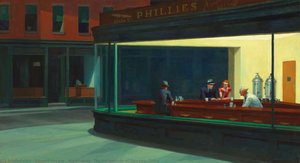
Edward Hopper’s “Nighthawks,” completed in 1942, is more than just a painting; it’s a distilled moment of American experience – a poignant exploration of loneliness and the quiet drama unfolding within the heart of a bustling city. The canvas depicts a late-night diner scene, bathed in an almost theatrical artificial light, instantly captivating viewers with its stark simplicity and profound emotional resonance. Hopper masterfully captures a sense of detachment, inviting us to contemplate the lives of these anonymous figures and the unspoken narratives that surround them.
The painting’s composition is meticulously crafted. The diner itself – a brightly lit rectangle against the enveloping darkness – acts as a stage, isolating its occupants within a carefully constructed space. Hopper's use of color is deliberate and restrained; the dominant hues of red, green, and yellow create a vibrant yet unsettling atmosphere, contrasting sharply with the muted tones of the surrounding cityscape. The sharp angles and geometric forms contribute to the painting’s sense of unease, reinforcing the feeling of confinement and isolation.
Hopper's style is firmly rooted in American Realism, but he transcends mere representation through his masterful manipulation of light and shadow. He employs a technique known as “accidental realism,” capturing fleeting moments of everyday life with an almost photographic precision. However, it’s not simply about accurate depiction; Hopper imbues his scenes with a deep sense of psychological depth. Notice the subtle details – the man's slumped posture, the woman's averted gaze, the bartender’s impassive expression – each contributing to the overall mood of quiet melancholy.
The painting’s execution is characterized by smooth brushstrokes and precise detailing, reflecting Hopper’s meticulous approach to his craft. He utilized oil paints on canvas, layering thin glazes to achieve a luminous effect and create a sense of depth and atmosphere. The use of reflected light within the diner's glass creates an illusion of transparency, further enhancing the painting’s dramatic impact.
"Nighthawks" was created during World War II, a period marked by uncertainty and anxiety in America. This context undoubtedly influenced Hopper’s themes of isolation and alienation, reflecting a growing sense of disillusionment among many Americans. The diner itself can be interpreted as a symbol of the American Dream – a place of refuge and connection – yet ironically, it becomes a space of profound loneliness.
The painting's title, "Nighthawks," evokes images of nocturnal birds, suggesting a sense of vulnerability and solitude. The figures within the diner are left ambiguous, their identities unknown, allowing viewers to project their own emotions and experiences onto the scene. Some art historians suggest Hopper was inspired by Ernest Hemingway’s short story “The Killers,” exploring themes of isolation and despair.
"Nighthawks" remains one of the most iconic images in American art, captivating audiences with its haunting beauty and enduring relevance. It speaks to a universal human experience – the feeling of being alone even amidst crowds, the quiet contemplation of life’s mysteries, and the search for connection in an increasingly fragmented world. Hopper's ability to capture these emotions with such precision and subtlety has ensured that “Nighthawks” continues to resonate with viewers today, solidifying its place as a masterpiece of American Realism.


1931 - 1967 , USA

Explore the profound history of American Regionalism. Discover how Grant Wood captured the heart of the Midwest through masterpieces like American Gothic. An expert guide to the movement, its cultural impact, and the enduring beauty of American Realism.


Hold deg oppdatert med de siste kunstnyhetene, eksklusive tilbud og dekorasjonsideer.
Fortell oss om prosjektet ditt, så vil våre kunsteksperter gi deg 3 personlige kunstforslag.
Vi velger ut 3 alternativer kun for deg – helt gratis!


 Forhåndsvisning
 Send
Send Del med andre
 Vis detaljer

 Last ned bildet
 Liknende objekter
 Røntgenundersøkelse
 Lysbildefremvisning
 Vis hele teksten




































 Glassalternativet er kun tilgjengelig i størrelser under 110 cm