


x

 Acrylic On CanvasWallArtEarly Venetian Renaissance
 1510
1510 745.0 x 545.0 cm
Giclée- eller lerretsprint av museumskvalitet med rask produksjon og fleksible valgmuligheter for etterbehandling. ( Kjøp håndlaget maleri Kjøp bilde)





























Velg mellom våre forhåndsdefinerte størrelser som bevarer kunstverkets opprinnelige proporsjoner.

Du kan oppgi egne mål for å tilpasse en spesifikk ramme eller et bestemt område. Dersom den valgte størrelsen ikke samsvarer med det originale bildets proporsjoner, vil vi enten beskjære kunstverket eller utvide bildet med en speilet eller ensfarget kant. En digital mockup vil bli sendt til din godkjenning før produksjonen starter.
Vennligst merk at forhåndsvisningen på skjermen ikke gjenspeiler den faktiske beskjæringen eller utvidelsen. Kun mockuppen vil vise den endelige komposisjonen nøyaktig.
Selv om tilpassede størrelser er tilgjengelige, anbefaler vi å velge et mål fra den forhåndsdefinerte listen for å bevare de originale proporsjonene.
Verdensomspennende levering () på 2 uker i stedet for standard 4/5 uker. (21 August)


Ceres
Størrelse på reproduksjon
Giorgio Barbarelli da Castelfranco, known universally as Giorgione (1477 – 1510), remains one of the most perplexing enigmas within the canon of Early Venetian Renaissance painting. Unlike many artists of his era whose biographies offer detailed accounts of their lives and careers, Giorgione’s story is fragmented—a tapestry woven from sparse historical records primarily gleaned from Giorgio Vasari’s biographical sketches. Born in Castelfranco Veneto, a town nestled on the outskirts of Venice, Giorgione’s artistic journey began under the tutelage of Giovanni Bellini, absorbing the established stylistic conventions before embarking upon an independent exploration that would ultimately redefine Venetian art.
‘The Tempest,’ housed in the Gallerie Venezia Palazzo Ducale, exemplifies Giorgione's unparalleled mastery of atmospheric illusionism and psychological subtlety. Painted circa 1506-1508, this monumental canvas depicts a shadowy interior scene—a room dominated by a woman seated on a stone bench beneath a tempestuous sky glimpsed through arched windows. The painting’s brilliance lies not merely in its technical virtuosity but also in its profound emotional resonance.
Giorgione revolutionized Venetian painting with his groundbreaking use of sfumato—a technique perfected by Bellini and subsequently embraced by Leonardo da Vinci—that achieved an unprecedented level of tonal gradation. Layers upon layers of translucent glaze meticulously blended to create soft, hazy contours that dissolved boundaries between light and dark. This masterful manipulation of color and texture wasn’t simply decorative; it served as a conduit for conveying mood and emotion with remarkable precision.
‘The Tempest’ emerged during a period of artistic ferment in Venice—a city grappling with the legacy of Dante Alighieri's ‘Divine Comedy’ and increasingly attuned to humanist ideals. Giorgione’s painting reflects this intellectual climate, prioritizing contemplation and psychological exploration over literal representation. It stands as a testament to Venetian artists’ commitment to capturing not just what was seen but also what was felt—a pursuit that distinguished Venice from other European capitals.
The tempestuous sky serves as a powerful symbol of inner turmoil—representing both external forces and psychological anxieties. The woman’s enigmatic gaze invites viewers to contemplate her thoughts and emotions, prompting questions about identity, desire, and fate. Giorgione's deliberate ambiguity ensures that ‘The Tempest’ remains perpetually open to interpretation, captivating audiences across centuries with its haunting beauty and enduring mystery.
Giorgione’s influence extends far beyond the confines of Venetian painting. His pioneering sfumato technique profoundly impacted subsequent generations of artists—including Leonardo da Vinci and Raphael—solidifying his place as a cornerstone of Western art history. ‘The Tempest,’ therefore, isn't merely a stunning visual experience; it is an embodiment of Giorgione’s artistic vision—a testament to the transformative power of atmosphere, emotion, and psychological insight.

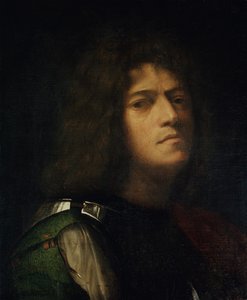
1477 - 1510 , Italia

Explore the luminous mastery of the Venetian Renaissance. Discover how masters like Titian and Giorgione revolutionized art through colorito, light, and atmosphere. An expert guide to the golden age of Italian painting for collectors and enthusiasts.


Hold deg oppdatert med de siste kunstnyhetene, eksklusive tilbud og dekorasjonsideer.
Fortell oss om prosjektet ditt, så vil våre kunsteksperter gi deg 3 personlige kunstforslag.
Vi velger ut 3 alternativer kun for deg – helt gratis!


 Forhåndsvisning
 Send
Send Del med andre
 Vis detaljer

 Last ned bildet
 Liknende objekter
 Røntgenundersøkelse
 Lysbildefremvisning
 Vis hele teksten







 Glassalternativet er kun tilgjengelig i størrelser under 110 cm


