x

 1463
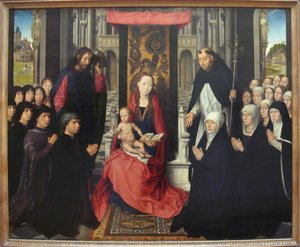
1463 154.0 x 43.0 cm
 Pinacoteca di Brera
Kjøp et høyoppløselig, forbedret digitalt bilde som er langt bedre enn forhåndsvisningen på nettet.
Hver fil er omhyggelig klargjort av våre egne spesialister ved hjelp av avanserte verktøy og profesjonell manuell retusjering. Vi sørger for at hvert bilde har eksepsjonell klarhet, presis fargegjengivelse og fine detaljer.
Den endelige filen leveres via e-post innen 72 timer, optimalisert for umiddelbar bruk i profesjonelle, redaksjonelle og trykte miljøer. Dette er den samme kvaliteten som benyttes av ledende designstudioer, utgivere og gallerier.
Last ned en høyoppløselig fil for personlig bruk, utskrift og kreative prosjekter. ( Kjøp trykk Kjøp håndlaget maleri)
Når du velger Most-Famous-Paintings.com, får du ikke bare et bilde – du mottar et profesjonelt forbedret digitalt kunstverk, skapt med presisjon og med en garantert tilfredshetsgaranti. Her er alt som automatisk følger med din bestilling:

Din høyoppløselige digitale bildefil sendes til din e-post innen 72 timer etter bestilling – klar til umiddelbar bruk.

Ditt kunstverk blir profesjonelt optimalisert ved hjelp av avanserte AI-verktøy og manuell redigering, noe som sikrer maksimal detaljrikdom, klarhet og fargegjengivelse.

Har du ved et uhell slettet eller mistet filen din? Ingen bekymring – vi sender den på nytt når som helst, helt gratis.

Nyt ditt kunstverk umiddelbart uten toll, avgifter eller leveringskostnader – digitale nedlastinger er alltid avgiftsfrie.

Vi sikrer at ditt digitale bilde gjenspeiler de originale fargene så nøyaktig som mulig ved hjelp av profesjonelle verktøy og fargehåndtering.

Hvis du ikke er fornøyd med ditt digitale bilde, vil vi revidere det eller refundere 100% innen 60 dager – uten spørsmål.

Ikke fornøyd? Få full refusjon innen 60 dager etter at du har mottatt din digitale fil – uten spørsmål.

Kjøp 3 bilder, spar 10% - Kjøp 5, spar 15% - Kjøp 10+, spar 20%. Ideelt for kreative prosjekter, gallerier og byråer.

John Michael Wright, a name often relegated to the footnotes of 17th-century English art history, emerges as a remarkably sophisticated and subtly powerful portraitist. Born in London around 1617 – though his precise origins remain tantalizingly debated – Wright’s life was a tapestry woven with threads of Scottish heritage, Roman artistic influence, and a complex engagement with the volatile political landscape of Restoration England. His work, characterized by an intimate realism and a profound understanding of human psychology, deserves renewed attention as a significant voice within a period dominated by the flamboyant style of Sir Peter Lely.
Wright’s early training unfolded in Edinburgh under the tutelage of George Jamesone, a Scottish painter who instilled in him a foundational knowledge of composition and technique. However, it was his extended sojourn in Rome that truly shaped his artistic vision. Admitted to the prestigious Accademia di San Luca in 1648, Wright immersed himself in the vibrant art scene of the Italian capital, absorbing the techniques of masters like Caravaggio and studying the classical ideals of Renaissance portraiture. This Roman period wasn’t merely a vacation; it was a deliberate investment in his artistic development, providing him with a critical understanding of light, shadow, and the nuances of human expression – elements he would later masterfully employ in his English portraits.
Returning to England in 1656, Wright quickly established himself as a sought-after portraitist, attracting patronage from both Protestant and Catholic circles. This period coincided with the tumultuous years of the Interregnum and the subsequent Restoration, creating a uniquely challenging environment for an artist navigating religious and political divisions. Wright’s ability to secure commissions from figures across the spectrum – including prominent Catholics like Charles II and James II – speaks volumes about his diplomatic skill and his capacity to transcend sectarian boundaries through his art.
His style diverged subtly from Lely's more overtly polished aesthetic. While Lely favored a glamorous, idealized representation of his subjects, Wright’s portraits possessed a greater sense of introspection and psychological depth. His sitters often appear thoughtful, engaged in private contemplation – a marked contrast to the carefully constructed smiles prevalent in many contemporary portraits. This subtle shift reflects a growing interest in capturing not just outward appearances but also the inner lives of his subjects.
Wright’s artistic development was profoundly influenced by the principles of Baroque painting, particularly as he encountered them during his time in Rome. The dramatic use of chiaroscuro – the interplay of light and shadow – became a defining characteristic of his work, lending depth and intensity to his portraits. He skillfully employed tenebrism, creating strong contrasts between illuminated areas and deep shadows, which heightened the drama and focused attention on key features of the subject’s face and expression. Furthermore, Wright's compositions often featured dynamic arrangements of figures and objects, reflecting a Baroque emphasis on movement and theatricality.
His engagement with the Accademia di San Luca also exposed him to contemporary Italian artists, including Rubens and Van Dyck, whose techniques he subtly incorporated into his own style. This cross-cultural fertilization resulted in a portraiture that was both distinctly English and infused with the sophistication of European artistic trends.
Despite facing periods of relative obscurity following his death in 1681, John Michael Wright’s work has been increasingly recognized for its remarkable realism and psychological insight. His portraits offer a rare glimpse into the inner lives of his subjects, revealing their thoughts, emotions, and personalities with subtle yet profound accuracy. Works like “Portrait of Mrs. Salesbury with her Grandchildren” exemplify this ability to capture not just physical likeness but also the complex relationships between individuals.
Today, Wright’s paintings are treasured within collections worldwide, serving as a testament to his artistic skill and his enduring contribution to the history of English portraiture. Further research continues to shed light on the complexities of his life and career, solidifying his place as a significant, though often overlooked, figure in the art world.

1617 - 1666 , Italy


Hold deg oppdatert med de siste kunstnyhetene, eksklusive tilbud og dekorasjonsideer.
Fortell oss om prosjektet ditt, så vil våre kunsteksperter gi deg 3 personlige kunstforslag.
Vi velger ut 3 alternativer kun for deg – helt gratis!


 Forhåndsvisning
 Send
Send Del med andre
 Vis detaljer

 Last ned bildet
 Liknende objekter
 Røntgenundersøkelse
 Lysbildefremvisning
 Vis hele teksten