x

 Acrylic On CanvasWallArtSurrealism
 1961
1961 31.0 x 47.0 cm
Kjøp et høyoppløselig, forbedret digitalt bilde som er langt bedre enn forhåndsvisningen på nettet.
Hver fil er omhyggelig klargjort av våre egne spesialister ved hjelp av avanserte verktøy og profesjonell manuell retusjering. Vi sørger for at hvert bilde har eksepsjonell klarhet, presis fargegjengivelse og fine detaljer.
Den endelige filen leveres via e-post innen 72 timer, optimalisert for umiddelbar bruk i profesjonelle, redaksjonelle og trykte miljøer. Dette er den samme kvaliteten som benyttes av ledende designstudioer, utgivere og gallerier.
Last ned en høyoppløselig fil for personlig bruk, utskrift og kreative prosjekter. ( Kjøp trykk Kjøp håndlaget maleri)
Når du velger Most-Famous-Paintings.com, får du ikke bare et bilde – du mottar et profesjonelt forbedret digitalt kunstverk, skapt med presisjon og med en garantert tilfredshetsgaranti. Her er alt som automatisk følger med din bestilling:

Din høyoppløselige digitale bildefil sendes til din e-post innen 72 timer etter bestilling – klar til umiddelbar bruk.

Ditt kunstverk blir profesjonelt optimalisert ved hjelp av avanserte AI-verktøy og manuell redigering, noe som sikrer maksimal detaljrikdom, klarhet og fargegjengivelse.

Har du ved et uhell slettet eller mistet filen din? Ingen bekymring – vi sender den på nytt når som helst, helt gratis.

Nyt ditt kunstverk umiddelbart uten toll, avgifter eller leveringskostnader – digitale nedlastinger er alltid avgiftsfrie.

Vi sikrer at ditt digitale bilde gjenspeiler de originale fargene så nøyaktig som mulig ved hjelp av profesjonelle verktøy og fargehåndtering.

Hvis du ikke er fornøyd med ditt digitale bilde, vil vi revidere det eller refundere 100% innen 60 dager – uten spørsmål.

Ikke fornøyd? Få full refusjon innen 60 dager etter at du har mottatt din digitale fil – uten spørsmål.

Kjøp 3 bilder, spar 10% - Kjøp 5, spar 15% - Kjøp 10+, spar 20%. Ideelt for kreative prosjekter, gallerier og byråer.
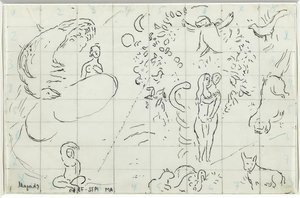
Marc Chagall's *Paradise (12)*, painted in 1961, isn’t merely a depiction of a biblical scene; it’s an immersion into the artist’s deeply personal universe—a vibrant tapestry woven from memory, faith, and the enduring spirit of his Vitebsk childhood. This canvas pulsates with a joyous energy, a testament to Chagall's ability to transform the familiar narratives of Eden into something profoundly moving and uniquely his own. The painting immediately draws the eye with its riotous color palette—a symphony of blues, greens, yellows, and reds that seem to shimmer with an inner light. It’s a world unbound by realism, where figures float and dance amidst a profusion of flowers, creating a sense of both earthly delight and celestial transcendence.
At the heart of *Paradise (12)* lies a group of figures—a multitude of individuals rendered in Chagall’s signature style. They aren't portraits, but rather embodiments of archetypes; Adam and Eve are present, naturally, but surrounded by a throng of family members, friends, and neighbors – all recognizable as characters from his Vitebsk past. The composition is deliberately loose and dynamic, suggesting movement and conversation. Notice how some figures are clustered together, engaged in animated dialogue, while others drift further into the background, lost in contemplation or simply enjoying the beauty of their surroundings. The arrangement feels less like a formal depiction and more like a spontaneous gathering—a celebration of life and connection.
Chagall’s work is rich with symbolism, drawing heavily on Jewish folklore and religious tradition. The abundance of flowers isn't simply decorative; they represent fertility, renewal, and the promise of eternal life. The presence of animals—a donkey, a bird, and a dog—adds layers of meaning, referencing biblical stories and representing aspects of nature and human relationships. The central figure, often interpreted as Chagall himself, is depicted with his characteristic flowing beard and distinctive hat, suggesting both humility and artistic authority. The inclusion of figures from his family – including his wife, Valentina (known as Bella) – reinforces the painting’s deeply personal nature, transforming a biblical narrative into a celebration of familial love and heritage.
*Paradise (12)* is executed in gouache on canvas, a medium that lends itself beautifully to Chagall’s expressive style. The flat, vibrant colors are applied with broad brushstrokes, creating a sense of immediacy and spontaneity. The lack of precise detail contributes to the painting's dreamlike quality—it feels as though we’re peering into a vivid memory or glimpsing a fleeting vision. Chagall’s use of color is particularly noteworthy; he employs contrasting hues to create visual excitement and depth, while also utilizing subtle gradations to suggest light and shadow. The overall effect is one of joyous exuberance—a testament to the artist's mastery of his chosen medium.
Beyond its technical brilliance, *Paradise (12)* possesses a profound emotional resonance. It’s not simply a retelling of the story of Adam and Eve; it's an affirmation of life’s beauty, joy, and interconnectedness. The painting radiates warmth and optimism—a reminder that even in the face of adversity, there is always hope for renewal and redemption. It invites us to contemplate our own relationships, our memories, and our place within the larger tapestry of human experience. *Paradise (12)* remains a powerful testament to Chagall’s enduring legacy as one of the 20th century's most beloved and influential artists.

1887 - 1985 , Belarus


Hold deg oppdatert med de siste kunstnyhetene, eksklusive tilbud og dekorasjonsideer.
Fortell oss om prosjektet ditt, så vil våre kunsteksperter gi deg 3 personlige kunstforslag.
Vi velger ut 3 alternativer kun for deg – helt gratis!


 Forhåndsvisning
 Send
Send Del med andre
 Vis detaljer

 Last ned bildet
 Liknende objekter
 Røntgenundersøkelse
 Lysbildefremvisning
 Vis hele teksten