


x

Giclée- eller lerretsprint av museumskvalitet med rask produksjon og fleksible valgmuligheter for etterbehandling. ( Kjøp håndlaget maleri Kjøp bilde)





























Velg mellom våre forhåndsdefinerte størrelser som bevarer kunstverkets opprinnelige proporsjoner.

Du kan oppgi egne mål for å tilpasse en spesifikk ramme eller et bestemt område. Dersom den valgte størrelsen ikke samsvarer med det originale bildets proporsjoner, vil vi enten beskjære kunstverket eller utvide bildet med en speilet eller ensfarget kant. En digital mockup vil bli sendt til din godkjenning før produksjonen starter.
Vennligst merk at forhåndsvisningen på skjermen ikke gjenspeiler den faktiske beskjæringen eller utvidelsen. Kun mockuppen vil vise den endelige komposisjonen nøyaktig.
Selv om tilpassede størrelser er tilgjengelige, anbefaler vi å velge et mål fra den forhåndsdefinerte listen for å bevare de originale proporsjonene.
Verdensomspennende levering () på 2 uker i stedet for standard 4/5 uker. (18 August)


Visning av Cappella Brancacci (før restaurering)
Størrelse på reproduksjon
Tommaso di Ser Giovanni di Simone, better known as Masaccio (1401-1428), stands as a pivotal figure in the transition from the medieval to the Renaissance. His brief but intensely productive career irrevocably altered the course of Western art, establishing a new standard for naturalism and profoundly influencing generations of artists to come. Born in San Giovanni Valdarno, his early life was marked by tragedy – orphaned at five years old – yet it fueled within him an extraordinary drive to capture the essence of human experience on canvas. Masaccio’s genius lay not merely in technical skill, but in a revolutionary approach to depicting space, light, and form; techniques that would forever change how artists perceived and represented the world.
The “View of the Cappella Brancacci (before restoration)” offers a rare glimpse into this transformative period. Painted in 1426, it’s not simply a depiction of a church interior; it's a carefully constructed illusion, a testament to Masaccio’s pioneering use of linear perspective and his mastery of *chiaroscuro* – the dramatic interplay of light and shadow. The fresco, originally part of a larger cycle adorning the Brancacci Chapel in Santa Maria del Carmine, Florence, captures a moment frozen in time: a man standing before a window, surrounded by figures engaged in prayer and contemplation. The scene is imbued with an almost palpable sense of depth and realism, achieved through meticulous observation and a radical departure from the stylized conventions of earlier art.
Masaccio’s innovation wasn't merely about accurately portraying objects; it was about creating the *illusion* of three-dimensional space on a two-dimensional surface. He achieved this through his masterful application of linear perspective, a technique he essentially invented in Western painting. Notice how lines converge towards a vanishing point, drawing the viewer’s eye into the scene and establishing a believable sense of depth. The figures themselves are rendered with astonishing anatomical accuracy – their muscles, veins, and drapery depicted with a realism previously unseen in Florentine art. Furthermore, Masaccio's use of *chiaroscuro*—the stark contrast between light and dark—adds to the drama and emotional impact of the scene. The strong illumination highlights key figures, drawing attention to their gestures and expressions, while casting other areas into shadow, creating a sense of mystery and solemnity.
The inclusion of details like the clock on the wall – a commonplace object in Renaissance life – adds another layer of realism, grounding the scene in its historical context. These seemingly minor elements contribute to the overall impression that Masaccio was striving for an unprecedented level of verisimilitude, capturing not just what he saw but also *how* it felt to be present within that space.
Beyond its technical brilliance, “View of the Cappella Brancacci” is rich in symbolic meaning. The man standing before the window can be interpreted as a representation of humanity contemplating God’s grace. The candles, positioned strategically within the scene, symbolize divine light and illumination. The overall atmosphere evokes a sense of reverence and spiritual contemplation – a feeling that was central to Masaccio's artistic vision. He wasn’t simply interested in creating beautiful images; he sought to communicate profound truths about human existence and our relationship with the divine.
It is important to note that this image represents the chapel *before* its extensive restoration in the late 19th century. The original frescoes were damaged by a devastating fire, and subsequent restorations have altered the appearance of the chapel. However, the “View of the Cappella Brancacci (before restoration)” offers an invaluable glimpse into Masaccio’s original vision – a testament to his revolutionary approach to art and his enduring legacy as one of the Renaissance's greatest masters.
Most-Famous-Paintings.com is proud to offer meticulously crafted, hand-painted reproductions of Masaccio’s “View of the Cappella Brancacci (before restoration).” These reproductions capture not only the visual details of the original fresco but also its emotional depth and spiritual resonance. Each reproduction is created by skilled artists using traditional techniques and archival-quality materials, ensuring that it will last for generations to come. Whether you are an art enthusiast, a collector, or simply seeking to add a touch of Renaissance beauty to your home or office, our reproductions offer a stunning way to experience the genius of Masaccio.


1401 - 1429 , Italia
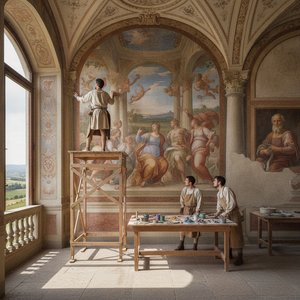
Explore the profound history and technical mastery of fresco painting. From ancient Roman murals to Michelangelo's Sistine Chapel, discover the enduring chemistry and artistry behind this timeless wall painting technique used by the world's greatest masters.


Hold deg oppdatert med de siste kunstnyhetene, eksklusive tilbud og dekorasjonsideer.
Fortell oss om prosjektet ditt, så vil våre kunsteksperter gi deg 3 personlige kunstforslag.
Vi velger ut 3 alternativer kun for deg – helt gratis!


 Forhåndsvisning
 Send
Send Del med andre
 Vis detaljer

 Last ned bildet
 Liknende objekter
 Røntgenundersøkelse
 Lysbildefremvisning


 Vis hele teksten







 Glassalternativet er kun tilgjengelig i størrelser under 110 cm


