x

 Baroque
 25.0 x 34.0 cm
Kjøp et høyoppløselig, forbedret digitalt bilde som er langt bedre enn forhåndsvisningen på nettet.
Hver fil er omhyggelig klargjort av våre egne spesialister ved hjelp av avanserte verktøy og profesjonell manuell retusjering. Vi sørger for at hvert bilde har eksepsjonell klarhet, presis fargegjengivelse og fine detaljer.
Den endelige filen leveres via e-post innen 72 timer, optimalisert for umiddelbar bruk i profesjonelle, redaksjonelle og trykte miljøer. Dette er den samme kvaliteten som benyttes av ledende designstudioer, utgivere og gallerier.
Last ned en høyoppløselig fil for personlig bruk, utskrift og kreative prosjekter. ( Kjøp trykk Kjøp håndlaget maleri)
Når du velger Most-Famous-Paintings.com, får du ikke bare et bilde – du mottar et profesjonelt forbedret digitalt kunstverk, skapt med presisjon og med en garantert tilfredshetsgaranti. Her er alt som automatisk følger med din bestilling:

Din høyoppløselige digitale bildefil sendes til din e-post innen 72 timer etter bestilling – klar til umiddelbar bruk.

Ditt kunstverk blir profesjonelt optimalisert ved hjelp av avanserte AI-verktøy og manuell redigering, noe som sikrer maksimal detaljrikdom, klarhet og fargegjengivelse.

Har du ved et uhell slettet eller mistet filen din? Ingen bekymring – vi sender den på nytt når som helst, helt gratis.

Nyt ditt kunstverk umiddelbart uten toll, avgifter eller leveringskostnader – digitale nedlastinger er alltid avgiftsfrie.

Vi sikrer at ditt digitale bilde gjenspeiler de originale fargene så nøyaktig som mulig ved hjelp av profesjonelle verktøy og fargehåndtering.

Hvis du ikke er fornøyd med ditt digitale bilde, vil vi revidere det eller refundere 100% innen 60 dager – uten spørsmål.

Ikke fornøyd? Få full refusjon innen 60 dager etter at du har mottatt din digitale fil – uten spørsmål.

Kjøp 3 bilder, spar 10% - Kjøp 5, spar 15% - Kjøp 10+, spar 20%. Ideelt for kreative prosjekter, gallerier og byråer.

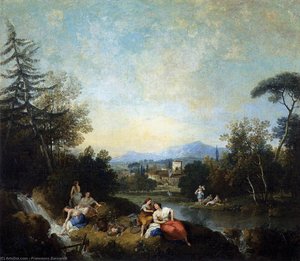
Michele Pagano (1697-1732) emerges from the vibrant, bustling artistic landscape of late Baroque Naples as a captivating figure – a landscape painter who skillfully blended classical influences with a distinctly local sensibility. His life, tragically cut short in his mid-thirties, nonetheless left behind a body of work that reveals a keen eye for detail, an understanding of atmospheric perspective, and a profound connection to the natural world. Pagano’s story is intertwined with the artistic lineage of Naples, beginning with his training under the esteemed Raimondo di Dominici, known as “il Maltese,” and later benefiting from the tutelage of Bernardo de Dominici – both masters who shaped the visual vocabulary of the city.
Di Dominici's influence instilled in Pagano a foundational knowledge of classical composition and technique. However, it was his subsequent association with Bernardo de Dominici that proved pivotal, exposing him to the work of Franz Joachim Beich, a German landscape painter whose style emphasized dramatic lighting and atmospheric effects. This exposure significantly broadened Pagano’s artistic horizons, equipping him with the tools necessary to develop his own unique voice. He quickly distinguished himself as a “vedutista,” a term denoting a landscape artist specializing in depictions of urban scenes and topographical views – a genre particularly favored in Naples during this period.
Pagano’s most celebrated works are his “vedute” – meticulously rendered depictions of Naples and its surrounding environs. These paintings aren't merely topographical records; they are imbued with a palpable sense of atmosphere, capturing the city’s energy, its light, and its inherent drama. He skillfully employed techniques such as aerial perspective—reducing detail and lightening colors in the distance—to create an illusion of depth and space. His compositions often feature grand vistas of the Bay of Naples, framed by imposing castles and churches, interwoven with bustling streets teeming with life.
Notable amongst his works are depictions of the Castel Nuovo (New Castle), the Duomo (Cathedral), and various views along the waterfront. These scenes aren’t idealized representations; Pagano doesn't shy away from portraying the city’s imperfections – its crumbling walls, its crowded streets, and its inherent chaos. Instead, he presents a nuanced portrait of Naples—a city of contrasts, beauty, and resilience. His ability to capture the interplay of light and shadow, particularly during the golden hours of dawn and dusk, is truly remarkable.
Despite his burgeoning success, Pagano’s life was tragically cut short at the age of thirty-five. Contemporary accounts suggest that he succumbed to complications arising from a treatment for venereal disease – a common affliction during the era, often involving the use of mercury. This grim detail adds a poignant layer to his biography, underscoring the precariousness of life in 18th-century Naples and the toll it could take on even the most talented artists.
The circumstances surrounding his death have fueled speculation about a possible familial connection to Francesco Pagano, a prominent painter from the 15th century. While this remains unconfirmed, it highlights the enduring legacy of the family name within the Neapolitan artistic community. His premature demise robbed the art world of a promising talent and left behind a relatively small but significant body of work that continues to fascinate and inspire.
Michele Pagano’s contribution to the development of Neapolitan landscape painting is undeniable. He stands as a key figure in the “veduta” genre, demonstrating a masterful command of technique and an exceptional ability to capture the essence of his subject matter. His work influenced subsequent generations of artists who followed in his footsteps, shaping the visual identity of Naples and contributing to the city’s rich artistic heritage.
Today, Pagano's paintings are housed in prominent museums throughout Italy, including the San Michele Museum in Bologna and Lucca, offering visitors a glimpse into the world of a talented artist whose life was tragically brief but whose legacy endures through his captivating landscapes. His art serves as a testament to the enduring power of observation, skill, and artistic vision.

1697 - 1732


Hold deg oppdatert med de siste kunstnyhetene, eksklusive tilbud og dekorasjonsideer.
Fortell oss om prosjektet ditt, så vil våre kunsteksperter gi deg 3 personlige kunstforslag.
Vi velger ut 3 alternativer kun for deg – helt gratis!


 Forhåndsvisning
 Send
Send Del med andre
 Vis detaljer

 Last ned bildet
 Liknende objekter
 Røntgenundersøkelse
 Lysbildefremvisning
 Vis hele teksten