x

Kjøp et høyoppløselig, forbedret digitalt bilde som er langt bedre enn forhåndsvisningen på nettet.
Hver fil er omhyggelig klargjort av våre egne spesialister ved hjelp av avanserte verktøy og profesjonell manuell retusjering. Vi sørger for at hvert bilde har eksepsjonell klarhet, presis fargegjengivelse og fine detaljer.
Den endelige filen leveres via e-post innen 72 timer, optimalisert for umiddelbar bruk i profesjonelle, redaksjonelle og trykte miljøer. Dette er den samme kvaliteten som benyttes av ledende designstudioer, utgivere og gallerier.
Last ned en høyoppløselig fil for personlig bruk, utskrift og kreative prosjekter. ( Bytt til trykk Bytt til håndmalt maleri)
Når du velger Most-Famous-Paintings.com, får du ikke bare et bilde – du mottar et profesjonelt forbedret digitalt kunstverk, skapt med presisjon og med en garantert tilfredshetsgaranti. Her er alt som automatisk følger med din bestilling:

Din høyoppløselige digitale bildefil sendes til din e-post innen 72 timer etter bestilling – klar til umiddelbar bruk.

Ditt kunstverk blir profesjonelt optimalisert ved hjelp av avanserte AI-verktøy og manuell redigering, noe som sikrer maksimal detaljrikdom, klarhet og fargegjengivelse.

Har du ved et uhell slettet eller mistet filen din? Ingen bekymring – vi sender den på nytt når som helst, helt gratis.

Nyt ditt kunstverk umiddelbart uten toll, avgifter eller leveringskostnader – digitale nedlastinger er alltid avgiftsfrie.

Vi sikrer at ditt digitale bilde gjenspeiler de originale fargene så nøyaktig som mulig ved hjelp av profesjonelle verktøy og fargehåndtering.

Hvis du ikke er fornøyd med ditt digitale bilde, vil vi revidere det eller refundere 100% innen 60 dager – uten spørsmål.

Ikke fornøyd? Få full refusjon innen 60 dager etter at du har mottatt din digitale fil – uten spørsmål.

Kjøp 3 bilder, spar 10% - Kjøp 5, spar 15% - Kjøp 10+, spar 20%. Ideelt for kreative prosjekter, gallerier og byråer.
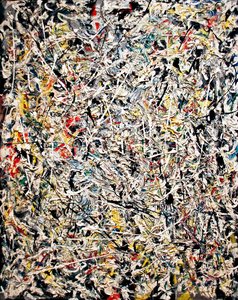
Jackson Pollock's “Blue (Moby Dick),” painted in 1943, isn’t merely a canvas splashed with color; it’s an immersive experience, a visual embodiment of the anxieties and primal forces that fueled Herman Melville’s epic tale. This work, residing within the Ohara Museum of Art in Kurashiki, Japan, stands as a pivotal moment in the trajectory of Abstract Expressionism, revealing Pollock's unique approach to translating complex emotions onto the canvas. It’s a piece that invites prolonged contemplation, rewarding viewers with layers of meaning and a profound sense of unease – mirroring, perhaps, the relentless pursuit of the unattainable.
Initially conceived as “Moby Dick,” the painting quickly underwent a transformation, reflecting Pollock's evolving artistic process and his engagement with psychological theories. The early iteration, a more explicitly figurative work, was deemed too constrained by conventional representation. Pollock, influenced by Jungian psychology and seeking to express raw emotion rather than depict concrete forms, abandoned this initial approach, opting instead for an all-over composition that prioritized the act of painting itself. This shift marked a crucial step toward his signature “drip” technique – a method where paint was poured, dripped, and flung onto the canvas from above, creating a dynamic web of color and texture.
The dominant hue is, unsurprisingly, blue—a deep, resonant shade that immediately establishes a mood of mystery and depth. However, this isn’t a simple monochromatic statement. Pollock masterfully employs a range of complementary colors – vibrant yellows, stark whites, and touches of black and orange – to create a swirling, almost turbulent effect. These contrasting hues aren't juxtaposed in a static manner; instead, they bleed into one another, suggesting movement, chaos, and the relentless power of nature. The composition itself is deliberately ambiguous, featuring amorphous shapes that evoke marine life—fish, whales, perhaps even the ominous form of Moby Dick himself—suspended within a dynamic field of color.
Pollock’s technique is central to the painting's impact. He utilized a mixed medium of gouache and ink on composition board, allowing for both precision and spontaneity. The “drip” method, perfected over years of experimentation, allowed him to bypass traditional brushstrokes, creating an immediate connection between his body and the artwork. The resulting surface is not smooth or polished; it’s textured, layered, and imbued with a palpable energy—a testament to the physicality of the act of painting.
While Pollock himself remained notoriously reticent about interpreting his work, scholars have identified several symbolic connections between “Blue (Moby Dick)” and Melville’s novel. The recurring motif of the table—a subtle yet persistent element within the composition—can be interpreted as a representation of the human psyche, a space where conflicting forces collide. The figures that populate the painting are not clearly defined; they exist in a state of flux, mirroring the instability and uncertainty inherent in the pursuit of knowledge and understanding – a key theme in *Moby Dick*.
Furthermore, the painting’s intense emotionality—the sense of dread, obsession, and ultimately, futility—resonates with the novel's exploration of human ambition and the limitations of reason. The whale itself, a symbol of both power and destruction, looms large in the subconscious of the viewer, prompting questions about humanity’s relationship to nature and its own destructive tendencies. It is believed that Pollock was influenced by Melville’s work, perhaps even drawing parallels between his own struggles with alcoholism and Ahab's relentless pursuit.
“Blue (Moby Dick)” stands as a powerful example of Abstract Expressionism’s ability to evoke profound emotional responses. Most-Famous-Paintings offers meticulously hand-painted reproductions that capture the essence of this iconic work, allowing you to experience its depth and complexity firsthand. These reproductions faithfully recreate Pollock's dynamic technique and vibrant color palette, bringing the painting’s raw energy into your space. Whether displayed in a contemporary setting or as a thoughtful addition to a classic interior, a reproduction of “Blue (Moby Dick)” serves as a constant reminder of the power of art to challenge our perceptions and connect us to the deepest recesses of human emotion.
Explore Most-Famous-Paintings’s collection of Jackson Pollock reproductions today and discover how you can bring this masterpiece into your world. View “Blue (Moby Dick)” reproduction here


1912 - 1956 , USA


Hold deg oppdatert med de siste kunstnyhetene, eksklusive tilbud og dekorasjonsideer.
Fortell oss om prosjektet ditt, så vil våre kunsteksperter gi deg 3 personlige kunstforslag.
Vi velger ut 3 alternativer kun for deg – helt gratis!


 Forhåndsvisning
 Send
Send Del med andre
 Vis detaljer

 Last ned bildet
 Liknende objekter
 Røntgenundersøkelse
 Lysbildefremvisning

 Vis hele teksten