x

 87.0 x 58.0 cm
 MO Museum / MO muziejus
Giclée- eller lerretsprint av museumskvalitet med rask produksjon og fleksible valgmuligheter for etterbehandling. ( Kjøp håndlaget maleri Kjøp bilde)
Velg mellom våre forhåndsdefinerte størrelser som bevarer kunstverkets opprinnelige proporsjoner.

Du kan oppgi egne mål for å tilpasse en spesifikk ramme eller et bestemt område. Dersom den valgte størrelsen ikke samsvarer med det originale bildets proporsjoner, vil vi enten beskjære kunstverket eller utvide bildet med en speilet eller ensfarget kant. En digital mockup vil bli sendt til din godkjenning før produksjonen starter.
Vennligst merk at forhåndsvisningen på skjermen ikke gjenspeiler den faktiske beskjæringen eller utvidelsen. Kun mockuppen vil vise den endelige komposisjonen nøyaktig.
Selv om tilpassede størrelser er tilgjengelige, anbefaler vi å velge et mål fra den forhåndsdefinerte listen for å bevare de originale proporsjonene.
Verdensomspennende levering () på 2 uker i stedet for standard 4/5 uker. (18 August)


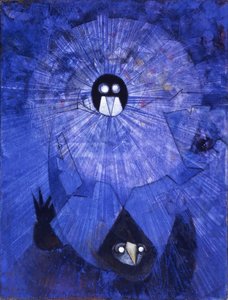
War I
Størrelse på reproduksjon

Barnett Newman (1905-1970) remains one of the most enigmatic and profoundly influential figures in 20th-century art. More than simply a painter, he was an architect of vast, silent spaces—a space that invited contemplation and demanded a surrender to its immensity. His work, characterized by monumental fields of color punctuated by thin, vertical “zips,” transcends mere representation, delving into the realm of pure feeling and spiritual experience. Newman’s journey from philosophical pursuits to becoming a leading voice in abstract expressionism is a testament to his unwavering commitment to exploring the fundamental nature of art and its capacity to connect us with something beyond the visible world.
Born in New York City, the son of Polish immigrants, Barnett Newman's early life was marked by a quiet intensity. He initially pursued philosophy at City College of New York, later working as a clerk for his father’s clothing manufacturing business. It wasn’t until the 1930s that he began to seriously devote himself to art, abandoning a career in law and teaching to fully embrace his artistic calling. This shift was profoundly influenced by the writings of Alon Bement, a teacher at Teachers College, Columbia University, who introduced Newman to the principles of Dow’s approach – an emphasis on intuitive design and personal expression rather than strict adherence to academic realism. Newman's early work, though initially characterized by elements of Expressionism, was ultimately dismantled, reflecting his desire to forge a completely new artistic language.
Newman’s breakthrough came in the late 1940s with the development of his signature style – the *Onement* series. These monumental paintings, often spanning several feet in width, are dominated by vast fields of color, typically reds, yellows, and pinks. Crucially, these colors aren't blended or mixed; they exist as pure, unmodulated tones. The “zips,” thin vertical lines that bisect the color fields, are not merely decorative elements but rather structural components—they define the spatial relationships within the painting and create a sense of depth and distance. Newman himself described the zips as "the edges of the world," suggesting they represent boundaries between the viewer’s consciousness and the infinite expanse beyond. Influences on this style included Paul Cézanne's emphasis on structure and color, and the pointillist techniques of Henri Matisse and Signac, which he adapted to create his own unique visual vocabulary.
Newman’s work is deeply rooted in a profound sense of place – specifically, the stark, desolate landscapes of New Mexico, where he spent much of his later life. He sought to capture not just the physical appearance of these environments but also their underlying spiritual essence. As Newman himself stated, “We are in the process of making the world, to a certain extent, in our own image.” This sentiment reflects his belief that art could serve as a vehicle for accessing and expressing fundamental human experiences—a yearning for connection, transcendence, and a sense of belonging within something larger than oneself. The vastness of the New Mexican desert, with its seemingly endless horizons and profound silence, provided an ideal setting for Newman’s exploration of these themes.
Newman's approach to color was equally significant. He rejected traditional notions of representation, opting instead to use color as a primary means of conveying emotion and spiritual experience. He famously stated that he “didn’t want to paint what I saw, but what I felt.” This commitment to subjective expression led him to develop a highly disciplined technique—he would often work directly on the canvas with large brushes, applying pure pigments without mixing or blending them. The resulting fields of color were not merely decorative; they possessed an almost palpable intensity, evoking feelings of awe, mystery, and profound stillness.
Newman’s most celebrated works include the *Onement* series (1948-1968), which established his signature style. Other significant paintings from this period include *Vir Heroicus Sublimis* (1950-1957), a monumental canvas that embodies Newman's exploration of spiritual themes, and numerous works in the *Color Field* series. His work was initially met with skepticism by some critics, who struggled to understand its abstract nature and perceived it as lacking narrative or representational content. However, over time, Newman’s paintings gained increasing recognition for their profound emotional impact and innovative use of color and form.
Newman's influence extends far beyond the realm of painting. He collaborated with architects and designers, exploring the potential of his visual language to inform spatial design. His work has been exhibited at major museums around the world, including the Museum of Modern Art in New York, the Tate Gallery in London, and the Centre Pompidou in Paris. Barnett Newman died in 1970, leaving behind a legacy as one of the most important and enduring figures in American art.
Barnett Newman's work continues to resonate with viewers today because it offers something profoundly rare in contemporary art—a space for quiet contemplation. His paintings are not meant to be “read” or interpreted in a literal sense; rather, they invite the viewer to surrender to their immensity and allow themselves to experience a sense of awe and wonder. Newman’s legacy lies not just in his innovative use of color and form but also in his ability to create works that transcend the boundaries of representation and tap into something deeper—the fundamental human need for connection, meaning, and transcendence.

1905 - 1979 , United States of America


Hold deg oppdatert med de siste kunstnyhetene, eksklusive tilbud og dekorasjonsideer.
Fortell oss om prosjektet ditt, så vil våre kunsteksperter gi deg 3 personlige kunstforslag.
Vi velger ut 3 alternativer kun for deg – helt gratis!


 Forhåndsvisning
 Send
Send Del med andre
 Vis detaljer

 Last ned bildet
 Liknende objekter
 Røntgenundersøkelse
 Lysbildefremvisning
 Vis hele teksten




































 Glassalternativet er kun tilgjengelig i størrelser under 110 cm