Lista życzeń Koszyk Cart
Zamów wydruk Zamów wydrukKup cyfrowy obraz Kup cyfrowy obraz UdostępnijUdostępnij
Szczegóły dziełaSzczegóły dzieła Dodaj do ulubionych Dodaj do ulubionych PobierzPobierz Podobne obiektyPodobne obiekty RTGRTG Pokaz slajdówPokaz slajdów

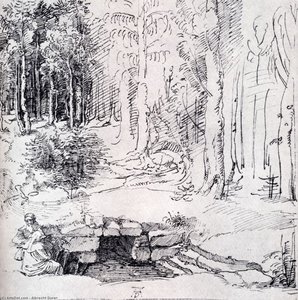
Perspectivist study

Albrecht Dürer’s Perspectivist Study showcases meticulous Renaissance draftsmanship with a detailed architectural archway and geometric constructions. Explore this scientific exploration of linear perspective, a captivating piece perfect for art lovers and collectors.

Albrecht Dürer – niemiecki mistrz renesansu! Jego grafiki, portrety i pejzaże fascynują od wieków. Odkryj świat jego arcydzieł i genialnej techniki!

Ręcznie malowana reprodukcja olejowa

Ręcznie malowany olej na płótnie w Twoim wymiarze i ramie, tworzony na zamówienie przez naszych artystów.

Standard
custom
CM
INCH

Wybierz spośród naszych predefiniowanych rozmiarów, które zachowują oryginalne proporcje dzieła sztuki.

szerokość
wysokość

Możesz wprowadzić własne wymiary, aby dopasować obraz do konkretnej ramy lub przestrzeni. Jeśli wybrany rozmiar nie będzie odpowiadał proporcjom oryginału, przytniecie dzieło sztuki lub rozszerzymy je o dodatkowe elementy, ręcznie domalowane przez artystę. Przed rozpoczęciem produkcji wyślemy projekt cyfrowy do Twojej akceptacji.
Należy pamiętać, że podgląd na ekranie nie odzwierciedla rzeczywistego przycinania ani rozszerzania obrazu. Tylko projekt dokładnie pokaże ostateczną kompozycję.
Choć oferujemy możliwość zamówienia niestandardowych rozmiarów, zalecamy wybór wymiaru z gotowej listy, aby zachować oryginalne proporcje dzieła.

Przykłady możliwych zmian: Zamień twarz na zdjęcie klienta; Dodaj zwierzę domowe (np. zamień kota na psa); Ukryj wiadomość w tle; Zmień krajobraz lub elementy tła.
Po złożeniu zamówienia zespół Most-Famous-Paintings.com skontaktuje się z klientem drogą mailową w celu uzyskania instrukcji i prześle wizualizację projektu

Dostawa na całym świecie () w ciągu 3/4 tygodni zamiast standardowych 5 tygodni. (21 Lipiec). Bez kompromisów w kwestii jakości.

why_choose_icon
Bezpłatna ekspresowa wysyłka na cały świat
why_choose_icon
Wysokiej jakości płótno lniane
why_choose_icon
Pełne ubezpieczenie przesyłki
why_choose_icon
Gwarancja zwrotu należności celnych
why_choose_icon
Gwarancja pełnego zgodności kolorystycznej
why_choose_icon
Polityka 60-dniowego zwrotu (tylko w przypadku wad)
why_choose_icon
Gwarancja 100% zwrotu pieniędzy
why_choose_icon
Zniżka przy większych zamówieniach

Suma całkowita

-

reproduction

Perspectivist study

Technika reprodukcji

Wymiary reprodukcji

-

Cena całkowita

-

Szybkie fakty

  • Location: Private Collection
  • Notable elements: Linear perspective
  • Artist: Albrecht Dürer
  • Title: Perspectivist Study
  • Movement: Renaissance
  • Artistic style: Draftsmanship, Precise
  • Year: 1520s

Opis dzieła

Perspectivist Study: A Window into Dürer's Mind

Albrecht Dürer’s “Perspectivist Study” is not merely a drawing; it’s a meticulously crafted meditation on the very foundations of visual representation, a testament to the Renaissance artist’s relentless pursuit of understanding and replicating the world through rational principles. Executed around 1524-1528, this monochromatic masterpiece offers a rare glimpse into Dürer's creative process – a preparatory study brimming with intellectual rigor and technical brilliance. The artwork depicts an architectural element—an archway integrated within a building facade—a subject frequently explored by the artist, showcasing his deep engagement with linear perspective and its application to represent three-dimensional space on a two-dimensional surface.

Composition and Technique: Mastering Illusion

  • Geometric Precision: The composition is dominated by a grid system, meticulously constructed using converging lines that lead the eye towards vanishing points. This deliberate arrangement underscores Dürer’s systematic approach to perspective, reflecting his belief in mathematics as a key tool for artistic creation.
  • Hatching and Cross-Hatching: The artwork's tonal range is achieved through masterful hatching and cross-hatching techniques, applied with remarkable control. These linear marks create a rich sense of texture, particularly evident in the rendering of the stonework, suggesting both its physical roughness and the illusion of depth.
  • Pen and Ink Mastery: Executed with precise pen or pencil on paper, the drawing demonstrates Dürer’s unparalleled skill in line work. The varying line densities contribute to a dynamic interplay between light and shadow, further enhancing the sense of spatial recession.

Renaissance Ideals and Symbolism

“Perspectivist Study” firmly anchors itself within the context of the German Renaissance, a period marked by an intense interest in classical antiquity and a burgeoning humanist philosophy. Dürer’s work reflects this intellectual fervor, mirroring the Renaissance emphasis on observation, measurement, and rational analysis – qualities that underpinned advancements across numerous fields, from architecture to astronomy. The archway itself, a recurring motif in Dürer's oeuvre, can be interpreted as a symbol of stability, permanence, and human aspiration—structures designed to endure both physically and conceptually. The focus on accurate representation aligns with the Renaissance ideal of *imitatio naturae* – imitation of nature – but through a deliberate, intellectual process rather than mere copying.

A Study in Depth and Perspective

Dürer’s profound understanding of linear perspective is immediately apparent. The artwork employs the principles of aerial or atmospheric perspective—objects receding into the distance appearing smaller and their parallel lines converging at vanishing points—to create a convincing illusion of depth. Overlapping forms further contribute to this spatial layering, reinforcing the sense that the viewer is observing a real architectural scene. This meticulous attention to detail speaks not only to Dürer’s technical skill but also to his intellectual curiosity and desire to unravel the secrets of visual perception.

Collecting a Masterpiece: Reproduction Options

Most-Famous-Paintings offers meticulously crafted hand-painted reproductions of “Perspectivist Study,” allowing you to bring this iconic work into your home or office. Our skilled artisans employ techniques mirroring Dürer’s original process, ensuring an authentic representation that captures the essence of this remarkable drawing. Choose from a range of sizes and framing options to perfectly complement your space. Own a piece of art history – a tangible connection to one of the greatest minds of the Renaissance.


Biografia artysty

A Life Forged in Nuremberg: The Early Years and Apprenticeship

Albrecht Dürer, a name synonymous with the German Renaissance, emerged from the bustling artisan city of Nuremberg in 1471. His father, Albrecht Dürer the Elder, was a successful goldsmith who had immigrated from Hungary, bringing with him a lineage steeped in craftsmanship. It was within this environment—the scent of metal and the meticulous precision of handiwork—that young Albrecht’s artistic inclinations first took root. Though his father envisioned a similar path for him, apprenticing him initially in the family trade, it soon became undeniable that Albrecht possessed an exceptional gift for drawing. At thirteen, he transitioned to the workshop of Michael Wolgemut, Nuremberg's leading artist at the time. This was no mere technical training; it was immersion into a world of illuminated manuscripts, painted panels, and—crucially—the burgeoning art of woodcut illustration. The sheer volume of work produced by Wolgemut’s workshop, including the extensive illustrations for the *Nuremberg Chronicle*, provided Dürer with an unparalleled foundation in design, composition, and the mechanics of image-making. A remarkable silverpoint self-portrait from 1484, created when he was barely a teenager, stands as astonishing evidence of his precocious talent—a testament to a burgeoning artistic identity already taking shape. This early work demonstrated a keen eye for detail, an understanding of perspective, and a nascent ability to capture the likeness of individuals with remarkable accuracy.

The Italian Influence and Artistic Maturation

Dürer’s ambition extended far beyond the confines of Nuremberg. Driven by an insatiable curiosity and a desire to master the art of painting, he embarked on his first journey to Italy in 1494. This was not simply a sightseeing trip; it was a pilgrimage to the heart of the Renaissance. He encountered the works of masters like Raphael, Giovanni Bellini, and Leonardo da Vinci—artists who were redefining the possibilities of form, perspective, and human expression. The impact of this exposure was profound. Dürer absorbed the classical motifs, harmonious compositions, and subtle sfumato techniques that characterized Italian art, yet he never abandoned his Northern European sensibility for meticulous detail and symbolic depth. He studied the grandeur of Rome, marveling at ancient ruins and absorbing the legacy of antiquity. This journey ignited a desire to integrate classical ideals into his own artistic practice, leading him to incorporate elements of Greek and Roman mythology and philosophy into his later works. A second sojourn to Italy between 1505 and 1507 further solidified these influences, allowing him to study ancient Roman ruins and refine his understanding of anatomy and proportion. This synthesis of Northern precision and Italian grace became the hallmark of Dürer’s unique artistic style.

Mastering the Mediums: Painting, Engraving, and Woodcut

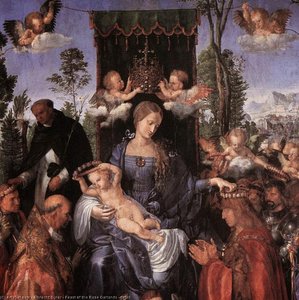
Dürer was a master of multiple mediums, each offering him distinct avenues for creative expression. His paintings, though fewer in number than his prints, demonstrate a remarkable command of oil paint and an ability to capture both physical likeness and psychological depth. Works like the *Feast of the Rose Garlands* (1507) reveal a vibrant palette influenced by Venetian colorism—bold hues and shimmering effects that create a sense of opulence and celebration. However, it was in the realm of printmaking—particularly engraving and woodcut—that Dürer truly revolutionized artistic practice. He elevated these techniques from mere reproductive methods to independent art forms, capable of conveying complex narratives and profound emotions. The *Apocalypse* series (1498), a collection of fourteen woodcuts illustrating the Book of Revelation, showcased his mastery of this medium despite its inherent limitations—the grainy texture of the woodcut demanded careful planning and execution. Later engravings like *Melencolia I* (1514) and *Saint Jerome in His Study* (1514) are testaments to his unparalleled skill—intricate compositions filled with symbolic meaning and executed with breathtaking precision. He didn’t just depict reality; he imbued it with layers of intellectual and spiritual significance, often incorporating complex allegories and moral lessons into his prints.

A Theorist and Innovator: The Legacy of Albrecht Dürer

Dürer was not merely an artist; he was a scholar, a theorist, and an innovator who sought to understand the underlying principles governing artistic creation. He believed in the mathematical foundations of art and dedicated himself to establishing a scientific approach to representation. His treatises on geometry, proportion, and human anatomy—most notably *Four Books of Human Proportion* (1528)—were groundbreaking for their time, demonstrating his commitment to rigorous observation and rational analysis. These writings were not simply academic exercises; they were intended to elevate the status of artists from mere craftsmen to intellectual practitioners. Dürer’s work on perspective, in particular, laid the groundwork for future generations of artists and architects. He meticulously documented his experiments with linear perspective, developing a system that allowed him to create realistic depictions of three-dimensional space on a two-dimensional surface. His theoretical writings were accompanied by numerous drawings and engravings that illustrated his concepts—a testament to his belief in the importance of visual demonstration. Dürer’s legacy extends far beyond his individual artworks. He bridged the gap between Northern European traditions and Italian Renaissance ideals, introducing classical motifs into Northern art while maintaining its distinctive character. His theoretical contributions helped establish a new framework for artistic practice, inspiring generations of artists with his technical skill, innovative spirit, and profound vision. He remains, to this day, one of the most important figures in the history of Western art.

Influences and Enduring Impact

  • Michael Wolgemut: Dürer’s initial mentor, providing foundational skills in drawing, painting, and woodcut techniques.
  • Leonardo da Vinci: Inspired Dürer's exploration of anatomy, perspective, and sfumato—the subtle blending of tones.
  • Raphael: Influenced Dürer’s compositional harmony and idealized forms.
  • Giovanni Bellini: Contributed to Dürer's understanding of color and Venetian painting traditions.

Dürer’s influence reverberates through centuries of art history. His meticulous realism, his innovative use of printmaking, and his theoretical writings continue to inspire artists and scholars alike. He demonstrated that art could be both technically masterful and intellectually rigorous—a legacy that continues to shape the artistic landscape today. His work stands as a testament to the power of observation, the pursuit of knowledge, and the enduring human desire to create beauty and meaning.

Albrecht Dürer

Albrecht Dürer

1471 - 1528 , Niemcy

Kluczowe informacje

  • Artistic Movement Or Style: Renesans północny
  • Artists Or Movements Influenced By This Artist:
    • Renesans włoski
    • Gothic
  • Artists Who Influenced This Artist:
    • Leonardo da Vinci
    • Michał Wolgemut
    • Rafael
  • Date Of Birth: 21 maja 1471
  • Date Of Death: 6 kwietnia 1528
  • Full Name: Albrecht Dürer
  • Nationality: Niemiec
  • Notable Artworks:
    • Apokalipsa
    • Melencolia I
    • Jeremia w jego studiu
  • Place Of Birth: Nuremberg, Niemcy
Odkryj dzieła sztuki uporządkowane według tematów, stylów i cech charakterystycznych.