x


 Zamów reprodukcję Kup cyfrowy obraz
 Udostępnij
 Szczegóły dzieła
 Dodaj do ulubionych
 Pobierz
 Podobne obiekty
 RTG
RTG
 Pokaz slajdów
Druk giclée lub płótno o jakości muzealnej z szybką realizacją i szerokim wyborem opcji wykończenia.





























Wybierz spośród naszych predefiniowanych rozmiarów, które zachowują oryginalne proporcje dzieła sztuki.

Możesz wprowadzić własne wymiary, aby dopasować dzieło do konkretnej ramy lub przestrzeni. Jeśli wybrany rozmiar nie będzie odpowiadał proporcjom oryginalnego obrazu, przytniecie dzieło lub rozszerzymy obraz za pomocą odbicia lustrzanego lub jednolitego wypełnienia krawędzi. Przed rozpoczęciem produkcji prześlemy cyfrową wizualizację do Twojej akceptacji.
Prosimy pamiętać, że podgląd na ekranie nie odzwierciedla faktycznego przycinania ani rozszerzania. Tylko wizualizacja dokładnie pokaże końcową kompozycję.
Mimo dostępności niestandardowych rozmiarów, zalecamy wybór wymiaru z listy zdefiniowanej, aby zachować oryginalne proporcje.
Dostawa na cały świat () w ciągu 2 tygodni zamiast standardowych 4/5 tygodni. (22 Lipiec)


L'Immaculée Conception
Wymiary reprodukcji
Anton Raphael Mengs' "L’Immaculée Conception" is not merely a depiction of a religious subject; it’s a carefully constructed tableau of serenity, embodying the ideals of Neoclassical art and reflecting the intellectual currents of 18th-century Europe. Painted between 1760 and 1770, this work transcends its devotional origins to offer a profound meditation on purity, humility, and divine grace – qualities that continue to resonate with viewers today. The painting’s quiet power stems from Mengs' masterful command of light, composition, and the subtle language of gesture, all hallmarks of his distinctive artistic vision.
Mengs, a pivotal figure bridging the Baroque and Neoclassical eras, was deeply influenced by the rediscovery of classical antiquity. He sought to revive the principles of balance, clarity, and idealized beauty that characterized ancient Greek and Roman art. This pursuit is vividly evident in “L’Immaculée Conception,” where the subject—likely representing Mary, the Mother of Jesus—is presented with an almost sculptural elegance. Her pose, reminiscent of classical statues, exudes a sense of dignified composure, while her gaze, direct yet gentle, invites contemplation and connection.
The painting’s color palette is deliberately restrained, dominated by soft, muted tones of beige, cream, and pale pink. These subtle hues create an atmosphere of tranquility and reverence, drawing the viewer's eye to the central figure without overwhelming her presence. Mengs employs a delicate layering technique—a hallmark of Neoclassical painting—to achieve nuanced tonal variations and smooth transitions between colors. This meticulous approach results in a surface that appears remarkably luminous and refined, as if illuminated from within.
Light plays a crucial role in shaping the artwork’s mood and highlighting key elements. The lighting is soft and diffused, casting a gentle glow around the figure's face and upper body while leaving the background slightly darker. This strategic use of light creates depth and dimension, emphasizing the subject’s serenity and drawing attention to her serene expression. Notice how the light subtly models the contours of her face, revealing the delicate structure of her features and conveying an impression of ethereal beauty.
The composition of “L’Immaculée Conception” is meticulously balanced, reflecting Mengs' deep understanding of classical principles. The subject is positioned centrally within the frame, creating a sense of stability and formality. Her crossed arms, a gesture of humility and devotion, are perfectly counterbalanced by her serene expression and direct gaze. This harmonious arrangement contributes to the painting’s overall feeling of composure and grace.
Mengs skillfully utilizes lines to define the figure's form and drapery. Soft, flowing lines delineate the contours of her face, hair, and garments, creating a sense of fluidity and movement. These lines are not harsh or angular but rather gentle and curved, contributing to the painting’s overall feeling of elegance and refinement. The circular forms present in her face and the folds of her clothing further enhance this impression of harmony and balance.
“L’Immaculée Conception” is deeply rooted in Christian iconography, representing Mary as conceived without original sin—a doctrine central to Catholic theology. The painting's symbolism extends beyond its religious subject matter, reflecting the broader intellectual currents of the Enlightenment. Mengs’ revival of classical ideals—emphasizing reason, order, and beauty—mirrors the philosophical movement that sought to emulate the achievements of ancient Greece and Rome.
The work was created during a period of significant artistic transition, as Baroque grandeur gave way to Neoclassical restraint. Mengs himself played a crucial role in this shift, advocating for a return to classical forms and principles. His “L’Immaculée Conception” exemplifies this transformation, demonstrating his ability to synthesize the traditions of the past with the ideals of the present.
“L’Immaculée Conception” remains a testament to Anton Raphael Mengs' artistic skill and intellectual vision. Its serene beauty, balanced composition, and subtle symbolism continue to captivate viewers centuries after its creation. Whether admired for its technical mastery or its profound spiritual resonance, this painting stands as a timeless masterpiece of Neoclassical art—a poignant reminder of the enduring power of grace, humility, and divine inspiration.

Anton Raphael Mengs (1728–1779) stands as a pivotal figure in the transition from Baroque to Neoclassical art, embodying the spirit of intellectual curiosity and artistic innovation that characterized the Enlightenment. Born in Ústí nad Labem, Bohemia – now part of the Czech Republic – his artistic journey was profoundly shaped by both his lineage and the burgeoning ideals of reason and order prevalent during his time.
His father, Ismael Mengs, a Danish painter who found patronage at the Dresden court, recognized young Anton’s exceptional talent early on. This recognition led to a decisive relocation in 1741: a move to Rome, where the budding artist was immersed in the study of ancient masterpieces and the works of Renaissance masters like Raphael. It was this exposure that indelibly imprinted his aesthetic sensibilities, instilling within him a deep reverence for classical form, clarity, and composition – qualities that would become hallmarks of his mature style.
From Dresden to Madrid: A Career Across Courts
Mengs’s artistic evolution wasn't solely driven by visual study; it was deeply intertwined with intellectual discourse. A crucial turning point came with his close friendship and collaboration with Johann Joachim Winckelmann, the pioneering art historian whose writings would become foundational to the Neoclassical movement. Winckelmann championed a return to the perceived purity and simplicity of ancient Greek art, advocating for an aesthetic based on reason, order, and idealized forms.
Mengs wasn’t merely illustrating Winckelmann's theories; he was actively engaged in shaping them, translating abstract concepts into tangible artistic expressions. Together, they believed that true beauty resided not in superficial ornamentation but in the underlying principles of harmony and proportion found in classical antiquity. This partnership extended beyond theoretical discussions; it manifested in Mengs’s paintings themselves, which increasingly reflected Winckelmann’s emphasis on noble simplicity and restrained emotion.
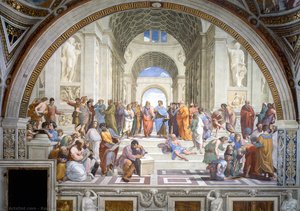
The School of Athens
Mengs's most celebrated work remains *The School of Athens*, commissioned by Cardinal Alessandro Albani for his villa in Rome. Completed around 1761, this monumental fresco embodies the spirit of Neoclassicism—a deliberate attempt to synthesize Baroque grandeur with emerging Enlightenment ideals.
His influence extended far beyond his paintings and frescoes; he served as director of the Vatican Painting School, nurturing a new generation of artists steeped in classical principles. He was a complex figure – a devout Catholic who also engaged with Enlightenment thought, an artist who balanced tradition with innovation. His life and work represent a fascinating intersection of artistic skill, intellectual curiosity, and historical circumstance, solidifying his place as a true pioneer of Neoclassical art.
His legacy continues to inspire artists today, reminding us of the enduring power of classical ideals to elevate artistic expression.

1728 - 1779 , Czech Republic

Odkryj fascynujący świat malarstwa religijnego! Poznaj historię ikon, symbolikę sakralną i techniki wykonania dzieł sztuki. Ekspercka analiza dla kolekcjonerów i miłośników historii.

Odkryj 10 arcydzieł renesansu – od Mona Lisy po freski Michała Anioła! Poznaj historie, techniki i wpływ największych artystów. Reprodukcje najwyższej jakości na Most-Famous-Paintings.com. Eksploruj kolekcję online!

Zamów unikalny obraz olejny na zamówienie! Profesjonalni artyści, cyfrowe makietowanie i najwyższa jakość materiałów. Personalizacja, portrety i reprodukcje. Ekskluzywne dzieła sztuki dla wymagających klientów.

Commission bespoke paintings with Most-Famous-Paintings.com! Expert artists create unique artworks tailored to your vision. Secure investment, lasting legacy & 100% satisfaction guaranteed.

Odkryj 10 arcydzieł renesansu, które uosabiają humanizm! Poznaj historie Leonarda da Vinci, Michała Anioła i Rafaela. Inspiracje wnętrzarskie & reprodukcje obrazów najwyższej jakości na Most-Famous-Paintings.com. Eksploruj kolekcję online!


Bądź na bieżąco z najnowszymi wiadomościami ze świata sztuki, ekskluzywnymi ofertami i inspiracjami dekoratorskimi.
Opowiedz nam o swoim projekcie, a nasi eksperci od sztuki przygotują dla Ciebie 3 spersonalizowane propozycje dzieł sztuki.
Pozwól nam przygotować 3 propozycje specjalnie dla Ciebie – za darmo!


 Udostępnij


 Rozwiń treść







 Opcja szkła jest dostępna wyłącznie w rozmiarach poniżej 110 cm