
Sprzedawaj swoją sztukę
Lista życzeń Koszyk zakupowy Cart
Podgląd w skaliPodgląd w skali Podgląd ARPodgląd AR Zamów wydruk Zamów wydrukKup obraz wysokiej rozdzielczości Kup obraz wysokiej rozdzielczości Wyślij jako kartkęWyślij jako kartkę
Szczegóły dziełaSzczegóły dzieła Dodaj do ulubionych Dodaj do ulubionych PobierzPobierz Podobne obiektyPodobne obiekty RTGRTG Pokaz slajdówPokaz slajdów

Young Herdsman

Franz Marc’s "Young Herdsman" captures a serene moment of repose in a classic Expressionist style, depicting a man with birds amidst a timeless scene reflecting the artist's spiritual connection to nature and animal life. Discover this beautiful hand-painted reproduction and bring art home.

Franz Marc (1880-1916) – niemiecki malarz ekspresjonistyczny, znany z symbolicznych obrazów zwierząt i duchowego przesłania. Odkryj jego unikalny styl i wpływ na sztukę nowoczesną!

Ręcznie malowana reprodukcja olejowa

Ręcznie malowany obraz olejny na płótnie, wykonany na zamówienie przez naszych artystów w wybranym przez Ciebie wymiarze i oprawie. (Zamów wydruk Zamów wydrukKup obraz wysokiej rozdzielczości Kup obraz wysokiej rozdzielczości)

P118B $10
P118H $10
P118W $10
P438Z $10
P508JH $12
P508YH $12
P805H $10
P805Z $10
P919BZ $10
P919G $10
P919XJ $10
P959ZH $10
P968JZ $12
W106C $8
W218G $10
W218JH $8
W218Y $10
W307PJ $10
W316G $10
W316PJ $8
W316Y $10
W398PJ $8
W4111J $10
W500HY $15
W500JH $15
W692G $12
W849H $8
W940BG $15
W953PJ $8

Standard
custom
CM
INCH

Wybierz spośród naszych standardowych rozmiarów, które zachowują oryginalne proporcje dzieła sztuki.

szerokość
wysokość

Możesz wprowadzić własne wymiary, aby dopasować obraz do konkretnej ramy lub przestrzeni. Jeśli wybrany rozmiar nie będzie odpowiadał proporcjom oryginału, przytniecie dzieło sztuki lub rozszerzymy je o dodatkowe elementy, ręcznie domalowane przez artystę. Przed rozpoczęciem produkcji wyślemy projekt cyfrowy do Twojej akceptacji.
Należy pamiętać, że podgląd na ekranie nie odzwierciedla rzeczywistego przycinania ani rozszerzania obrazu. Tylko projekt dokładnie pokaże ostateczną kompozycję.
Choć oferujemy możliwość zamówienia niestandardowych rozmiarów, zalecamy wybór wymiaru z gotowej listy, aby zachować oryginalne proporcje dzieła.

Przykłady możliwych zmian: Zamień twarz na zdjęcie klienta; Dodaj zwierzę domowe (np. zamień kota na psa); Ukryj wiadomość w tle; Zmień krajobraz lub elementy tła.
Po złożeniu zamówienia zespół Most-Famous-Paintings.com skontaktuje się z klientem drogą mailową w celu uzyskania instrukcji i prześle wizualizację projektu

Dostawa na całym świecie () w ciągu 3–4 tygodni zamiast standardowych 5 tygodni. (15 Sierpień). Bez kompromisów w kwestii jakości.

why_choose_icon
Bezpłatna ekspresowa wysyłka na cały świat
why_choose_icon
Wysokiej jakości płótno lniane
why_choose_icon
Pełne ubezpieczenie przesyłki
why_choose_icon
Gwarancja zwrotu należności celnych i podatków importowych
why_choose_icon
Gwarancja wiernego odwzorowania kolorów
why_choose_icon
Polityka 60-dniowego zwrotu (tylko w przypadku wad)
why_choose_icon
Gwarancja 100% zwrotu kosztów
why_choose_icon
Zniżka przy zamówieniu wielu produktów

Suma całkowita

$ 272

reproduction

Young Herdsman

Technika reprodukcji

Wymiary reprodukcji

-

Cena całkowita

$ 272

Szybki podgląd

  • Subject or theme: Rural Life, Nature
  • Artistic style: Animal Spirit
  • Artist: Franz Marc
  • Title: Young Herdsman
  • Movement: Expressionism
  • Year: 1902

Opis dzieła

Franz Marc's 'Young Herdsman': A Portrait of Spiritual Seeking

Franz Marc’s ‘Young Herdsman,’ painted in 1902, is more than just a portrait; it’s a profound meditation on the relationship between humanity and nature, rendered with the characteristic intensity that would define his place as a pivotal figure in German Expressionism. The painting depicts a young man, seated casually on the ground with crossed legs, seemingly lost in repose or perhaps even sleep. His attire – a jacket and tie – subtly hints at an urban past, yet he is immediately grounded by his connection to the natural world, represented by the two birds that punctuate the composition.

  • Subject & Composition: The central figure, identified as a "Young Herdsman," embodies Marc’s fascination with rural life and its perceived innocence. The relaxed posture and simple clothing suggest a rejection of bourgeois values, aligning with the Expressionist desire to portray authentic emotion and experience.
  • Color Palette: Marc's masterful use of color is immediately striking. Deep blues, greens, and ochres dominate, creating a sense of tranquility and depth while simultaneously conveying an underlying emotional intensity. The colors aren’t merely descriptive; they are imbued with symbolic meaning, reflecting the artist’s spiritual concerns.

The Expressionist Vision: Bridging Art and Spirit

Painted during a period of intense artistic experimentation in Munich, ‘Young Herdsman’ reflects Marc's broader engagement with the tenets of Expressionism. This movement sought to express subjective emotions and experiences rather than objective reality, often through distorted forms and jarring color combinations. However, unlike some of his contemporaries, Marc remained deeply rooted in symbolism, believing that art could serve as a conduit for spiritual understanding. His work was heavily influenced by his interest in folklore, mythology, and the animal kingdom – particularly wolves and horses – which he saw as possessing a profound spiritual significance.

Marc’s artistic journey began with theological studies, reflecting a lifelong quest to reconcile faith and reason. This intellectual background is evident in the painting's quiet contemplation and its suggestion of a deeper, unspoken truth. The birds, frequently recurring motifs in Marc’s work, represent freedom, spirituality, and the connection between earth and heaven.

Technique & Materials: A Study in Texture

Marc employed a distinctive technique characterized by broad, confident brushstrokes and a deliberate layering of paint. This approach creates a rich, tactile surface that invites close examination. The impasto – thick application of paint – adds to the painting’s physicality, emphasizing its emotional intensity. Marc's use of oil paints allowed for subtle gradations in color and tone, contributing to the overall sense of depth and atmosphere. The meticulous detail given to the man's clothing contrasts with the looser rendering of the background, further highlighting the subject's importance within the composition.

Symbolic Resonance & Emotional Impact

'Young Herdsman’ resonates deeply with viewers due to its evocative portrayal of solitude and contemplation. The painting speaks to a universal human desire for connection – not just with nature, but also with something beyond ourselves. Marc's work invites us to consider the spiritual dimensions of everyday life, prompting reflection on themes of mortality, innocence, and the enduring power of the natural world. This reproduction captures the essence of Marc’s artistic vision, offering a timeless piece of art that continues to inspire awe and contemplation.

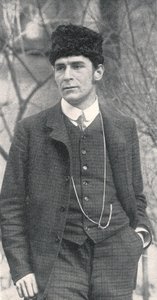
O artyście

A Life Immersed in Color and Spirit

Franz Moritz Wilhelm Marc, born in Munich in 1880, was a painter whose brief but intensely focused career irrevocably altered the course of German Expressionism. His story is one of profound spiritual seeking translated into a vibrant visual language, a quest to understand the essence of life through the purity he found in the natural world—particularly within the animal kingdom. Initially influenced by his father, Wilhelm Marc, a landscape painter, young Franz’s artistic path wasn't immediately certain. He briefly considered theology, grappling with questions of faith and existence before ultimately dedicating himself to art at the Academy of Fine Arts in Munich. These early explorations into religious thought would remain deeply embedded within his work, shaping his belief that art could be a conduit for spiritual experience. His academic training provided him with technical foundations, but it was encounters with the works of Vincent van Gogh during visits to Paris that truly ignited his artistic vision. Van Gogh’s emotive use of color and raw expression resonated profoundly with Marc, liberating him from conventional techniques and setting him on a path toward a more subjective and emotionally charged style.

The Blue Rider and a New Artistic Vision

Marc's artistic development wasn’t solitary; it flourished within the dynamic context of early 20th-century Munich. He experimented with various artist groups, including the Neue Künstlervereinigung München, before co-founding *Der Blaue Reiter* (The Blue Rider) in 1911 alongside Wassily Kandinsky. This wasn’t merely a group or an exhibition series; it was a philosophical and artistic revolution. *Der Blaue Reiter* sought to move beyond mere representation, aiming instead to express inner spiritual truths through abstraction and symbolic color. The journal of the same name became a platform for disseminating these ideas, showcasing not only their own work but also that of other forward-thinking artists and exploring diverse cultural influences from folk art to primitive sculpture. Marc’s contributions during this period were pivotal. He moved away from depicting landscapes as static scenes, instead focusing on animals—horses, deer, foxes—as vessels of spiritual energy. These weren’t simply animal portraits; they were symbolic representations of innocence, harmony, and a connection to the natural world that he believed humanity had lost. The influence of Robert Delaunay’s exploration of abstract forms and vibrant colors further propelled Marc toward simplification and heightened emotional expression in his work. Paintings like *The Tiger* (1912) and *Red Deer* (1912) exemplify this shift, showcasing bold color choices and a growing focus on the inherent qualities of his subjects rather than realistic depiction.

Symbolism, Color, and the Essence of Being

Marc’s artistic style is immediately recognizable for its distinctive use of color and form. He didn't employ color descriptively; instead, he imbued it with symbolic meaning. Blue represented spirituality and masculinity, yellow signified joy and femininity, and red embodied violence and materiality. These weren’t arbitrary choices but a carefully constructed system designed to convey specific emotional and philosophical ideas. His animals aren’t merely subjects; they are embodiments of these concepts. The simplification of forms—reducing figures to their essential shapes—further emphasized the underlying spiritual essence he sought to capture. *The Tower of Blue Horses* (1913), sadly lost during World War II, is perhaps the most iconic example of this approach, a powerful and evocative composition that encapsulates his artistic vision. He believed animals possessed an inherent purity and connection to nature that humans had forfeited through societal constraints and intellectualization. By portraying them with such reverence and symbolic weight, Marc sought to remind viewers of this lost harmony and inspire a deeper appreciation for the natural world. His work wasn’t about depicting *what* he saw but rather *how* he felt—a deeply personal and spiritual response to his surroundings.

Influences and Development

Marc's artistic journey was shaped by a confluence of influences. Initially, his father’s landscape paintings instilled in him an appreciation for the beauty of nature. However, it was his exposure to Impressionism during his time in Paris that fundamentally altered his approach. The vibrant colors and fleeting moments captured by artists like Monet ignited within him a desire to express emotion through color rather than simply replicating reality. Van Gogh’s raw emotionality and expressive brushstrokes proved particularly transformative, liberating Marc from the constraints of academic tradition. He also drew inspiration from Symbolist art, which emphasized subjective experience and spiritual symbolism. The writings of Nietzsche and Schopenhauer, exploring themes of spirituality and existentialism, further informed his artistic vision. The encounter with Kandinsky within *Der Blaue Reiter* was crucial; their shared interest in abstraction and the exploration of inner states led to a collaborative dialogue that pushed both artists toward new creative horizons. Marc’s early works, characterized by meticulous detail and realistic depictions, gradually gave way to a more expressive style marked by simplified forms, bold colors, and symbolic imagery.

A Tragic End and Lasting Legacy

The outbreak of World War I in 1914 dramatically altered Marc's life and artistic trajectory. Despite seeking exemption due to his status as an artist, he was drafted into the German army, serving as a cavalryman. The horrors of war deeply affected him, yet even amidst the chaos, he continued to paint, finding solace and meaning in his art. Tragically, Franz Marc died on March 4, 1916, at the Battle of Verdun, a devastating loss for the art world. His untimely death cut short a career brimming with potential, but it also cemented his place as a pivotal figure in modern art history. His work continues to resonate today, influencing generations of artists and captivating audiences with its emotional depth and spiritual resonance. Marc’s paintings are exhibited in major museums worldwide, including the Lenbachhaus in Munich, which holds an extensive collection of his work. He is remembered not only as a pioneer of German Expressionism but also as a visionary artist who dared to explore the profound connection between art, spirituality, and the natural world—a legacy that continues to inspire awe and contemplation. His artistic vision remains a testament to the power of art to transcend the material realm and touch upon something deeper within the human spirit.
Franz Marc

Franz Marc

1880 - 1916 , Niemcy

Krótka nota

  • Artistic Movement Or Style: Ekspresjonizm
  • Artists Or Movements Influenced By This Artist: ['Der Blaue Reiter']
  • Artists Who Influenced This Artist:
    • Van Gogh
    • Delaunay
  • Date Of Birth: 8 lutego 1880
  • Date Of Death: 4 marca 1916
  • Full Name: Franz Moritz Wilhelm Marc
  • Nationality: Niemiec
  • Notable Artworks:
    • Kruk
    • Jeździec
    • Koń
  • Place Of Birth: Monachium, Niemcy
Odkryj dzieła sztuki uporządkowane według tematów, stylów i cech charakterystycznych.




































