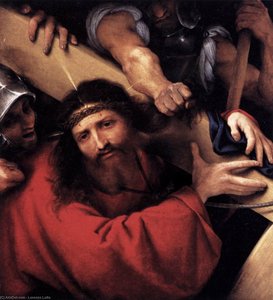
A Venetian Wanderer: The Life and Art of Lorenzo Lotto
Born in the vibrant heart of Venice around 1480, Lorenzo Lotto emerged as a distinctive voice within the Italian Renaissance, though his artistic journey would lead him far beyond the lagoon city’s celebrated studios. Unlike many of his contemporaries who firmly established themselves within specific schools or courts, Lotto embarked on a peripatetic career, traversing cities like Treviso, Rome, Bergamo, and Ancona before ultimately finding solace as a lay brother in Loreto. This itinerant existence profoundly shaped his artistic vision, exposing him to diverse influences while fostering an independent spirit that set him apart. While early training remains somewhat shrouded in mystery, it’s believed he absorbed the lessons of Giovanni Bellini, a leading figure of the Venetian school, yet Lotto quickly transcended simple imitation, forging a style uniquely his own—a blend of High Renaissance grace and nascent Mannerist sensibilities.
Blending Traditions: Style and Influences
Lotto’s artistic signature lies in his remarkable ability to synthesize diverse influences into a cohesive and deeply personal aesthetic. His early works reveal the impact of Giorgione's poetic naturalism, particularly evident in the subtle atmospheric effects and lyrical compositions. The hazy light and evocative landscapes reminiscent of Giorgione’s *Pastoral Concert* can be seen in Lotto’s early paintings like *The Adoration of the Magi*. However, a sojourn in Rome brought him into contact with the art of Raphael, imbuing his work with a newfound clarity of form and compositional balance. The influence of Raphael is particularly noticeable in his later altarpieces, where he adopted a more structured and balanced approach to composition. Later, during his extended stay in Bergamo, he absorbed elements of Lombard realism, adding a grounded physicality to his figures—a departure from the ethereal quality often associated with Venetian painting. This eclectic approach is not merely additive; Lotto masterfully integrated these influences, creating paintings that are both technically refined and emotionally resonant. He wasn’t afraid to experiment with perspective, often employing unusual vantage points to heighten the sense of drama or intimacy. His palette, while rooted in Venetian colorism—the rich reds, blues, and golds characteristic of Venetian painting—evolved over time, becoming increasingly vibrant and expressive.
Susanna and the Elders, painted during his Bergamo period, exemplifies this maturity—a captivating narrative rendered with luminous colors and a keen psychological insight into the characters’ emotions. The composition itself is dynamic, drawing the viewer's eye through the scene with carefully placed figures and dramatic lighting.
Portraits of the Soul: Lotto’s Masterpieces
While Lotto excelled in religious painting, it is perhaps through his portraits that he truly distinguished himself. He possessed an extraordinary gift for capturing not just the physical likeness but also the inner life of his sitters. His portraits are rarely idealized; instead, they present individuals with all their complexities and vulnerabilities.
Man with a Golden Paw, painted in 1527, is a prime example—a captivating study of a gentleman holding a small golden statuette, its symbolism open to interpretation but undeniably intriguing. The sitter’s gaze is direct and engaging, conveying a sense of intelligence and quiet contemplation. The subtle details – the folds of his clothing, the expression on his face – reveal a deep understanding of human psychology. Similarly,
Portrait of a 37-year-old Man showcases Lotto's ability to convey personality through subtle details—the man’s clothing, his posture, the expression in his eyes all contribute to a compelling psychological portrait. These are not merely representations of individuals; they are windows into their souls. His portraits often depict subjects engaged in everyday activities, further enhancing their sense of realism and immediacy.
A Rediscovered Legacy: Historical Significance
Despite achieving considerable recognition during his lifetime, Lotto's reputation waned after his death in 1556 or 1557. His works, often dispersed throughout provincial churches and private collections, were largely overlooked for centuries. It wasn’t until the late 19th century, with Bernard Berenson’s groundbreaking scholarship, that Lotto experienced a significant revival of interest. Berenson's meticulous research uncovered Lotto’s testament and diary, providing invaluable insights into his artistic process and motivations. This rediscovery sparked renewed appreciation for his unique style and profound psychological depth. Today, he is recognized as one of the most original and compelling artists of the Italian Renaissance. His unique blend of stylistic influences, his psychological depth, and his technical mastery continue to captivate audiences and inspire art historians. He stands as a testament to the power of artistic independence—a wanderer who forged his own path and left an indelible mark on the world of art. The rediscovery of Lotto’s oeuvre has enriched our understanding of the Renaissance, revealing a complex and multifaceted artist whose work deserves continued exploration and appreciation.
Major Works
Here are some of Lorenzo Lotto's most significant works:
- The Adoration of the Magi (Treviso) – A dynamic composition showcasing Lotto’s mastery of perspective and his ability to convey movement and emotion.
- Madonna and Child with St. Jerome (Naples) – An early work demonstrating Lotto's influence from Giovanni Bellini, characterized by its serene beauty and delicate colors.
- Entombment (Jesi) – A dramatic depiction of the Entombment of Christ, showcasing Lotto’s use of light and shadow to create a sense of pathos and realism.
- Transfiguration (Recanati) – A complex and emotionally charged altarpiece demonstrating Lotto's innovative approach to composition and his ability to capture the spiritual essence of the subject.
- Man with a Golden Paw (1527) - A captivating portrait capturing the sitter’s intelligence and contemplative nature.



 Preview
 Zamów wydruk
 Udostępnij
 Szczegóły dzieła
 Dodaj do ulubionych
 Pobierz
 Podobne obiekty
 RTG
RTG
 Pokaz slajdów






 Udostępnij


 Rozwiń treść




































 Opcja szkła jest dostępna wyłącznie w rozmiarach poniżej 110 cm