A Pop Visionary's Still Life: Exploring Roy Lichtenstein’s Bananas and Grapefruit
Roy Fox Lichtenstein (1923–1997) irrevocably altered the trajectory of twentieth-century art, establishing himself as a pivotal figure within the Pop Art movement. Far from merely mirroring his era, Lichtenstein actively interrogated it—transforming commonplace imagery into profound artistic statements that continue to resonate today. His formative years were marked by exposure to museums and concerts, fostering an early appreciation for visual culture that would inform his groundbreaking approach to artmaking. Initially drawn to realistic drawing and painting, Lichtenstein’s formal training commenced at the Art Students League in 1939 under Reginald Marsh, followed by studies at Ohio State University – interrupted briefly by wartime service. This multifaceted background shaped his artistic sensibility and propelled him toward a revolutionary reimagining of traditional genres.
Subject & Composition: The Bold Geometry of Familiar Forms
Bananas and Grapefruit, created in 1972, exemplifies Lichtenstein’s signature style applied to the venerable tradition of still life. At first glance, the artwork presents a deceptively simple arrangement—a bowl brimming with olives against a stark black background intersected by horizontal white stripes. However, beneath this apparent austerity lies a meticulously crafted composition designed to maximize visual impact. The central focus rests squarely on these forms – stylized representations of fruit – which are positioned with deliberate precision to command attention and establish a dominant visual hierarchy. Lichtenstein’s masterful use of geometric shapes—primarily straight lines and rectangles—creates a sense of order and control, contrasting sharply with the organic contours of the olives themselves. This juxtaposition underscores Lichtenstein's intention to elevate everyday objects into symbols of artistic innovation.
Style & Technique: Embracing Comic Book Aesthetics
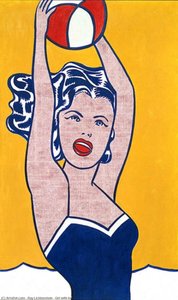
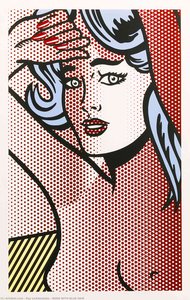
Lichtenstein’s stylistic choices are deeply rooted in the aesthetics of comic books and commercial printing techniques—a deliberate rejection of Abstract Expressionism’s subjective exploration of emotion. The artwork is characterized by bold, flat planes of color, defined by crisp black outlines that delineate each element with unwavering clarity. This technique mimics the halftone printing process prevalent in comics, resulting in a distinctive visual texture reminiscent of newspaper illustrations. Furthermore, Lichtenstein employs Ben-Day dots—though not explicitly visible in this particular piece—to simulate the mottled appearance of printed materials and reinforce the artwork’s connection to mass media. The deliberate lack of painterly brushstrokes contributes to an overall impression of manufactured perfection—a hallmark of Pop Art's embrace of industrial processes.
Historical Context & Artistic Movement: Challenging Conventions
Emerging in the 1960s, Pop Art challenged the prevailing Abstract Expressionist movement by prioritizing popular culture as its subject matter. Artists like Andy Warhol and Lichtenstein sought to democratize art by drawing inspiration from advertising campaigns, comic books, and everyday objects—a reaction against the elitism of postwar intellectual circles.
Bananas and Grapefruit stands as a testament to this artistic dialogue, demonstrating Lichtenstein’s unwavering engagement with these themes. The decade witnessed Pop Art solidify its position in the art world, influencing graphic design, fashion, and broader cultural trends. Lichtenstein's work from this period consistently explored variations on still life, showcasing his ability to transform mundane subjects into compelling visual statements—a feat that cemented his legacy as one of the most influential artists of the era.
Symbolism & Emotional Impact: A Quiet Reflection on Abundance
While ostensibly depicting a bowl of olives – a symbol of nourishment and prosperity –
Bananas and Grapefruit subtly conveys a contemplative mood. The flattened perspective and absence of depth contribute to an immediacy that captures the essence of Pop Art’s rejection of subjective expression in favor of objective representation. The stylized depiction of fruit underscores Lichtenstein's fascination with consumer culture, prompting viewers to consider the relationship between art and commerce. Ultimately, the artwork evokes a sense of understated elegance—a testament to Lichtenstein’s masterful ability to transform familiar forms into enduring symbols of artistic innovation.
- Artist: Roy Lichtenstein (1923 – 1997)
- Date: 1972
- Style: Pop Art, Still Life
- Medium: Likely Digital Illustration/Screenprint (based on aesthetic)
Photo Description: --Overall Impression-- The artwork is a Pop Art-inspired still life depicting a bowl of olives. It employs a bold, graphic style with simplified forms and flat planes of color. The composition is dominated by the bowl and its contents, arranged centrally within a black background intersected by thick, horizontal white stripes. The use of lines is primarily geometric – straight, crisp black lines define the shapes and outlines. Shapes are predominantly simple, rounded forms representing the olives and the bowl itself, rendered with minimal detail. Texture appears to be created through flat color application, suggesting a screen-printing or lithographic technique. Lighting is implied rather than explicitly depicted; it’s uniform and even across the scene. Perspective is flattened, lacking any sense of three-dimensionality. Depth is achieved primarily through overlapping shapes and the use of black as a receding background element. The subject matter is straightforward – a bowl of olives – but presented in an abstracted and stylized manner. Symbolic or emotional elements are minimal; it evokes a sense of modern simplicity and directness characteristic of Pop Art’s rejection of subjective expression in favor of objective representation. It's a visually arresting piece that invites contemplation on the relationship between art, commerce, and everyday life. The flattened perspective and lack of depth contribute to a feeling of immediacy and graphic impact.
Size: Unknown
Date: 1972
ARTIST INFORMATION:
==================
Artist: Roy Fox Lichtenstein
Birth Year: 1923
Death Year: 1997
Birth City: Manhattan
Birth Country: United States of America
Biography:
The Genesis of a Pop Visionary
Roy Fox Lichtenstein, born in the vibrant metropolis of New York City on October 27, 1923, indelibly altered the landscape of twentieth-century art, establishing himself as a pivotal figure within the Pop Art movement. Emerging as a revolutionary artist—challenging conventional notions of fine art—he sought to democratize art by drawing inspiration from popular culture and mass production. Childhood exposure to museums and concerts fostered both a cultural awareness and an early artistic inclination. Early training at the Art Students League in 1939 under Reginald Marsh, followed by studies at Ohio State University – interrupted briefly by wartime service – laid the groundwork for a creative spirit that would redefine visual art. Lichtenstein’s initial fascination with realistic drawing and painting evolved into a bold experimentation with color and form—a pivotal moment in his artistic journey."