


x

Ręcznie malowany olej na płótnie w Twoim wymiarze i ramie, tworzony na zamówienie przez naszych artystów. ( Switch to Print Switch to Image)





























Wybierz spośród naszych predefiniowanych rozmiarów, które zachowują oryginalne proporcje dzieła sztuki.

Możesz wprowadzić własne wymiary, aby dopasować obraz do konkretnej ramy lub przestrzeni. Jeśli wybrany rozmiar nie będzie odpowiadał proporcjom oryginału, przytniecie dzieło sztuki lub rozszerzymy je o dodatkowe elementy, ręcznie domalowane przez artystę. Przed rozpoczęciem produkcji wyślemy projekt cyfrowy do Twojej akceptacji.
Należy pamiętać, że podgląd na ekranie nie odzwierciedla rzeczywistego przycinania ani rozszerzania obrazu. Tylko projekt dokładnie pokaże ostateczną kompozycję.
Choć oferujemy możliwość zamówienia niestandardowych rozmiarów, zalecamy wybór wymiaru z gotowej listy, aby zachować oryginalne proporcje dzieła.
Dostawa na całym świecie () w ciągu 3/4 tygodni zamiast standardowych 5 tygodni. (30 Lipiec). Bez kompromisów w kwestii jakości.


Globe
Wymiary reprodukcji
Victor Vasarely's "Globe" is more than just a painting; it’s an invitation into the heart of Op Art, a visual exploration of perception and movement that defined a generation. This vibrant composition, dominated by concentric circles of luminous yellow and orange, immediately draws the eye inward, creating a mesmerizing depth that seems to defy the two-dimensional surface. The artwork's genesis lies in Vasarely’s pioneering work with kinetic art and his deep engagement with geometric abstraction – principles he honed during his formative years at the Bauhaus-influenced Műhely workshop.
Born in 1906 in Pécs, Croatia, Vasarely’s artistic trajectory began unexpectedly. Initially pursuing a medical degree, he abandoned this path to embrace the burgeoning world of visual expression, ultimately becoming a key figure in the development of Op Art – Optical Art. This movement, flourishing in the mid-20th century, sought to stimulate optical illusions through precise geometric forms. Vasarely’s approach was revolutionary; he meticulously constructed his paintings using static elements—circles, lines, and squares—to create dynamic visual effects that appeared to shift and move before the viewer's eyes. “Globe” exemplifies this technique perfectly, demonstrating how seemingly simple shapes can generate complex optical experiences.
The execution of "Globe" reveals Vasarely’s mastery of color theory and his deliberate manipulation of visual perception. The use of contrasting yellows and oranges isn't merely decorative; it’s a calculated strategy to heighten the illusion of movement and depth. Each circle is rendered with painstaking precision, creating a series of overlapping planes that trick the eye into perceiving three-dimensional space. Vasarely’s technique involved layering thin washes of paint, allowing each color to subtly interact with its neighbors, further enhancing the artwork's dynamic quality. The meticulous detail suggests a dedication to scientific observation and an understanding of how the human visual system processes information.
"Globe" can be interpreted as a representation of the universe itself – a microcosm reflecting the vastness and complexity of space. The concentric circles evoke notions of orbits, cycles, and interconnectedness, mirroring Vasarely’s fascination with mathematical principles and their application to art. Beyond its symbolic resonance, the artwork possesses a powerful emotional impact. Its vibrant colors and dynamic composition generate a sense of excitement, wonder, and perhaps even a slight disorientation – a testament to Op Art's ability to challenge our perceptions and stimulate our senses. This piece is not simply observed; it’s experienced.

1906 - 1997 , Chorwacja
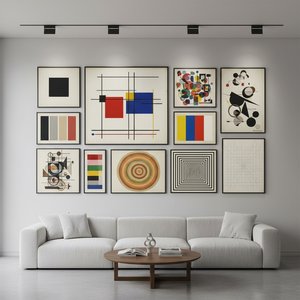
Odkryj 10 arcydzieł abstrakcji geometrycznej! Poznaj historię Mondriana, Kandinskiego i Maleвича. Inspiracje wnętrzarskie z malarstwem abstrakcyjnym – reprodukcje najwyższej jakości na Most-Famous-Paintings.com. Eksploruj kolekcję online!

Explore the revolutionary world of Victor Vasarely, father of Op Art. Discover his geometric masterpieces, artistic system, & lasting impact on modern design. A guide for discerning art collectors.

Odkryj fascynujący świat orfizmu! Poznaj historię Roberta i Sonii Delaunay, teoretyczne podstawy tego ruchu oraz jego wpływ na sztukę XX wieku. Ekskluzywny artykuł dla miłośników sztuki nowoczesnej.

Explore the fascinating relationship between color & emotion in art history. Discover how master artists like Matisse & Gauguin used vibrant hues to evoke feelings and cultural meanings. A deep dive for classic art enthusiasts.

Poznaj historię geometrycznej abstrakcji w sztuce – od kubizmu po współczesne trendy. Poradnik dla kolekcjonerów o inwestycjach, wartości dzieł i wybitnych polskich artystach. Ekspercka analiza i inspiracje.


Bądź na bieżąco z najnowszymi wiadomościami ze świata sztuki, ekskluzywnymi ofertami i inspiracjami dekoratorskimi.
Opowiedz nam o swoim projekcie, a nasi eksperci od sztuki przygotują dla Ciebie 3 spersonalizowane propozycje dzieł sztuki.
Pozwól nam przygotować 3 propozycje specjalnie dla Ciebie – za darmo!


 Preview
 Udostępnij
 Udostępnij
 Szczegóły dzieła

 Pobierz
 Podobne obiekty
 RTG
RTG Pokaz slajdów

 Rozwiń treść







 Opcja szkła jest dostępna wyłącznie w rozmiarach poniżej 110 cm


