x

Ręcznie malowany obraz olejny na płótnie, wykonany na zamówienie przez naszych artystów w wybranym przez Ciebie wymiarze i oprawie. ( Zamów wydruk Kup obraz wysokiej rozdzielczości)





























Wybierz spośród naszych standardowych rozmiarów, które zachowują oryginalne proporcje dzieła sztuki.

Możesz wprowadzić własne wymiary, aby dopasować obraz do konkretnej ramy lub przestrzeni. Jeśli wybrany rozmiar nie będzie odpowiadał proporcjom oryginału, przytniecie dzieło sztuki lub rozszerzymy je o dodatkowe elementy, ręcznie domalowane przez artystę. Przed rozpoczęciem produkcji wyślemy projekt cyfrowy do Twojej akceptacji.
Należy pamiętać, że podgląd na ekranie nie odzwierciedla rzeczywistego przycinania ani rozszerzania obrazu. Tylko projekt dokładnie pokaże ostateczną kompozycję.
Choć oferujemy możliwość zamówienia niestandardowych rozmiarów, zalecamy wybór wymiaru z gotowej listy, aby zachować oryginalne proporcje dzieła.
Dostawa na całym świecie () w ciągu 3–4 tygodni zamiast standardowych 5 tygodni. (23 Sierpień). Bez kompromisów w kwestii jakości.


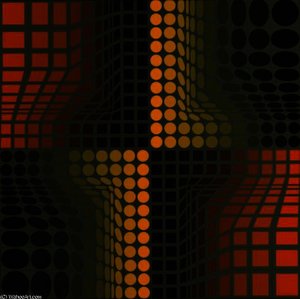
Nobel II
Wymiary reprodukcji
Victor Vasarely (1906-1997) stands as an undisputed titan of Op art, a movement that irrevocably altered the landscape of 20th-century visual culture. Born Károly Vásárhelyi in Pécs, Hungary – then part of Austria-Hungary – his artistic journey began with aspirations for medicine but swiftly pivoted towards the captivating realm of painting in 1927, enrolling at Sándor Bortnyik’s influential workshop in Budapest.
This formative decision wasn't merely a career change; it was an embrace of geometric abstraction and a profound fascination with perception itself. Bortnyik’s teachings instilled within Vasarely the core principles of Bauhaus design – functionality intertwined with aesthetic innovation – shaping his artistic vision for decades to come.
The breakthrough arrived with his enrollment in Vasarely's workshop, where he absorbed the revolutionary ideas championed by László Moholy-Nagy and Béla Julesz. These mentors instilled a belief that art should transcend elitism and become accessible to all, mirroring Vasarely’s own unwavering commitment to democratizing visual experience.
Vasarely's signature style – characterized by mesmerizing patterns of concentric circles and radiating lines – emerged from this crucible of intellectual exchange. He meticulously crafted these intricate compositions using a technique known as “screenprinting,” applying pigment onto translucent acetate sheets, resulting in vibrant, luminous prints that defy conventional representation.
“Nobel IV,” created in 1983, exemplifies Vasarely’s masterful manipulation of optical illusion. The bold red circle dominates the canvas, encircled by a multitude of smaller black circles – each meticulously positioned to create an unsettling yet captivating visual effect. This artwork isn't simply decorative; it embodies the spirit of Op art’s challenge to our senses and its exploration of how we perceive reality.
More than just aesthetically pleasing, “Nobel IV” speaks to a broader philosophical concern: Vasarely sought to liberate art from traditional constraints, presenting it as an instrument for stimulating contemplation and fostering a deeper understanding of the human condition. It remains a testament to his enduring legacy as one of the most innovative and influential artists of the 20th century.
Vasarely’s work continues to inspire designers and collectors alike, demonstrating that beauty can reside in complexity and that art possesses the power to transform our perception of the world. Its vibrant colors and mesmerizing patterns resonate with a timeless elegance, securing its place as an icon of modern artistic expression.

1906 - 1997 , Chorwacja

Explore the science of Op Art through the lens of masters like Victor Vasarely. Discover how geometric abstraction uses optical illusions to create movement and delve into the neuroaesthetics of perception with our expert art history guide.

Master the complexities of Geometric Abstraction. Our expert guide explores the evolution from Cubist deconstruction to Bauhaus precision, decoding the power of shape and form. Perfect for art students seeking deep historical context and academic insight into modern masterpieces.

Explore the profound impact of Minimalism and Geometric Abstraction. From Mondrian to Malevich, discover how stripping art to its essential forms revolutionized modern aesthetics through our expert-led historical guide.


Bądź na bieżąco z najnowszymi wiadomościami ze świata sztuki, ekskluzywnymi ofertami i inspiracjami dekoratorskimi.
Opowiedz nam o swoim projekcie, a nasi eksperci przygotują dla Ciebie 3 spersonalizowane propozycje dzieł sztuki.
Przygotujemy dla Ciebie 3 propozycje zupełnie za darmo!


 Podgląd w skali
 Wyślij jako kartkę
 Udostępnij
 Szczegóły dzieła

 Pobierz
 Podobne obiekty
 RTG
RTG Pokaz slajdów
 Rozwiń treść







 Opcja ze szkłem jest dostępna wyłącznie w rozmiarach poniżej 110 cm