Sprzedawaj swoją sztukę
Lista życzeń Koszyk zakupowy Cart
Podgląd w skaliPodgląd w skali Podgląd ARPodgląd AR Zamów wydruk Zamów wydrukKup obraz wysokiej rozdzielczości Kup obraz wysokiej rozdzielczości Wyślij jako kartkęWyślij jako kartkę
Szczegóły dziełaSzczegóły dzieła Dodaj do ulubionych Dodaj do ulubionych PobierzPobierz Podobne obiektyPodobne obiekty RTGRTG Pokaz slajdówPokaz slajdów

Three Rectangles

Explore 'Three Rectangles' by Wassily Kandinsky – an iconic abstract painting bursting with vibrant colors and geometric forms. Discover the revolutionary spirit of modern art.

Wassily Kandinsky – pionier abstrakcji! Odkryj jego ekspresjonistyczne obrazy, duchowe tematy i wpływ na Bauhaus. Piękno koloru i emocji w sztuce XX wieku.

Ręcznie malowana reprodukcja olejowa

Ręcznie malowany obraz olejny na płótnie, wykonany na zamówienie przez naszych artystów w wybranym przez Ciebie wymiarze i oprawie. (Zamów wydruk Zamów wydrukKup obraz wysokiej rozdzielczości Kup obraz wysokiej rozdzielczości)

P118B $10
P118H $10
P118W $10
P438Z $10
P508JH $12
P508YH $12
P805H $10
P805Z $10
P919BZ $10
P919G $10
P919XJ $10
P959ZH $10
P968JZ $12
W106C $8
W218G $10
W218JH $8
W218Y $10
W307PJ $10
W316G $10
W316PJ $8
W316Y $10
W398PJ $8
W4111J $10
W500HY $15
W500JH $15
W692G $12
W849H $8
W940BG $15
W953PJ $8

Standard
custom
CM
INCH

Wybierz spośród naszych standardowych rozmiarów, które zachowują oryginalne proporcje dzieła sztuki.

szerokość
wysokość

Możesz wprowadzić własne wymiary, aby dopasować obraz do konkretnej ramy lub przestrzeni. Jeśli wybrany rozmiar nie będzie odpowiadał proporcjom oryginału, przytniecie dzieło sztuki lub rozszerzymy je o dodatkowe elementy, ręcznie domalowane przez artystę. Przed rozpoczęciem produkcji wyślemy projekt cyfrowy do Twojej akceptacji.
Należy pamiętać, że podgląd na ekranie nie odzwierciedla rzeczywistego przycinania ani rozszerzania obrazu. Tylko projekt dokładnie pokaże ostateczną kompozycję.
Choć oferujemy możliwość zamówienia niestandardowych rozmiarów, zalecamy wybór wymiaru z gotowej listy, aby zachować oryginalne proporcje dzieła.

Przykłady możliwych zmian: Zamień twarz na zdjęcie klienta; Dodaj zwierzę domowe (np. zamień kota na psa); Ukryj wiadomość w tle; Zmień krajobraz lub elementy tła.
Po złożeniu zamówienia zespół Most-Famous-Paintings.com skontaktuje się z klientem drogą mailową w celu uzyskania instrukcji i prześle wizualizację projektu

Dostawa na całym świecie () w ciągu 3–4 tygodni zamiast standardowych 5 tygodni. (17 Sierpień). Bez kompromisów w kwestii jakości.

why_choose_icon
Bezpłatna ekspresowa wysyłka na cały świat
why_choose_icon
Wysokiej jakości płótno lniane
why_choose_icon
Pełne ubezpieczenie przesyłki
why_choose_icon
Gwarancja zwrotu należności celnych i podatków importowych
why_choose_icon
Gwarancja wiernego odwzorowania kolorów
why_choose_icon
Polityka 60-dniowego zwrotu (tylko w przypadku wad)
why_choose_icon
Gwarancja 100% zwrotu kosztów
why_choose_icon
Zniżka przy zamówieniu wielu produktów

Suma całkowita

$ 272

reproduction

Three Rectangles

Technika reprodukcji

Wymiary reprodukcji

-

Cena całkowita

$ 272

Szybki podgląd

  • Movement: Abstract Art
  • Year: 1930
  • Notable elements or techniques: Geometric shapes, Color & form
  • Artistic style: Abstract Expressionism
  • Dimensions: 70 x 60 cm
  • Medium: Oil on Canvas
  • Influences:
    • Impressionism
    • Fauvism

Quiz o sztuce

Do każdego pytania dotyczy tylko jedna poprawna odpowiedź.

Pytanie 1:
What artistic movement is Wassily Kandinsky most closely associated with?
Pytanie 2:
Which of the following best describes the primary effect Kandinsky aims to achieve with the use of color in ‘Three Rectangles’?
Pytanie 3:
What year was ‘Three Rectangles’ painted?
Pytanie 4:
The frame surrounding the painting is described as adding what to the overall aesthetic?
Pytanie 5:
According to the text, what was a key influence on Kandinsky’s artistic development early in his career?

Opis dzieła

A Symphony in Geometry: Exploring “Three Rectangles” by Wassily Kandinsky

Wassily Kandinsky’s “Three Rectangles,” painted in 1930, isn't merely a depiction of geometric forms; it’s an invitation to a deeply personal and profoundly moving experience. This seminal work from the heart of his abstract period embodies the core tenets of Kandinsky’s revolutionary approach to art – that color and shape could directly communicate emotion and meaning, bypassing the need for representational imagery. The painting, measuring 70 x 60 cm, is a testament to his belief in the power of pure abstraction, a philosophy he meticulously developed over decades of experimentation.

The Language of Color and Form

Kandinsky’s palette for “Three Rectangles” is both restrained and intensely vibrant. He masterfully employs a carefully considered selection of hues – the assertive reds, the cool blues, the sunny yellows, the delicate pinks, and the warm oranges – each chosen not just for its visual appeal but for its capacity to evoke specific emotional responses. The rectangles themselves aren’t static; they seem to pulse with an internal energy, their placement within the composition creating a dynamic interplay of space and movement. Notice how the red rectangle, often associated with passion and vitality, dominates the center, drawing the eye while simultaneously suggesting a grounding force. The blue and yellow rectangles, positioned on either side, offer counterpoints – a sense of serenity alongside energetic dynamism.

A Revolutionary Approach to Composition

Kandinsky’s approach to composition in “Three Rectangles” is radically different from traditional Western painting. He deliberately eschewed the illusionistic techniques of perspective and realism, instead focusing on the inherent qualities of color and shape themselves. The rectangles aren't placed within a defined space; rather, they exist as independent entities, interacting with each other through their colors and relationships. This creates an almost three-dimensional effect, inviting the viewer to step into the painting and experience it from multiple perspectives. The subtle variations in size and orientation of the rectangles contribute to this sense of depth and complexity, suggesting a carefully orchestrated balance between order and chaos.

Symbolism and Inner Vision

While Kandinsky famously declared that he sought to paint “the purely spiritual,” the symbolism within "Three Rectangles" remains open to interpretation. Some scholars suggest the rectangles represent musical notes, reflecting Kandinsky’s lifelong fascination with music and his belief in its inherent connection to art. Others see them as symbols of human emotions – red for passion, blue for contemplation, yellow for joy. Regardless of a definitive reading, the painting undeniably taps into universal emotional experiences, resonating with viewers on a deeply intuitive level. It's crucial to remember that Kandinsky wasn’t aiming to depict a concrete scene; he was striving to translate inner states and feelings onto canvas.

Framing the Experience: Context and Legacy

The painting is presented within a frame, an element that subtly enhances its impact. The frame isn't merely decorative; it serves as a visual boundary, framing the composition and drawing attention to the interplay of colors and shapes. Kandinsky’s work profoundly influenced subsequent generations of artists, paving the way for abstract expressionism and other non-representational movements. “Three Rectangles” stands as a cornerstone of this legacy, demonstrating his pioneering spirit and his unwavering commitment to exploring the expressive potential of pure abstraction. Today, reproductions of this iconic piece continue to captivate audiences worldwide, offering a glimpse into the visionary mind of one of art history’s most influential figures. For those seeking to bring Kandinsky's evocative vision into their own spaces, Most-Famous-Paintings offers high-quality reproductions that faithfully capture the essence of this remarkable painting.


O artyście

A Life Immersed in Color and Spirit

Wassily Wassilyevich Kandinsky, born in Moscow in 1866, was a revolutionary figure who irrevocably altered the course of modern art. His journey wasn’t one of immediate artistic calling; initially destined for a career in law and economics at the University of Moscow, it was a profound encounter with Impressionist painting – specifically Claude Monet's “Haystacks” – and a deeply moving experience witnessing Wagner’s opera "Lohengrin" that ignited within him an irrepressible desire to pursue art. This pivotal moment, occurring around age thirty, marked not merely a career change but a complete transformation of perspective, setting him on a path toward pioneering abstraction. He soon relocated to Munich, enrolling at the prestigious Academy of Fine Arts and studying under Franz von Stuck, though even within formal training, Kandinsky’s spirit yearned for exploration beyond conventional boundaries. Early influences included Russian folk art, gleaned from an ethnographic expedition to the Vologda region in 1889, which instilled a fascination with vibrant color palettes and symbolic imagery. This foundation would prove crucial as he began to develop his unique artistic language. These early explorations weren’t simply about aesthetic preference; they were rooted in a deep cultural connection and a burgeoning understanding of how art could communicate beyond the literal.

The Dawn of Abstraction: From Expressionism to Inner Necessity

Kandinsky’s early works reveal a strong expressionistic bent, characterized by bold colors and emotional intensity – pieces like “Papeln (Poplars)” from 1902 exemplify this period. However, he wasn't content with merely representing the external world; he sought to express inner realities, spiritual truths that transcended mere visual depiction. This quest led him gradually away from representational art and toward a revolutionary exploration of color, form, and their emotional resonance. He began to believe that colors possessed inherent psychological effects, capable of evoking specific feelings and sensations in the viewer. This conviction was deeply intertwined with his burgeoning interest in Theosophy, a spiritual movement emphasizing esoteric knowledge and universal brotherhood. As he delved deeper into these ideas, Kandinsky’s paintings became increasingly non-objective, shedding recognizable forms in favor of abstract compositions driven by an “inner necessity.” This wasn't simply about abandoning representation; it was about discovering a new visual language capable of expressing the intangible realms of emotion and spirituality. He sought to create a visual equivalent of music, where color and form harmonized to evoke profound emotional responses.

Geometric Harmony and Spiritual Resonance

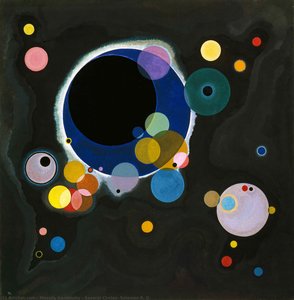
The period following his involvement with the influential artist group Der Blaue Reiter (The Blue Rider), which he co-founded in Munich in 1911, saw a further evolution in Kandinsky’s style. While earlier works often featured fluid, organic shapes, he began to explore geometric abstraction, focusing on the interplay of circles, triangles, and squares. “Several Circles” (140 x 140 cm) stands as a prime example of this phase – a dynamic composition where color and form interact in a harmonious yet energetic dance. This wasn't cold or sterile geometry; rather, it was imbued with spiritual significance. Kandinsky believed that geometric shapes possessed inherent symbolic meaning, and their arrangement within the canvas could evoke specific emotional responses. His theoretical writings, most notably “Concerning the Spiritual in Art” (1911), articulated these beliefs, laying the groundwork for a new understanding of abstract art as a vehicle for expressing profound spiritual truths. He argued that art should not aim to imitate nature but rather to reveal the artist’s inner world and connect with the viewer on a deeper, more intuitive level.

Bauhaus Influence and Lasting Legacy

The outbreak of World War I forced Kandinsky's return to Russia in 1914, but following the Russian Revolution, he found himself increasingly at odds with the prevailing artistic climate. In 1920, he accepted a teaching position at the Bauhaus school in Germany, where he profoundly influenced generations of artists with his theories on color, form, and abstraction. The Bauhaus provided an ideal environment for Kandinsky to further develop his ideas and explore new creative avenues. He continued to experiment with geometric forms and vibrant colors, often incorporating layered impasto techniques to create textured surfaces that added depth and complexity to his compositions – as seen in later works like “An Intimate Party” (1942). After the closure of the Bauhaus by the Nazi regime in 1933, Kandinsky moved to France, where he remained for the rest of his life, becoming a French citizen in 1939. His impact on modern art is immeasurable; he is widely recognized as a pioneer of abstract expressionism and a key figure in the development of non-representational painting. His works are held in major museums worldwide, including the Tretyakov Gallery in Moscow, which houses his monumental “Composition VII,” a testament to his artistic vision and enduring legacy. Kandinsky’s exploration of color, form, and spirituality continues to inspire artists today, solidifying his place as one of the most important figures in 20th-century art history. He didn't just paint pictures; he painted emotions, ideas, and the very essence of the human spirit.
Wassily Wassilyevich Kandinsky

Wassily Wassilyevich Kandinsky

1866 - 1944 , Rosja

Krótka nota

  • Artistic Movement Or Style: Abstrakcjonizm, Ekspresjonizm
  • Artists Or Movements Influenced By This Artist:
    • Ekspresjonizm
    • Abstrakcjonizm
  • Artists Who Influenced This Artist:
    • Monet
    • Wagner
  • Date Of Birth: 1866
  • Date Of Death: 1944
  • Full Name: Wassily Wassilyevich Kandinsky
  • Nationality: Rosyjski, Francuski
  • Notable Artworks:
    • Kompozycja VII
    • Wszystkich Świętych II
  • Place Of Birth: Moskwa, Rosja
Odkryj dzieła sztuki uporządkowane według tematów, stylów i cech charakterystycznych.