A Life Bridging Worlds: The Artistic Odyssey of Aleksandra Ekster
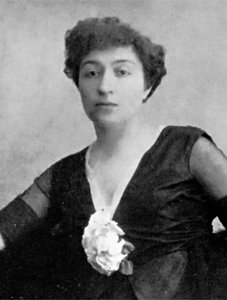
Aleksandra Ekster, a name that resonates deeply within the annals of 20th-century art, was far more than simply a painter; she was a cultural architect, a visionary who masterfully connected artistic currents between Russia and Europe. Born Aleksandra Aleksandrovna Grigorovich on January 6, 1882, in Białystok – then part of the Russian Empire, now Poland – her life unfolded against a backdrop of profound social and artistic transformation. Her upbringing within a prosperous Belarusian family afforded her an exceptional education, nurturing not only a refined aesthetic sensibility but also a remarkably cosmopolitan outlook that would become the cornerstone of her extraordinary career. The relocation to Kyiv proved pivotal, establishing it as the fertile ground where she received formal artistic training at the Kyiv School of Art, encountering fellow burgeoning talents like Alexander Bogomazov and Alexander Archipenko – individuals who would soon form the nucleus of the vibrant Russian avant-garde movement. Even in her early years, Ekster’s studio evolved into a dynamic hub for intellectual exchange, attracting poets such as Anna Akhmatova and Osip Mandelstam, writers like Ilya Ehrenburg, and dancers including Bronislava Nijinska, solidifying her position at the heart of Kyiv's burgeoning cultural landscape.
Embracing Innovation: From Cubo-Futurism to Constructivism
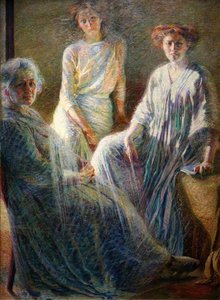
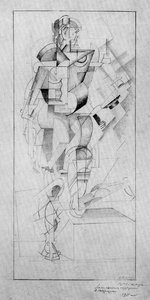
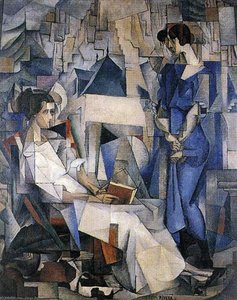
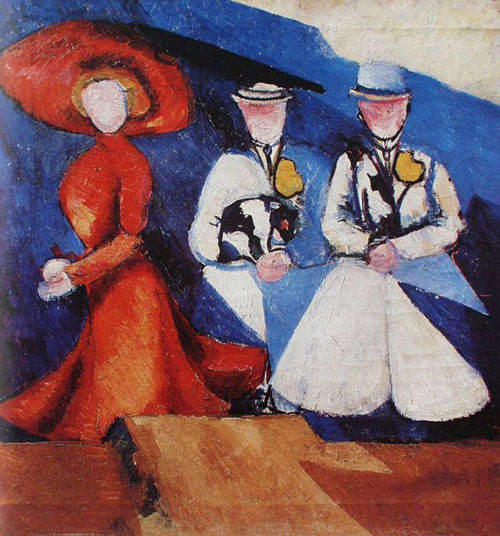
Ekster’s artistic journey was characterized by an unwavering commitment to innovation and a profound openness to diverse influences. A transformative sojourn in Paris with her husband, Nikolai Evgenyevich Ekster, commencing in 1907, ignited within her a passionate desire for experimentation that would fuel the subsequent evolution of her work. Exposure to the ferment of the avant-garde at the Académie de la Grande Chaumière in Montparnasse acted as a catalyst, propelling her into a world brimming with new ideas and techniques. Returning to Russia, she swiftly became an integral figure within several groundbreaking artistic groups and exhibitions. Her early works are imbued with the unmistakable hallmarks of Cubist principles – fractured forms, dynamic perspectives, and a deliberate fragmentation of reality—yet she quickly transcended mere imitation, infusing her paintings with a distinctly Russian sensibility rooted in folklore and national identity. She forged powerful connections with Pablo Picasso and Georges Braque, even being introduced to Gertrude Stein, further cementing her place within the international art scene’s most influential circles. Participation in exhibitions such as the Salon des Indépendants alongside luminaries like Kazimir Malevich and Sonia Delaunay-Terk underscored her dedication to pushing artistic boundaries. The influence of Futurism is also powerfully evident in this period, with its emphasis on movement, speed, and the dynamism of modern life—a theme that would continue to inform her work throughout her career. A pivotal moment arrived with her embrace of Suprematism in 1915, joining Malevich’s group and exploring the radical potential of geometric abstraction as a means of expressing pure artistic feeling. This led to collaborative artisan workshops where she worked alongside other prominent artists like Lyubov Popova and Olga Rozanova, fostering a spirit of collective creativity and experimentation. Her involvement extended beyond painting; Ekster actively contributed to the revolutionary fervor sweeping Russia, designing abstract motifs for street decorations in Kyiv and creating innovative costumes for Vadym Meller’s ballet studio, collaborating directly with Bronislava Nijinska herself.
A Pedagogue of Form: VKhUTEMAS and Artistic Dissemination
Following the Russian Revolution, Ekster dedicated herself to art education, believing passionately in the transformative power of artistic training to shape a new society. From 1921 to 1924, she served as director of the basic color course at VKhUTEMAS – the Higher Art and Technical Studios in Moscow—one of the most influential art schools of its time. Her pedagogical approach was revolutionary, emphasizing not just technical skill but also a deep understanding of form, color theory, and composition. She encouraged her students to break free from traditional constraints, fostering an environment where experimentation and individual expression were paramount. This period witnessed the birth of groundbreaking designs for stage sets and costumes, reflecting her commitment to integrating art into everyday life—a core tenet of Constructivist ideology. Her influence extended beyond the classroom; she actively sought to disseminate her knowledge through workshops and exhibitions, ensuring that her ideas reached a wider audience.
Parisian Refinement and a Lasting Legacy
In 1924, Ekster embarked on a new chapter, emigrating to Paris with her husband. She continued to teach at the Académie de l'Art Moderne and later at the Académie d’Art Contemporain Fernand Léger, sharing her expertise with a new generation of artists. However, it was during this Parisian period that she developed a distinctive style characterized by delicate gouache illuminations—intricate compositions imbued with a lyrical quality and an exquisite attention to detail. Her masterpiece from this time is widely considered to be the *Callimaque* manuscript (circa 1939), a stunning translation of Callimachus’ hymns into French, adorned with her exquisite illustrations – a testament to her artistic versatility and intellectual curiosity. These works reveal a shift towards greater refinement and decorative elegance, while still retaining the underlying principles of abstraction that defined her earlier career. Despite facing challenges in gaining widespread recognition during her lifetime—partly due to the political turmoil of the era—Ekster’s reputation has experienced a remarkable resurgence in recent decades. Her contributions to stage design, painting, art education, and costume design are now celebrated as pivotal moments in the development of modern art. However, it is important to note that the increasing demand for her work has unfortunately led to a proliferation of forgeries, highlighting the importance of careful authentication when acquiring pieces attributed to this remarkable artist. Aleksandra Ekster died in Fontenay-aux-Roses, France, on March 17, 1949, leaving behind an enduring legacy as a true pioneer of the avant-garde—an artist who fearlessly embraced innovation and bridged cultural divides with her visionary art.
A Synthesis of Styles: Ekster’s Enduring Influence
Aleksandra Ekster's significance lies not in adherence to a single style, but rather in her remarkable ability to synthesize diverse artistic currents – Cubo-Futurism, Suprematism, and Constructivism – into a uniquely personal visual language. Her work embodies the spirit of experimentation and innovation that defined the Russian avant-garde, while simultaneously reflecting a cosmopolitan sensibility shaped by her travels and interactions with artists across Europe. She was a master colorist, employing bold hues and dynamic compositions to create works that are both intellectually stimulating and emotionally resonant. Her contributions to stage design were equally groundbreaking, transforming the theatrical experience through abstract sets and innovative costumes. Ekster’s legacy extends beyond her paintings; she was a dedicated educator who inspired countless students to embrace artistic freedom and explore new possibilities. She remains a vital figure in the history of modern art—a testament to the power of creativity and the enduring allure of artistic innovation.
- Key Movements: Cubo-Futurism, Suprematism, Constructivism, Art Deco
- Significant Collaborations: Pablo Picasso, Georges Braque, Kazimir Malevich, Bronislava Nijinska
- Major Contributions: Painting, stage design, art education, costume design.



 Comprar impressão
 Enviar
 Detalhes da obra
 Adicionar aos favoritos
 Baixar
 Semelhantes
 Raio X
 Slideshow






 Compartilhar


 Ver mais




































 A opção de vidro está disponível apenas para tamanhos inferiores a 110 cm