


x

Adquira uma imagem digital de alta resolução e aprimorada, muito superior à prévia online.
Cada arquivo é meticulosamente preparado por nossos especialistas internos, utilizando ferramentas avançadas e retoques manuais de alta precisão. Garantimos que cada imagem apresente clareza excepcional, fidelidade de cores e detalhes minuciosos.
O arquivo final é entregue por e-mail em até 72 horas, otimizado para uso imediato em ambientes profissionais, editoriais e de impressão. Esta é a mesma qualidade utilizada por estúdios de design de alto nível, editoras e galerias.
Baixe um arquivo de alta resolução para exibição pessoal, impressão e projetos criativos. ( Encomendar impressão Encomendar reprodução pintada à mão)
Ao escolher o Most-Famous-Paintings.com, você não está apenas adquirindo uma imagem — você está recebendo uma obra de arte digital profissionalmente aprimorada, elaborada com precisão e com garantia de satisfação. Aqui está tudo o que acompanha seu pedido, automaticamente:

O seu arquivo de imagem digital em alta resolução será enviado por e-mail em até 72 horas após o pedido — pronto para uso imediato.

Sua obra de arte é otimizada profissionalmente por meio de ferramentas avançadas de IA e edição manual, garantindo o máximo de detalhes, clareza e precisão de cores.

Apagou ou perdeu o seu ficheiro acidentalmente? Não se preocupe – nós reenviamos para si a qualquer momento, gratuitamente.

Desfrute da sua obra de arte instantaneamente, sem taxas alfandegárias, impostos ou custos de entrega — downloads digitais são sempre isentos de taxas.

Garantimos que sua imagem digital reflita as cores originais com a maior fidelidade possível, utilizando ferramentas profissionais e gerenciamento de cores.

Se você não estiver satisfeito com sua imagem digital, nós a revisaremos ou reembolsaremos 100% dentro de 60 dias — sem perguntas.

Não está satisfeito? Receba o reembolso total em até 60 dias após o recebimento do seu arquivo digital — sem perguntas.

Compre 3 imagens, economize 10% - Compre 5, economize 15% - Compre 10+, economize 20%. Ideal para projetos criativos, galerias e agências.
Egon Schiele’s “Fighter,” painted in 1913, is not merely a depiction of a man throwing a punch; it’s a visceral exploration of the human condition rendered with the unflinching intensity characteristic of Schiele's expressionist style. This work, created during a period of immense personal and artistic turmoil for the artist, embodies his fascination with vulnerability, mortality, and the struggle for control – themes that would become central to his oeuvre. The painting’s power resides in its brutal honesty, a quality amplified by Schiele’s signature technique: bold, gestural brushstrokes applied with a furious energy that seems to vibrate off the canvas. The distorted musculature of the figure, the strained posture, and the almost violent extension of the arm all contribute to an overwhelming sense of impending impact, capturing a moment suspended between preparation and release.
Schiele's approach to depicting the human form was revolutionary for his time. Rejecting the idealized representations favored by many of his contemporaries, he embraced a deliberately unsettling realism, often exaggerating anatomical features to heighten emotional effect. In “Fighter,” this is evident in the elongated limbs and the almost skeletal quality of the figure’s body. The use of muted earth tones – browns, ochres, and greys – further emphasizes the painting's somber mood, creating a sense of claustrophobia and impending doom. His technique involved layering thin washes of paint, building up texture through repeated applications of brushstrokes, resulting in a surface that is both rough and intensely expressive. This deliberate roughness mirrors the emotional intensity he sought to convey.
"Fighter" was created at a pivotal moment in European history – 1913, a year marked by rising political tensions and anxieties surrounding World War I. Schiele’s personal life mirrored this instability; plagued by illness, loss, and the looming threat of conflict, he channeled his fears and uncertainties into his art. The painting can be interpreted as a reflection of these broader societal concerns – a visual representation of the fragility of human existence in the face of overwhelming forces. Schiele's work aligns with the Expressionist movement’s rejection of objective reality in favor of subjective emotional experience, anticipating many of the key tenets that would define the movement.
The inclusion of the cup held by the figure adds another layer of complexity to the painting's symbolism. It could represent a fleeting moment of solace or perhaps an attempt to control the chaos within, mirroring the inherent human desire for order amidst turmoil. The act of throwing the punch itself is not simply a physical gesture; it’s a symbolic confrontation with one's own demons, a desperate assertion of agency in a world that increasingly felt beyond one's control. The overall effect is profoundly unsettling and deeply moving, inviting viewers to confront uncomfortable truths about human nature.

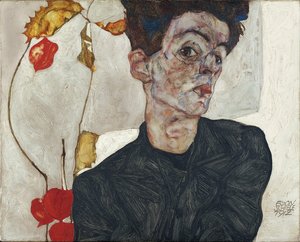
1890 - 1918 , Áustria


Fique por dentro das últimas notícias de arte, ofertas exclusivas e ideias de decoração.
Conte-nos sobre o seu projeto e os nossos especialistas em arte fornecerão 3 sugestões de arte personalizadas.
Deixe que selecionamos 3 opções especialmente para você – Grátis!


 Visualizar em escala
 Enviar
 Compartilhar
 Ver detalhes

 Baixar
 Semelhantes
 Raio X
 Apresentação de slides

 Ver mais


