x

Impressão giclée ou em tela de qualidade de museu, com produção rápida e opções flexíveis de acabamento. ( Encomendar reprodução pintada à mão Comprar imagem em alta resolução)





























Escolha entre os nossos tamanhos pré-definidos que respeitam as proporções originais da obra de arte.

Você pode inserir suas próprias dimensões para se ajustar a uma moldura ou espaço específico. Se o tamanho selecionado não corresponder às proporções da imagem original, iremos recortar a obra de arte ou estender a imagem com uma borda espelhada ou preenchimento sólido. Um mockup digital será enviado para sua aprovação antes do início da produção.
Por favor, observe que a visualização na tela não reflete o recorte ou a extensão real. Apenas o mockup mostrará com precisão a composição final.
Embora tamanhos personalizados estejam disponíveis, recomendamos selecionar uma dimensão da lista predefinida para preservar as proporções originais.
Entrega mundial () em 2 semanas, em vez das 4/5 semanas padrão. (15 Agosto)


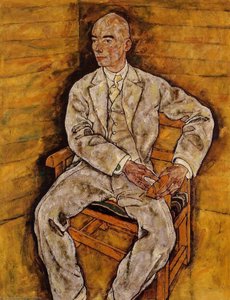
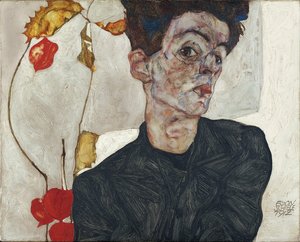
Triple Self Portrait
Dimensões da Reprodução
Egon Schiele’s “Triple Self Portrait,” painted in 1913, stands as a haunting testament to the anxieties simmering beneath the surface of Expressionist art. More than just a depiction of three figures seated before a chair—though these elements contribute significantly to its visual impact—the painting delves into profound psychological complexities and embodies Schiele’s signature preoccupation with mortality and vulnerability.
Schiele, born in Tulln an der Donau in 1890, experienced early trauma that profoundly shaped his artistic vision. His father's debilitating syphilis illness instilled within him a visceral awareness of disease and decay—themes that would permeate throughout his oeuvre. Raised primarily by his mother and later under the watchful eye of his uncle Leopold Czihaczek, Schiele’s upbringing fostered an independent spirit tempered by intellectual curiosity. Despite familial disapproval regarding his artistic pursuits – deemed frivolous compared to more practical ambitions – he relentlessly pursued drawing, honing his skill with unwavering dedication.
The painting itself is executed in watercolor on paper, a technique Schiele favored for its ability to convey subtle tonal variations and capture the immediacy of emotion. His distinctive style—characterized by angular lines, flattened perspectives, and unsettlingly realistic depictions of human anatomy—is instantly recognizable. The figures are rendered with meticulous detail, their faces pressed together in expressions of anguish and introspection. Notably, the inclusion of two chairs serves as a powerful visual metaphor for confinement and isolation; they represent not merely physical spaces but also psychological barriers hindering self-awareness.
Painted during a period marked by intellectual ferment and societal upheaval—the burgeoning avant-garde movement challenging traditional artistic conventions alongside the looming shadow of World War I— “Triple Self Portrait” reflects the pervasive atmosphere of unease and disillusionment prevalent in Europe at the time. Schiele’s unflinching gaze confronts viewers with uncomfortable truths about human existence, prompting contemplation on themes of suffering, fear, and the inescapable awareness of death.
“Triple Self Portrait” continues to resonate powerfully today as a masterpiece of psychological portraiture. Its haunting beauty lies not in idealized representation but in its courageous articulation of inner turmoil—a testament to Schiele’s enduring legacy as one of Expressionism's most influential figures and a poignant reminder of the artist’s profound engagement with the human condition.
1890 - 1918 , Áustria
Transforme suas memórias em obras de arte atemporais! Retratos personalizados pintados por artistas experientes. Qualidade, exclusividade e um legado emocional para toda a vida. Descubra o poder da arte sob encomenda.

Explore the emotionally charged world of Egon Schiele (1890-1918). Discover his Expressionist masterpieces, psychological themes, and lasting impact on modern art. A comprehensive guide for collectors & enthusiasts.

Explore the fascinating evolution of portraiture from classical masterpieces to digital art! Discover symbolism, techniques & societal impact. Expert insights for collectors & enthusiasts at Most-Famous-Paintings.

Explore the groundbreaking work of Paula Modersohn-Becker, a pioneer of Expressionism. Discover her intimate self-portraits & poignant depictions of motherhood – shaping early 20th-century art with emotional depth and innovation.
Descubra as 25 obras-primas de Egon Schiele, o mestre expressionista austríaco. Explore a vida, técnica e simbolismo por trás de seus retratos icônicos e nus impactantes. Encontre reproduções de arte exclusivas para decorar sua casa com emoção e estilo em Most-Famous-Paintings.com


Fique por dentro das últimas notícias de arte, ofertas exclusivas e ideias de decoração.
Conte-nos sobre o seu projeto e os nossos especialistas em arte fornecerão 3 sugestões de arte personalizadas.
Deixe que selecionamos 3 opções especialmente para você – Grátis!


 Visualizar em escala
 Enviar
 Compartilhar
 Ver detalhes

 Baixar
 Semelhantes
 Raio X
 Apresentação de slides

 Ver mais







 A opção de vidro está disponível apenas para tamanhos inferiores a 110 cm