Venda sua arte
Lista de desejos Carrinho de compras Cart
Visualizar em escalaVisualizar em escala Visualizar em RAVisualizar em RA Encomendar impressão Encomendar impressãoComprar imagem em alta resolução Comprar imagem em alta resolução EnviarEnviar
Ver detalhesVer detalhes Adicionar aos favoritos Adicionar aos favoritos BaixarBaixar SemelhantesSemelhantes Raio XRaio X Apresentação de slidesApresentação de slides

Study of a Fowl, Lateral View, with skin and underlying fascial layers removed, from 'A Comparative Anatomical Exposition of the Structure of the Human Body with that of a Tiger and a Common Fowl'

A striking anatomical study by George Stubbs depicting a fowl's internal structure with remarkable detail and precision. Explore the artistry of comparative anatomy.

George Stubbs (1724-1806): Pintor inglês renomado por sua precisão anatômica e representações magistrais de cavalos. Pioneiro do Romantismo, famoso pelo 'Whistlejacket'. Explore sua arte equestre e legado artístico.

Reprodução em Óleo Feita à Mão

Óleo sobre tela pintado à mão no seu tamanho e moldura, feito sob encomenda pelos nossos artistas. (Encomendar impressão Encomendar impressãoComprar imagem em alta resolução Comprar imagem em alta resolução)

P118B $10
P118H $10
P118W $10
P438Z $10
P508JH $12
P508YH $12
P805H $10
P805Z $10
P919BZ $10
P919G $10
P919XJ $10
P959ZH $10
P968JZ $12
W106C $8
W218G $10
W218JH $8
W218Y $10
W307PJ $10
W316G $10
W316PJ $8
W316Y $10
W398PJ $8
W4111J $10
W500HY $15
W500JH $15
W692G $12
W849H $8
W940BG $15
W953PJ $8

Standard
custom
CM
INCH

Escolha entre os nossos tamanhos pré-definidos que respeitam as proporções originais da obra de arte.

largura
altura

Pode inserir as suas próprias dimensões para se adequar a uma moldura ou espaço específico. Se o tamanho selecionado não corresponder às proporções da imagem original, iremos cortar a obra de arte ou estender a pintura com elementos adicionais pintados à mão. Um esboço digital será enviado para sua aprovação antes do início da produção.
Tenha em atenção que a pré-visualização no ecrã não reflete o corte ou extensão real. Apenas o esboço mostrará com precisão a composição final.
Embora tamanhos personalizados estejam disponíveis, recomendamos selecionar uma dimensão da lista predefinida para preservar as proporções originais.

Exemplos do que pode ser personalizado: Substituir o rosto pela foto do cliente; Adicionar um animal de estimação (ex: substituir gato por cão); Incluir uma mensagem oculta no fundo; Alterar a paisagem ou elementos do fundo.
Após o pedido, a equipa Most-Famous-Paintings.com enviará um e-mail ao cliente para solicitar instruções e fornecer uma prévia do esboço.

Entrega mundial () em 3 a 4 semanas, em vez das 5 semanas padrão. (14 Agosto). Sem comprometer a qualidade.

why_choose_icon
Envio Expresso Gratuito para todo o Mundo
why_choose_icon
Tela de Linho Premium
why_choose_icon
Seguro de transporte total
why_choose_icon
Garantia de Reembolso de Impostos Alfandegários
why_choose_icon
Garantia de Fidelidade de Cor
why_choose_icon
Política de Devolução de 60 Dias (Apenas para Defeitos)
why_choose_icon
Garantia de reembolso de 100%
why_choose_icon
Desconto para múltiplas unidades

Preço Total

$ 272

reproduction

Study of a Fowl, Lateral View, with skin and underlying fascial layers removed, from 'A Comparative Anatomical Exposition of the Structure of the Human Body with that of a Tiger and a Common Fowl'

Técnica de Reprodução

Dimensões da Reprodução

-

Preço Total

$ 272

Detalhes Rápidos

  • Artistic style: Scientific illustration
  • Artist: George Stubbs
  • Movement: Romanticism
  • Influences: Stubbs's studies
  • Location: Yale Center Art
  • Title: Study of a Fowl
  • Subject or theme: Comparative anatomy

Teste de Conhecimentos Artísticos

Cada pergunta possui apenas uma resposta correta.

Questão 1:
What is the primary subject of George Stubbs’s ‘Study of a Fowl, Lateral View…’?
Questão 2:
The artwork’s style is most closely associated with which period?
Questão 3:
What technique is predominantly used to render the musculature and bone structure in this study?
Questão 4:
According to the description, what is a key characteristic of Stubbs’s approach to animal painting?
Questão 5:
The artwork’s composition features the subject centrally positioned. What effect does this create?

Descrição da Obra

The Unveiling of Form: An Anatomical Meditation

To gaze upon this study is to participate in an act of profound intellectual curiosity. It is not merely a depiction of a fowl, but rather a meticulous excavation of life itself—a moment where the superficial veil of skin and flesh has been carefully drawn back to reveal the intricate machinery beneath. George Stubbs, master anatomist and painter, presents us with a lateral view that arrests the viewer in a state of suspended scientific wonder. The composition is utterly focused, drawing all attention to the delicate interplay between bone, sinew, and fascia. There is an undeniable tension captured here; the bird seems caught mid-motion, its neck arched as if recalling some forgotten flight, even though the study demands absolute stillness for its observation.

Mastery in Line: Technique and Precision

The sheer technical brilliance on display is breathtaking. Stubbs employs a vocabulary of line that speaks volumes about his dedication to empirical truth. Observe how the artist has utilized hatching and cross-hatching, not just as shading techniques, but as descriptive tools. These fine, precise lines do more than suggest shadow; they articulate the very texture of muscle fiber, the smooth curve of tendon, and the stark geometry of bone structure. The medium, likely graphite or charcoal on paper, allows for an unparalleled subtlety in tone—a graduation from deep, velvety blacks to the palest whispers of white. This masterful control over value gives the illusion of depth, making the layered anatomy feel almost tangible, as if one could reach out and trace the path of a ligament.

A Window into Enlightenment Science

This work situates itself firmly within the grand tradition of scientific illustration from the eighteenth century. During this era, art and science were deeply intertwined; the pursuit of aesthetic beauty often walked hand-in-hand with the relentless drive for objective knowledge. Stubbs’s commitment to comparative anatomy—comparing fowl structure to that of man and tiger in a larger context—places this piece within a rich intellectual lineage. It speaks to an age fascinated by classification, understanding the universal laws governing biological form. For the modern collector or designer, owning such a reproduction is not just acquiring art; it is curating a tangible piece of Enlightenment thought.

Emotional Resonance Beyond the Subject

While the subject matter—a dissected animal—is inherently clinical and devoid of overt narrative emotion, its impact on the viewer is anything but detached. There is an undeniable pull toward the sublime in this level of detail. It evokes a complex cocktail of emotions: profound respect for life’s engineering, the thrill of discovery, and perhaps a touch of poignant melancholy at the necessary act of dissection required to reveal such secrets. This piece invites contemplation; it asks us to look closer, to appreciate the hidden complexity that supports every graceful movement we take.

Integrating Art into Modern Spaces

For those seeking art for an interior space, this study offers a unique focal point. It transcends mere decoration, acting instead as a sophisticated intellectual anchor. Framed thoughtfully, it introduces a layer of scholarly gravitas and refined naturalism to any room—be it a library, a study, or a gallery-inspired living area. The monochromatic palette ensures that its impact is timeless, complementing rich wood tones, muted textiles, and modern minimalist aesthetics alike. It is an object that rewards prolonged viewing, promising endless moments of quiet, detailed appreciation.


Biografia do Artista

Early Life and Training

George Stubbs, a name synonymous with the majestic depiction of horses in art, was born on August 25th, 1724, in Liverpool, a bustling port city at the heart of England’s burgeoning colonial trade. His early years were marked by a modest upbringing; his father, John Stubbs, worked as a leather-dresser, a craft that initially shaped young George's path. However, from a remarkably young age – around the age of fifteen – he displayed an undeniable passion for art, diverging from his family’s traditional profession to pursue his artistic ambitions. He sought out apprenticeship with Hamlet Winstanley, a local painter and engraver, gaining a foundational understanding of technique and artistic principles. This brief but formative period provided him with access to the collection at Knowsley Hall, an estate belonging to Winstanley's family, exposing Stubbs to a wealth of classical art and inspiring his own artistic vision. It was during this time that he began to develop his keen eye for detail and his fascination with anatomy, laying the groundwork for his future masterpieces.

Artistic Development and Notable Works

Stubbs’s dedication to anatomical study proved pivotal in shaping his distinctive style. Recognizing the importance of understanding the underlying structure of animals, he moved to York in 1744, where he became an assistant to Charles Atkinson, a surgeon at York County Hospital. This immersion in medical science provided him with unparalleled insight into animal musculature and skeletal systems – knowledge that would later manifest in his remarkably accurate and lifelike depictions of horses. A significant milestone in Stubbs’s career occurred in 1756 when he rented a farmhouse in Lincolnshire, establishing a dedicated studio where he spent an astonishing eighteen months meticulously dissecting horses. This intensive period of study culminated in the publication of *Anatomy of the Horse* in 1766, a groundbreaking work that showcased his anatomical precision and cemented his reputation as a scientific artist. The illustrations from this book are now housed at the Royal Academy, testament to their enduring value and artistic merit. It was during this time that he began receiving commissions from prominent aristocratic patrons, including the Duke of Richmond, who commissioned three large paintings in 1759 – a turning point that propelled Stubbs into the realm of established success.

The Rise of Romanticism and Iconic Paintings

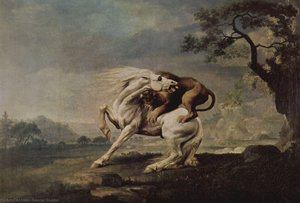
Stubbs’s artistic trajectory reached its zenith with his groundbreaking series of paintings depicting a lion attacking a horse. These works, particularly *A Lion Attacking a Horse*, are considered seminal examples of the burgeoning Romantic movement in art. Departing from the rigid conventions of classical painting, Stubbs infused these scenes with dramatic intensity, capturing not just the physical struggle but also the raw emotion and primal instincts of the animals involved. Notably, his paintings for the Duke of Rockingham – *Whistlejacket* and two other works – broke with established artistic norms by featuring plain backgrounds, a bold move that prioritized the dynamism and power of the subject matter over elaborate ornamentation. *Whistlejacket*, a painting of a thoroughbred racehorse rising on his hind legs, is arguably Stubbs’s most famous work, instantly recognizable for its captivating portrayal of equine athleticism and its subtle yet profound commentary on the social hierarchy of horse racing. The National Gallery in London proudly houses this iconic masterpiece.

Legacy and Historical Significance

George Stubbs's legacy extends far beyond his individual paintings; he fundamentally transformed the way horses were depicted in art, elevating them to a position of dignity and grandeur. His meticulous anatomical studies, combined with his masterful use of color, light, and composition, created images that are both scientifically accurate and emotionally resonant. Stubbs’s influence can be seen in the works of subsequent generations of artists, solidifying his place as one of the most important figures in British art history. He was not merely a painter of horses; he was an innovator, a pioneer, and a visionary who captured the essence of animal life with unparalleled skill and insight. His work continues to inspire awe and admiration, serving as a testament to the enduring power of artistic observation and creative expression.
George Stubbs

George Stubbs

1724 - 1806 , Reino Unido

Informações Rápidas

  • Artistic Movement Or Style: Romantismo, Equina
  • Artists Or Movements Influenced By This Artist: ['Joshua Reynolds']
  • Artists Who Influenced This Artist: ['Hamlet Winstanley']
  • Date Of Birth: 25 de agosto de 1724
  • Date Of Death: 10 de julho de 1806
  • Full Name: George Stubbs
  • Nationality: Britânico
  • Notable Artworks:
    • Whistlejacket
    • Leão e Cavalo
    • Ataque de Leão
  • Place Of Birth: Liverpool, Reino Unido
Explore obras de arte organizadas por temas, estilos e características.