
Lista de desejos Carrinho de compras Cart
Visualizar na paredeVisualizar na parede Ver em RAVer em RA Comprar pintura feita à mão Comprar pintura feita à mãoComprar imagem Comprar imagem CompartilharCompartilhar
DetalhesDetalhes Adicionar aos favoritos Adicionar aos favoritos Baixar imagemBaixar imagem SemelhantesSemelhantes Raio XRaio X SlideshowSlideshow

Victime

Moreau’s haunting ‘Victime,’ a Symbolist masterpiece depicting a sorrowful woman gazing upwards amidst fantastical elements—a bird, boat, and swirling clouds—captures the artist's profound exploration of myth and emotion. Immerse yourself in this evocative image and bring timeless beauty into your home.

Explore a obra singular de Gustave Moreau (1826-1898), mestre do simbolismo francês! Mitologia, religião e sonhos em pinturas exuberantes e enigmáticas. Influenciou Matisse & Rouault.

Giclée / Impressão de Arte

Impressão giclée ou em tela de qualidade de museu, com produção rápida e opções flexíveis de acabamento. (Comprar pintura feita à mão Comprar pintura feita à mãoComprar imagem Comprar imagem)

P118B $10
P118H $10
P118W $10
P438Z $10
P508JH $12
P508YH $12
P805H $10
P805Z $10
P919BZ $10
P919G $10
P919XJ $10
P959ZH $10
P968JZ $12
W106C $8
W218G $10
W218JH $8
W218Y $10
W307PJ $10
W316G $10
W316PJ $8
W316Y $10
W398PJ $8
W4111J $10
W500HY $15
W500JH $15
W692G $12
W849H $8
W940BG $15
W953PJ $8

Standard
custom
CM
INCH

Escolha entre os nossos tamanhos pré-definidos que respeitam as proporções originais da obra de arte.

largura
altura

Você pode inserir suas próprias dimensões para se ajustar a uma moldura ou espaço específico. Se o tamanho selecionado não corresponder às proporções da imagem original, iremos recortar a obra de arte ou estender a imagem com uma borda espelhada ou preenchimento sólido. Um mockup digital será enviado para sua aprovação antes do início da produção.
Por favor, observe que a visualização na tela não reflete o recorte ou a extensão real. Apenas o mockup mostrará com precisão a composição final.
Embora tamanhos personalizados estejam disponíveis, recomendamos selecionar uma dimensão da lista predefinida para preservar as proporções originais.

Entrega mundial () em 2 semanas, em vez das 4/5 semanas padrão. (22 Agosto)

why_choose_icon
Envio expresso gratuito para todo o mundo
why_choose_icon
Tela de Linho de Alta Qualidade
why_choose_icon
Seguro de transporte completo
why_choose_icon
Garantia de Reembolso de Impostos Alfandegários
why_choose_icon
Garantia de Fidelidade Cromática
why_choose_icon
Política de Devolução em 60 Dias (Apenas para Defeitos)
why_choose_icon
Garantia de reembolso de 100%
why_choose_icon
Oferta de desconto por quantidade

Preço Total

$ 68

reproduction

Victime

Giclée / Impressão de Arte

Tamanho da Reprodução

-

Preço Total

$ 68

Informações Rápidas

  • Artist: Gustave Moreau
  • Artistic style: Dreamlike; Surrealist
  • Title: Victime
  • Medium: Oil on canvas
  • Subject or theme: Mythological figure; Distress

Quiz de Arte

Cada pergunta possui apenas uma resposta correta.

Pergunta 1:
What artistic movement is Gustave Moreau's 'Victime' considered a cornerstone of?
Pergunta 2:
What does the woman's upward gaze in the painting primarily suggest?
Pergunta 3:
Which technique did Moreau use to achieve a velvety surface texture and subtle light nuances?
Pergunta 4:
What recurring motif in the painting is often interpreted as symbolizing hope and transcendence?
Pergunta 5:
The color palette of 'Victime' primarily uses which tones to evoke melancholy and spiritual contemplation?

Descrição do Colecionável

A Vision of Sorrowful Beauty: The Ethereal World of Gustave Moreau

In the twilight of the nineteenth century, as the rigid structures of academic realism began to fracture, Gustave Moreau emerged as a master weaver of dreams. His work, specifically the hauntingly beautiful "Victime," serves as a profound cornerstone of the Symbolist movement—a period where the artist’s duty shifted from capturing the tangible world to exploring the boundless reaches of the human psyche. To gaze upon this canvas is to step through a portal into a realm where the boundaries between reality and myth dissolve, leaving the viewer suspended in a state of spiritual contemplation. The painting does not merely present a figure; it presents an atmosphere of otherworldly luminescence, inviting those with a discerning eye for depth and mystery to lose themselves in its enigmatic layers.

The composition is anchored by a central female figure, a presence that dominates the canvas with a palpable sense of vulnerability and grace. Bathed in a light that seems to emanate from within rather than from an external source, she gazes upward toward the heavens, her expression a delicate tapestry of anguish and aspiration. This upward trajectory of her gaze suggests a soul caught in the tension between earthly suffering and divine longing. Surrounding her, the elements of the scene—swirling, nebulous clouds and the distant, ghostly silhouette of a boat—contribute to an overwhelming sense of isolation. The artist masterfully employs a circular framing around the subject, a technique that reinforces her solitude, making her appear as if she is encased within a celestial or perhaps even a fateful orb, separate from the terrestrial world.

Technique and the Alchemy of Light

For the collector or interior designer seeking a piece that commands attention through texture and nuance, Moreau’s technical prowess offers endless fascination. His method was one of meticulous alchemy, utilizing a layering technique known as glazing—applying thin, translucent skins of pigment upon one another to achieve a velvety, multidimensional surface. This process allows light to penetrate the upper layers and reflect back from the depths of the paint, creating that signature Moreau glow. The subtle interplay of muted blues, golds, and shadows creates an illusionistic depth that transforms a flat canvas into a window onto a dreamscape.

Every brushstroke is intentional, designed to evoke a sensory response. The way the light catches the fine details of her hair or the soft shimmer of her skin provides a tactile quality that makes a high-quality reproduction feel remarkably alive. This mastery of light and shadow—chiaroscuro reimagined through a Symbolist lens—ensures that the painting remains dynamic, changing its emotional temperature depending on the lighting of the room in which it is displayed. It is an artwork that does not just sit upon a wall; it breathes within a space.

Symbolic Resonance and Emotional Legacy

Beyond its aesthetic splendor, "Victime" is a dense thicket of symbolic meaning, drawing heavily from the Greco-Roman myths and religious allegories that preoccupied Moreau. The presence of recurring motifs, such as the bird soaring above the woman’s head, serves as a potent symbol of transcendence and the enduring hope that survives even the darkest tribulations. The very title suggests a state of sacrifice, yet the figure's resilience is etched into her features, offering a narrative of strength amidst sorrow.

For those looking to curate an environment of intellectual depth and emotional resonance, this piece offers unparalleled inspiration. It speaks to the themes of fate, destiny, and the eternal struggle of the human spirit. Whether placed in a quiet study to provoke introspection or as a focal point in a grand salon to spark conversation, Moreau’s "Victime" brings with it a legacy of profound psychological exploration. Owning a reproduction of such a masterpiece is an invitation to surround oneself with the sublime, turning any interior into a sanctuary of artful contemplation and timeless beauty.

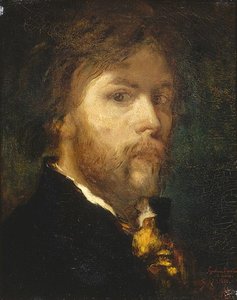
Biografia do Artista

A Dream Weaver of Symbolism: The Life and Art of Gustave Moreau

Gustave Moreau, a name inextricably linked to the ethereal beauty and profound mysteries of Symbolist painting, emerged from 19th-century Paris as an artist utterly distinct in his vision. Born in 1826 into a comfortable bourgeois family—his father an architect and archivist—Moreau’s early life was steeped in intellectual curiosity and a deep appreciation for aesthetics. From a remarkably young age, he displayed a prodigious talent for drawing, nurtured through the rigorous training of the École des Beaux-Arts under masters like François-Édouard Picot. However, Moreau's artistic trajectory swiftly diverged from the prevailing Realist and Impressionist currents of his time. He wasn’t driven by a desire to capture fleeting moments or represent objective reality; instead, he sought to unlock the hidden realms of myth, religion, and the intricate workings of the human psyche through a deeply personal and symbolic visual language. His journey was one of inward exploration, translating subjective emotions and spiritual yearnings onto canvas with an almost obsessive attention to detail and a palette often rich in vibrant, unexpected hues.

The Forge of Imagination: Influences and Artistic Development

Moreau’s artistic development wasn't forged in isolation. While consciously rejecting the dominant trends of his era, he drew inspiration from a remarkably diverse range of sources. The dramatic use of color and exotic subject matter found in the works of Eugène Delacroix ignited within him a passionate interest in narrative painting imbued with intense emotionality. He held Renaissance masters—Michelangelo and Leonardo da Vinci, in particular—in high regard, deeply admiring their mastery of composition, anatomical precision, and their remarkable ability to penetrate the complexities of human psychology. Yet, Moreau wasn’t merely imitating these giants; he was skillfully synthesizing their influences into something entirely new, a distinctly personal style. His pivotal journey to Italy during the 1850s proved transformative, immersing him in the art of antiquity and the Renaissance. This experience provided an unparalleled wealth of motifs and stylistic cues that would subsequently populate his paintings—a treasure trove of imagery he meticulously studied and absorbed. He undertook countless copies of Old Master works, not as mere reproductions, but as a means of understanding their techniques and unlocking the secrets behind their enduring power. This dedication to meticulous study, combined with an increasingly fervent interest in mythology and literature, formed the bedrock of his unique artistic vision.

A World of Symbols: Themes and Techniques

Moreau’s paintings are not simply illustrations of myths or biblical stories; they are complex allegories designed to provoke contemplation and interpretation. He didn't aim to retell these narratives literally but rather to explore their underlying psychological and spiritual truths. His canvases are often teeming with symbolic imagery—serpents representing temptation, jewels signifying earthly desires, and figures embodying abstract concepts such as grief, loss, or redemption. He masterfully created an atmosphere of dreaminess through intricate detail, rich textures, and a frequently unsettling juxtaposition of light and shadow. Moreau’s technique was characterized by a deliberate layering of paint—a painstaking process that resulted in surfaces shimmering with iridescent colors and evoking a sense of otherworldly beauty. His skillful use of gold leaf further enhanced this effect, lending his works a Byzantine quality that underscored their spiritual dimension. Crucially, Moreau wasn't concerned with capturing realistic textures or perspectives; instead, he prioritized the expressive power of color and form to convey mood and meaning—a deliberate departure from conventional artistic practices.

Notable Works and Lasting Legacy

Throughout his prolific career, Gustave Moreau produced a remarkable body of work, including iconic paintings such as *Salome Dancing before Herod*, *Jupiter and Semele*, *Orpheus*, *The Apparition*, and *Desdemona*. *Salome Dancing before Herod*, perhaps his most celebrated painting, exemplifies his opulent style and enduring fascination with biblical narratives. *Jupiter and Semele* showcases his masterful command of composition and color, while *Orpheus* explores the themes of loss and artistic inspiration through multiple iterations. Moreau’s influence extended far beyond his own lifetime. He accepted a professorship at the École des Beaux-Arts in 1893, where he profoundly impacted generations of artists, including Henri Matisse and Georges Rouault, encouraging them to embrace imagination, symbolism, and individual expression. Despite initially facing mixed reactions from critics, Moreau’s work gained increasing recognition in the decades following his death in 1898, culminating in the establishment of the Musée Gustave Moreau in Paris—a dedicated space for showcasing his extraordinary artistic legacy. Today, Gustave Moreau is widely regarded as a pivotal figure in the Symbolist movement and a significant precursor to modern art, his paintings continuing to captivate audiences with their evocative beauty and profound psychological depth.
Gustave Moreau

Gustave Moreau

1826 - 1898 , França

Dados Rápidos

  • Artistic Movement Or Style: Simbolismo
  • Artists Or Movements Influenced By This Artist:
    • Matisse
    • Rouault
  • Artists Who Influenced This Artist:
    • Delacroix
    • Michelangelo
    • Leonardo
  • Date Of Birth: 6 de abril de 1826
  • Date Of Death: 18 de abril de 1898
  • Full Name: Gustave Moreau
  • Nationality: Francês
  • Notable Artworks:
    • Salomé Dançando
    • Júpiter e Semele
    • Orfeu
    • A Aparição
    • Desdemona
  • Place Of Birth: Paris, França
Explore obras de arte organizadas por temas, estilos e características.




































