


x
![[untitled] — Miné Okubo](/media/artworks/images/full/a4/58/a45846b911e34fa2a838b81d38810794.Jpg)
Impressão giclée ou em tela de qualidade de museu, com produção rápida e opções flexíveis de acabamento. ( Encomendar reprodução pintada à mão Comprar imagem em alta resolução)





























Escolha entre os nossos tamanhos pré-definidos que respeitam as proporções originais da obra de arte.

Você pode inserir suas próprias dimensões para se ajustar a uma moldura ou espaço específico. Se o tamanho selecionado não corresponder às proporções da imagem original, iremos recortar a obra de arte ou estender a imagem com uma borda espelhada ou preenchimento sólido. Um mockup digital será enviado para sua aprovação antes do início da produção.
Por favor, observe que a visualização na tela não reflete o recorte ou a extensão real. Apenas o mockup mostrará com precisão a composição final.
Embora tamanhos personalizados estejam disponíveis, recomendamos selecionar uma dimensão da lista predefinida para preservar as proporções originais.
Entrega mundial () em 2 semanas, em vez das 4/5 semanas padrão. (14 Agosto)


[Untitled]
Dimensões da Reprodução
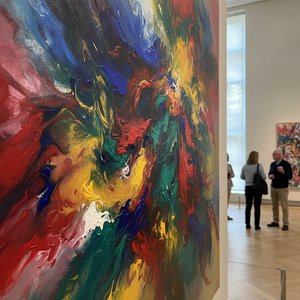
Miné Okubo's "Untitled," painted in 1974, isn't merely a depiction of flowers within a vase; it’s a vibrant testament to resilience forged during a profoundly challenging period. Created amidst the upheaval of World War II and the subsequent internment of Japanese Americans, this artwork embodies a complex tapestry of memory, displacement, and ultimately, an enduring spirit. The painting pulses with a raw energy, born from Okubo's direct observation of life within the Topaz Relocation Center in Utah – a place that simultaneously represented confinement and a space for creative expression.
The style is decidedly abstract expressionist, yet grounded in a meticulous attention to detail. Thick, impasto brushstrokes dominate the composition, lending a tactile quality to the work and suggesting layers of experience. The colors—bold reds, deep blues, sunny yellows, and crisp whites—aren’t employed with photographic realism but rather as vehicles for emotional resonance. Notice how the red dominates the central floral forms, perhaps symbolizing both the intensity of life within the camp and the fiery determination of its inhabitants. The background is a dynamic interplay of fractured planes and contrasting hues, creating a sense of movement and instability that mirrors the psychological landscape of those enduring confinement.
While seemingly a still life, “Untitled” is rich with symbolic weight. The arrangement of flowers within a vase immediately evokes traditional Japanese aesthetics – a connection to Okubo’s heritage and a subtle nod to the beauty that persisted even in the face of adversity. However, these aren't delicate, idealized blossoms; they are rendered with a forceful energy, their petals slightly distorted, their forms imbued with a sense of urgency. The vase itself acts as a container, not just holding the flowers but also representing the constraints and limitations imposed by the internment experience.
Crucially, the painting’s power lies in its ambiguity. Okubo deliberately avoids explicit representation, allowing viewers to project their own interpretations onto the scene. The fragmented background hints at a disrupted world, while the vibrant colors suggest an unwavering hope for the future. The signature “Mine Okubo 1974” in the lower right corner serves as a grounding element, anchoring the work within its historical context and reminding us of the artist’s personal journey.
To fully appreciate "Untitled," it's essential to understand the tumultuous era in which it was created. Following Executive Order 9066, nearly 120,000 Japanese Americans – including citizens and legal residents – were forcibly removed from their homes and incarcerated in camps across the Western United States. Miné Okubo’s art became a vital record of this injustice, documenting the daily realities of camp life through her meticulous drawings and paintings. Her work is part of a larger body of art created by Japanese Americans during this period—a powerful collective response to an unprecedented act of discrimination.
The fact that Okubo continued to create art *during* her confinement speaks volumes about her resilience and commitment to bearing witness. Her decision to document her experiences through visual means offered a form of agency and control in the face of overwhelming circumstances. It’s a poignant reminder of the enduring power of art as a tool for survival, remembrance, and social commentary.
Reproductions of Miné Okubo's "Untitled" offer a remarkable opportunity to bring this powerful artwork into your home or office. The vibrant colors and dynamic composition will undoubtedly serve as a focal point, injecting energy and emotion into any space. Consider framing the piece in a simple dark wood frame – allowing the artwork’s intensity to truly shine through—or opting for a more contemporary setting that complements its bold aesthetic.
Beyond its visual appeal, “Untitled” carries a profound historical significance. Owning or displaying a reproduction of this work is an act of remembrance and solidarity with the Japanese American community. It’s a chance to engage with a crucial chapter in American history and honor the artistic legacy of Miné Okubo – a woman who transformed personal suffering into a testament to human resilience.


1912 - 2001 , Estados Unidos da América
Explore the profound emotional depth of Lyrical Abstraction. Discover how masters like Raymond Parker used color and form to bridge Impressionism and Abstract Expressionism. Learn about this pivotal movement through our expert-led art history guide.

Explore the profound emotional depth of Color Field painting. Discover the history of mid-century abstraction, from Rothko to Newman, and learn how pure color transforms the viewer's experience through our expert art history guide.

Explore the profound history of American Regionalism. Discover how Grant Wood captured the heart of the Midwest through masterpieces like American Gothic. An expert guide to the movement, its cultural impact, and the enduring beauty of American Realism.


Fique por dentro das últimas notícias de arte, ofertas exclusivas e ideias de decoração.
Conte-nos sobre o seu projeto e os nossos especialistas em arte fornecerão 3 sugestões de arte personalizadas.
Deixe que selecionamos 3 opções especialmente para você – Grátis!


 Visualizar em escala
 Enviar
 Compartilhar
 Ver detalhes

 Baixar
 Semelhantes
 Raio X
 Apresentação de slides


 Ver mais







 A opção de vidro está disponível apenas para tamanhos inferiores a 110 cm


