Venda sua arte
Lista de desejos Carrinho de compras Cart
Visualizar em escalaVisualizar em escala Visualizar em RAVisualizar em RA Encomendar impressão Encomendar impressãoComprar imagem em alta resolução Comprar imagem em alta resolução EnviarEnviar
Ver detalhesVer detalhes Adicionar aos favoritos Adicionar aos favoritos BaixarBaixar SemelhantesSemelhantes Raio XRaio X Apresentação de slidesApresentação de slides

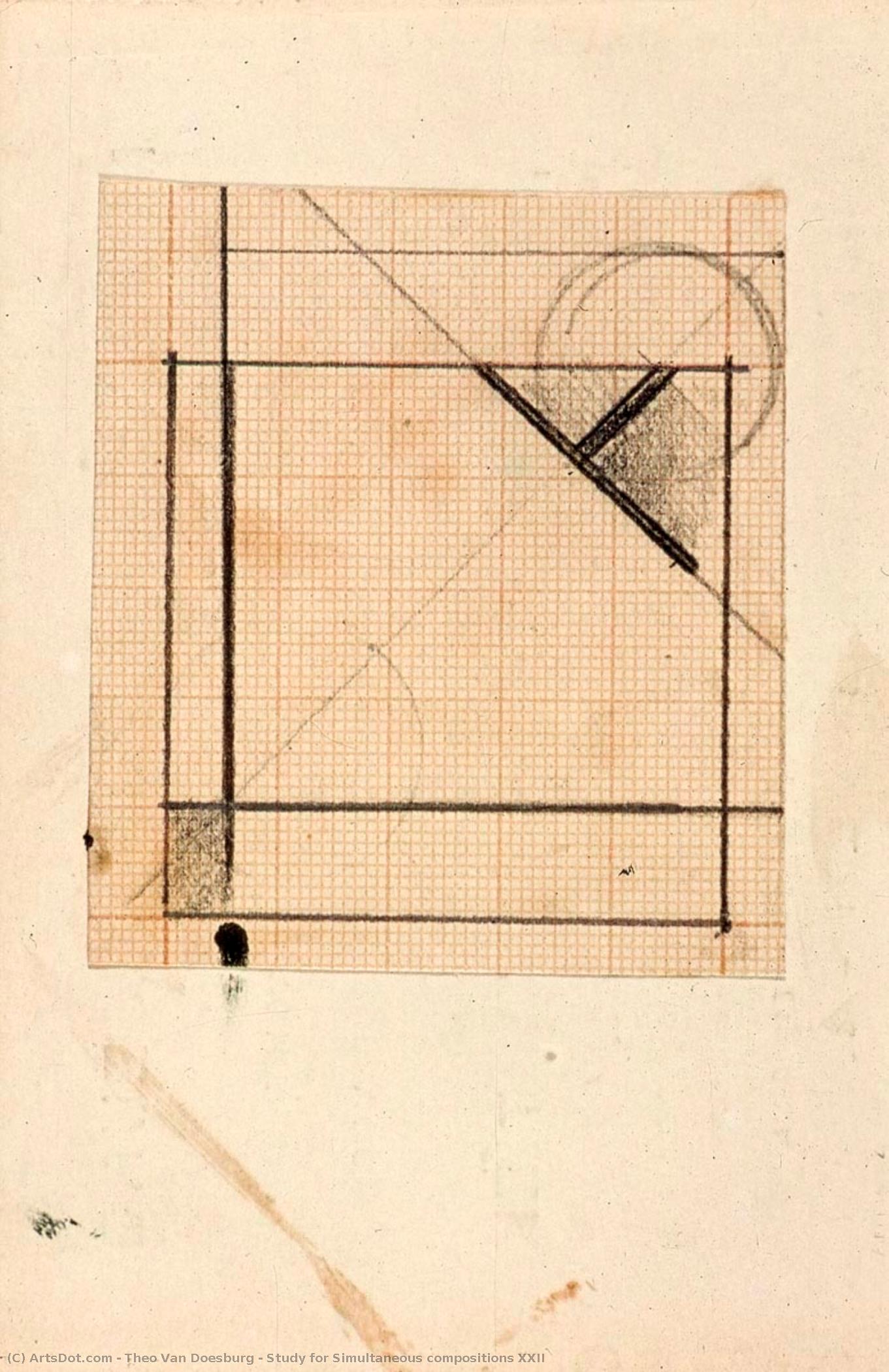
Study for Simultaneous compositions XXII

Study for Simultaneous compositions XXII by Theo van Doesburg: A rare geometric abstraction showcasing early De Stijl principles. Explore this 7cm sketch's layered lines & aged paper texture.

Explore a vida e obra de Theo van Doesburg, fundador do De Stijl! Sua arte geométrica revolucionou a arquitetura, design e a abstração moderna. Um visionário da harmonia universal.

Reprodução em Óleo Feita à Mão

Óleo sobre tela pintado à mão no seu tamanho e moldura, feito sob encomenda pelos nossos artistas. (Encomendar impressão Encomendar impressãoComprar imagem em alta resolução Comprar imagem em alta resolução)

P118B $10
P118H $10
P118W $10
P438Z $10
P508JH $12
P508YH $12
P805H $10
P805Z $10
P919BZ $10
P919G $10
P919XJ $10
P959ZH $10
P968JZ $12
W106C $8
W218G $10
W218JH $8
W218Y $10
W307PJ $10
W316G $10
W316PJ $8
W316Y $10
W398PJ $8
W4111J $10
W500HY $15
W500JH $15
W692G $12
W849H $8
W940BG $15
W953PJ $8

Standard
custom
CM
INCH

Escolha entre os nossos tamanhos pré-definidos que respeitam as proporções originais da obra de arte.

largura
altura

Pode inserir as suas próprias dimensões para se adequar a uma moldura ou espaço específico. Se o tamanho selecionado não corresponder às proporções da imagem original, iremos cortar a obra de arte ou estender a pintura com elementos adicionais pintados à mão. Um esboço digital será enviado para sua aprovação antes do início da produção.
Tenha em atenção que a pré-visualização no ecrã não reflete o corte ou extensão real. Apenas o esboço mostrará com precisão a composição final.
Embora tamanhos personalizados estejam disponíveis, recomendamos selecionar uma dimensão da lista predefinida para preservar as proporções originais.

Exemplos do que pode ser personalizado: Substituir o rosto pela foto do cliente; Adicionar um animal de estimação (ex: substituir gato por cão); Incluir uma mensagem oculta no fundo; Alterar a paisagem ou elementos do fundo.
Após o pedido, a equipa Most-Famous-Paintings.com enviará um e-mail ao cliente para solicitar instruções e fornecer uma prévia do esboço.

Entrega mundial () em 3 a 4 semanas, em vez das 5 semanas padrão. (17 Agosto). Sem comprometer a qualidade.

why_choose_icon
Envio Expresso Gratuito para todo o Mundo
why_choose_icon
Tela de Linho Premium
why_choose_icon
Seguro de transporte total
why_choose_icon
Garantia de Reembolso de Impostos Alfandegários
why_choose_icon
Garantia de Fidelidade de Cor
why_choose_icon
Política de Devolução de 60 Dias (Apenas para Defeitos)
why_choose_icon
Garantia de reembolso de 100%
why_choose_icon
Desconto para múltiplas unidades

Preço Total

$ 272

reproduction

Study for Simultaneous compositions XXII

Técnica de Reprodução

Dimensões da Reprodução

-

Preço Total

$ 272

Detalhes Rápidos

  • Year: 1929
  • Subject or theme: Formal exploration
  • Artist: Theo van Doesburg
  • Location: Kröller-Müller Museum
  • Medium: Pencil on graph paper
  • Dimensions: 12,5 × 9,5 cm
  • Influences: Piet Mondrian

Teste de Conhecimentos Artísticos

Cada pergunta possui apenas uma resposta correta.

Questão 1:
What artistic movement is Theo van Doesburg’s ‘Study for Simultaneous compositions XXII’ associated with?
Questão 2:
The predominant geometric element in the artwork is:
Questão 3:
What material was primarily used to create this drawing?
Questão 4:
The artwork’s background is characterized by:
Questão 5:
Based on its style and composition, ‘Study for Simultaneous compositions XXII’ reflects the principles of which influential art movement?

Descrição da Obra

Study for Simultaneous compositions XXII

Theo van Doesburg’s “Study for Simultaneous compositions XXII” stands as a testament to the radical aesthetic principles of De Stijl – a movement that irrevocably altered the trajectory of 20th-century art. Executed in graphite on graph paper mounted on cardboard, this deceptively simple sketch encapsulates the core tenets of Neo-Plasticism: pure abstraction and geometric harmony achieved through orthogonal lines and fundamental shapes. Created around 1929, it represents a pivotal moment in Van Doesburg’s artistic evolution, marking his unwavering commitment to distilling visual experience into its purest form.
  • Subject Matter & Composition: The artwork presents a meticulously constructed grid overlaid with intersecting diagonal lines and a central square – elements characteristic of De Stijl's exploration of spatial relationships. A smaller circle is positioned strategically within the upper-left quadrant, subtly disrupting the geometric order while maintaining visual balance.
  • Style & Technique: Van Doesburg’s technique—dry media applied directly to paper—emphasizes precision and control. The graphite lines are drawn with deliberate accuracy, creating a stark contrast against the pale graph paper background. This method reflects De Stijl's rejection of illusionistic representation in favor of an intellectual engagement with form and structure.
  • Historical Context: Born Christian Emil Marie Küpper in Utrecht in 1883, Theo van Doesburg emerged from the Impressionist and Post-Impressionist traditions but swiftly rejected their subjective biases. Inspired by Kandinsky’s pioneering explorations into abstract expressionism, he founded De Stijl alongside Piet Mondrian in 1917, establishing a visual language rooted in geometric abstraction and chromatic neutrality.
  • Symbolism & Meaning: The arrangement of shapes—the square, diagonal lines, and circle—is laden with symbolic significance. These forms represent not merely visual elements but also conceptual ideas related to balance, harmony, and universality – core concepts underpinning De Stijl’s philosophical stance. It embodies the movement's aspiration to transcend earthly concerns and access a realm of pure spiritual contemplation.
  • Emotional Impact: Viewing “Study for Simultaneous compositions XXII” evokes a sense of intellectual curiosity and methodical construction. Rather than eliciting emotional response, it invites contemplation on the fundamental principles governing visual perception and artistic creation. Its austere beauty speaks to an enduring fascination with geometric abstraction as a vehicle for conveying profound ideas.
The artwork resides in the Kröller-Müller Museum in Otterlo, Netherlands (KM 112.407), where it continues to inspire admiration for its masterful execution and unwavering adherence to De Stijl’s groundbreaking aesthetic vision. Its enduring appeal lies in its ability to distill complex philosophical concepts into a visually arresting composition—a testament to Theo van Doesburg's legacy as the architect of abstraction.

Biografia do Artista

The Architect of Abstraction: A Life in Geometric Harmony

Theo van Doesburg, born Christian Emil Marie Küpper in 1883 in Utrecht, Netherlands, wasn’t merely a painter; he was a revolutionary force who fundamentally reshaped the very foundations of modern art. His journey began amidst the lingering echoes of Impressionism and Post-Impressionism, initially mirroring styles reminiscent of Vincent van Gogh – both in subject matter and emotional intensity. However, this early phase served as a crucial prelude, a necessary stepping stone toward the radical transformation that would define his enduring legacy. A pivotal moment arrived in 1913 with his encounter with Wassily Kandinsky’s *Rückblicke*. This text sparked within van Doesburg a profound realization: true artistic expression lay not in replicating the external world but in channeling an inner, spiritual reality through pure abstraction. It was this conviction that birthed Neoplasticism, more commonly known as De Stijl – a movement he founded and fiercely championed, becoming its most ardent advocate.

Forging a New Visual Language: The Principles of De Stijl

De Stijl wasn’t merely an artistic style; it was a comprehensive philosophical manifesto translated into visual form. Van Doesburg believed in stripping art down to its most essential elements – straight lines, right angles, and the primary colors of red, yellow, and blue, alongside black, white, and gray. This austere palette wasn't born from limitation but from a desire for universality—a belief that these fundamental forms resonated with an underlying cosmic order. He envisioned a *total* work of art, extending beyond the canvas to encompass architecture, design, and even everyday objects. Collaboration was key; van Doesburg worked closely with architects like J.J.P. Oud and Gerrit Rietveld, designing stained glass windows, furniture, and entire interiors that embodied the principles of De Stijl. His collaborations extended to fellow artists such as Piet Mondrian, with whom he co-founded the influential journal *De Stijl*, a platform for disseminating their ideas and attracting like-minded creatives. However, despite their shared origins, tensions arose between van Doesburg and Mondrian regarding the rigidity of Neoplasticism. Van Doesburg introduced “Elementarism” in 1926, advocating for diagonal lines and more dynamic compositions – a departure that ultimately led to a schism within the movement, revealing his restless spirit and constant pursuit of artistic evolution.

A Multifaceted Artistic Vision: Beyond Painting

While celebrated as a painter, Theo van Doesburg’s artistic pursuits were remarkably diverse. He was a prolific writer, poet, and critic, using his pen to articulate the theoretical underpinnings of De Stijl and challenge conventional notions of art. His engagement with Dadaism in the early 1920s further broadened his artistic horizons, leading to experimental works that incorporated collage and typography. This period also saw him teaching at the Bauhaus, where he shared his ideas with a new generation of artists and designers. He wasn’t content to remain within the confines of traditional art forms; van Doesburg actively sought to integrate art into everyday life, believing it had the power to transform society. His designs for interiors and furniture weren't merely aesthetic exercises but attempts to create harmonious living spaces that reflected the principles of De Stijl. A prime example is his collaboration on designing artist residences, showcasing a holistic approach to artistic creation – an attempt to build a world *in* the image of his ideals.

Key Influences and Developments

Van Doesburg’s artistic development was shaped by a confluence of influences. Initially drawn to the expressive brushwork of Vincent van Gogh, he quickly moved beyond mere imitation, seeking a more fundamental language for art. The impact of Wassily Kandinsky's exploration of inner vision proved transformative, pushing him toward abstraction and a focus on spiritual expression. His encounter with Futurism, though ultimately critical, exposed him to the dynamism of modern life and challenged his initial commitment to static forms. Furthermore, his time in Berlin and subsequent travels throughout Europe broadened his artistic perspective, exposing him to diverse cultural traditions and experimental movements. The Bauhaus, with its emphasis on functional design and collaboration between art and craft, provided a fertile ground for developing his ideas about the integration of art into everyday life.

Legacy and Enduring Influence

Theo van Doesburg’s life was tragically cut short in 1931 at the age of 47, yet his impact on modern art remains profound. De Stijl, though relatively short-lived as a cohesive movement, exerted an enormous influence on subsequent artistic developments, including Bauhaus design, Minimalism, and Constructivism. His emphasis on geometric abstraction, pure color, and functionalism continues to resonate with artists and designers today. His work serves as a reminder that art is not merely about representation but about the exploration of fundamental forms and ideas. Van Doesburg’s legacy extends beyond his paintings and designs; it lies in his unwavering commitment to artistic innovation and his belief in the transformative power of abstraction. His vision of a unified, harmonious world – expressed through the language of De Stijl – continues to inspire those who seek to create a more beautiful and meaningful environment.
Theo van Doesburg

Theo van Doesburg

1883 - 1931 , Países Baixos

Informações Rápidas

  • Artistic Movement Or Style: De Stijl, Neoplasticismo
  • Artists Or Movements Influenced By This Artist:
    • Bauhaus
    • Minimalismo
  • Artists Who Influenced This Artist:
    • Wassily Kandinsky
    • Vincent van Gogh
  • Date Of Birth: 30 de agosto de 1883
  • Date Of Death: 7 de março de 1931
  • Full Name: Theo van Doesburg
  • Nationality: Holandês
  • Notable Artworks:
    • Composição com Vermelho...
    • Composição com meio valores...
    • Dançarinas
  • Place Of Birth: Utrecht, Holanda
Explore obras de arte organizadas por temas, estilos e características.