x

Óleo sobre tela pintado à mão no tamanho e moldura de sua escolha, feito sob encomenda pelos nossos artistas. ( Comprar impressão Comprar imagem)





























Escolha entre os nossos tamanhos pré-definidos que respeitam as proporções originais da obra de arte.

Pode inserir as suas próprias dimensões para se adequar a uma moldura ou espaço específico. Se o tamanho selecionado não corresponder às proporções da imagem original, iremos cortar a obra de arte ou estender a pintura com elementos adicionais pintados à mão. Um esboço digital será enviado para sua aprovação antes do início da produção.
Tenha em atenção que a pré-visualização no ecrã não reflete o corte ou extensão real. Apenas o esboço mostrará com precisão a composição final.
Embora tamanhos personalizados estejam disponíveis, recomendamos selecionar uma dimensão da lista predefinida para preservar as proporções originais.
Entrega mundial () em 3 a 4 semanas, em vez das 5 semanas padrão. (23 Agosto). Sem comprometer a qualidade.


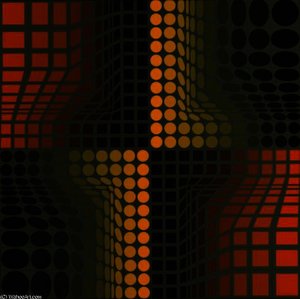
Nobel II
Tamanho da Reprodução
Victor Vasarely (1906-1997) stands as an undisputed titan of Op art, a movement that irrevocably altered the landscape of 20th-century visual culture. Born Károly Vásárhelyi in Pécs, Hungary – then part of Austria-Hungary – his artistic journey began with aspirations for medicine but swiftly pivoted towards the captivating realm of painting in 1927, enrolling at Sándor Bortnyik’s influential workshop in Budapest.
This formative experience instilled within him a profound understanding of geometric abstraction and functional design principles, concepts deeply rooted in the Bauhaus ethos. It was here that Vasarely encountered the revolutionary ideas championed by Josef Albers and László Moholy-Nagy, sparking an intellectual fervor that would propel him to forge his signature style – a mesmerizing blend of illusion and precision.
“Nobel IV,” created in 1983, exemplifies this groundbreaking approach. Executed as a screenprint on paper, the artwork showcases Vasarely’s masterful manipulation of color and form. The central motif is a large circle punctuated by numerous smaller circles radiating outwards, creating an arresting visual paradox.
Vasarely's technique involved meticulously layering translucent inks onto a substrate, exploiting optical phenomena like Trompe l'oeil to generate dynamic patterns that seem to shift and shimmer before the viewer’s eyes. This deliberate illusionistic strategy wasn’t merely stylistic; it represented a conscious effort to challenge conventional perceptions of reality and explore the subconscious mind.
Beyond its aesthetic beauty, “Nobel IV” speaks volumes about Vasarely's broader artistic vision – one dedicated to making art accessible and engaging for everyone. He believed that visual experience could be transformed into a powerful tool for contemplation and emotional resonance. This conviction is palpable in the artwork’s vibrant hues and captivating geometric complexity, cementing its place as an enduring symbol of Op art’s legacy.
The piece's impact extends far beyond the confines of the art world, influencing designers, architects, and even fashion trends. Vasarely’s pioneering exploration of optical illusions continues to inspire artists today, demonstrating the timeless relevance of his groundbreaking aesthetic principles.

1906 - 1997 , Croácia

Explore the science of Op Art through the lens of masters like Victor Vasarely. Discover how geometric abstraction uses optical illusions to create movement and delve into the neuroaesthetics of perception with our expert art history guide.

Master the complexities of Geometric Abstraction. Our expert guide explores the evolution from Cubist deconstruction to Bauhaus precision, decoding the power of shape and form. Perfect for art students seeking deep historical context and academic insight into modern masterpieces.

Explore the profound impact of Minimalism and Geometric Abstraction. From Mondrian to Malevich, discover how stripping art to its essential forms revolutionized modern aesthetics through our expert-led historical guide.


Fique por dentro das últimas notícias de arte, ofertas exclusivas e ideias de decoração.
Conte-nos sobre o seu projeto e os nossos especialistas em arte fornecerão 3 sugestões de arte personalizadas.
Deixe que selecionamos 3 opções especialmente para você – Grátis!


 Visualizar na parede
 Compartilhar
 Compartilhar
 Detalhes

 Baixar imagem
 Semelhantes
 Raio X
 Slideshow
 Ler mais







 A opção de vidro está disponível apenas para tamanhos inferiores a 110 cm