


x

 Oil On CanvasWallArtAbstract Expressionism
 1993
1993 191.0 x 101.0 cm
 Serpentine Galleries
Printuri giclée sau pe canvas de calitate muzeală, cu proces de producție rapid și opțiuni flexibile de finisare. ( Comandă pictură lucrată manual Cumpără imaginea)





























Alegeți dintre dimensiunile noastre prestabilite, care respectă proporțiile originale ale operei de artă.

Puteți introduce propriile dimensiuni pentru a se potrivi unui anumit cadru sau spațiu. Dacă dimensiunea selectată nu corespunde proporțiilor imaginii originale, vom decupa lucrarea de artă sau vom extinde imaginea cu margini oglindite sau cu o culoare uniformă. Un mockup digital va fi trimis pentru aprobarea dumneavoastră înainte de începerea producției.
Vă rugăm să rețineți că previzualizarea de pe ecran nu reflectă decuparea sau extinderea reală. Doar mockup-ul va arăta cu exactitate compoziția finală.
Deși dimensiunile personalizate sunt disponibile, vă recomandăm să selectați o dimensiune din lista predefinită pentru a păstra proporțiile originale.
Livrare în întreaga lume () în 2 săptămâni, în loc de cele 4/5 săptămâni standard. (20 August)


Tectonic,
Dimensiune reproducere
Zaha Hadid's "Tectonic," a striking acrylic and watercolour study on cartridge paper from 1993, isn’t merely a depiction of architectural forms; it’s an embodiment of tectonic forces – the very processes that shape our planet. Born amidst the intellectual currents of Baghdad and nurtured by a family steeped in both artistic sensibility and political influence, Hadid's early life instilled within her a profound fascination with spatial relationships and the interplay between structure and movement. This piece, created during a pivotal period of her career, reveals a nascent exploration of abstraction that would later define her revolutionary architectural style – a style characterized by fluid geometries, dynamic curves, and an unapologetic embrace of the unexpected.
The artwork immediately commands attention with its monochromatic palette, primarily shades of grey ranging from near-white to deep charcoal. This deliberate restraint serves not to diminish the piece’s impact, but rather to amplify the underlying dynamism. Geometric shapes – cubes, rectangles, and subtly curved elements – are arranged in a deliberately asymmetrical composition, reminiscent of a geological cross-section or perhaps even a stylized map of tectonic plates. The central structure, resembling a fragmented bicycle frame, anchors the image while radiating outwards with other forms, creating a sense of controlled chaos that mirrors the complex processes occurring within the Earth’s crust. It's a visual representation of forces in constant motion, a testament to Hadid’s fascination with the underlying mechanics of both architecture and nature.
Hadid’s approach to “Tectonic” is deeply rooted in her early artistic explorations. Inspired by the pioneering Russian avant-garde, particularly Kazimir Malevich's Suprematist paintings, she sought a way to move beyond traditional architectural representation. Malevich’s emphasis on pure geometric forms and their spatial relationships profoundly influenced Hadid’s thinking, encouraging her to explore abstraction as a means of conveying complex ideas about space and movement. The piece echoes this influence through its simplified shapes and the deliberate distortion of perspective – a departure from conventional realism. This deconstruction of form wasn't simply an aesthetic choice; it was a conscious effort to reveal the underlying structure and energy within the depicted subject matter.
The use of acrylic and watercolour paints contributes significantly to the artwork’s textural quality. The layering and blending create subtle tonal variations, suggesting depth without resorting to traditional shading techniques. While the surface appears relatively smooth, a closer examination reveals a delicate balance between precision in rendering the geometric shapes and an expressive quality in the flowing lines. This combination of technical skill and artistic intuition is characteristic of Hadid’s work – a seamless integration of logic and emotion.
Beyond its formal qualities, “Tectonic” resonates with powerful symbolic meaning. The fragmented forms can be interpreted as representations of tectonic plates shifting and colliding, mirroring the geological processes that shape our planet. The swirling lines evoke a sense of dynamism and transformation, suggesting the constant flux of energy within the Earth’s interior. The central bicycle frame, a recurring motif in Hadid's work, may symbolize human ingenuity and its interaction with the natural world – a reminder of humanity’s capacity to both create and be shaped by forces beyond our control. The muted color palette reinforces this connection to the earth, evoking images of stone, sediment, and the vastness of geological time.
Furthermore, the artwork's ambiguity invites multiple interpretations. It could be seen as an exploration of form, space, and movement, or a meditation on themes of chaos and order, creation and destruction. Ultimately, “Tectonic” is a testament to Hadid’s visionary approach to architecture – a bold and innovative work that continues to inspire awe and provoke thought.


1950 - 2016 , Irak

Master the complexities of Geometric Abstraction. Our expert guide explores the evolution from Cubist deconstruction to Bauhaus precision, decoding the power of shape and form. Perfect for art students seeking deep historical context and academic insight into modern masterpieces.

Discover the profound intersection of geometry and emotion in Cubist Expressionism. Explore art history through our expert analysis of modern masters and find museum-quality, hand-painted oil reproductions of iconic masterpieces for your collection.

Explore the profound impact of Minimalism and Geometric Abstraction. From Mondrian to Malevich, discover how stripping art to its essential forms revolutionized modern aesthetics through our expert-led historical guide.
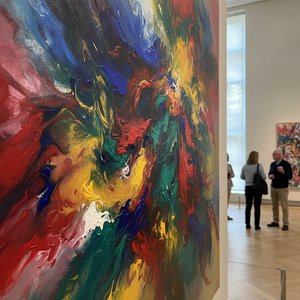
Explore the profound emotional depth of Lyrical Abstraction. Discover how masters like Raymond Parker used color and form to bridge Impressionism and Abstract Expressionism. Learn about this pivotal movement through our expert-led art history guide.


Rămâneți la curent cu cele mai recente știri din lumea artei, ofertele noastre exclusive și ideile de decor.
Spuneți-ne despre proiectul dumneavoastră, iar experții noștri în artă vă vor oferi 3 sugestii personalizate.
Vom selecta 3 opțiuni special pentru tine – Gratuit!


 Previzualizare
 Trimite
 Distribuie
 Detalii despre lucrare

 Descarcă
 Produse similare
 Radiografie
 Diapozitive automate
 Vezi mai mult







 Opțiunea cu sticlă este disponibilă doar pentru dimensiuni de sub 110 cm


