x

Printuri giclée sau pe canvas de calitate muzeală, cu proces de producție rapid și opțiuni flexibile de finisare. ( Comandă pictură lucrată manual Cumpără imaginea)





























Alegeți dintre dimensiunile noastre prestabilite, care respectă proporțiile originale ale operei de artă.

Puteți introduce propriile dimensiuni pentru a se potrivi unui anumit cadru sau spațiu. Dacă dimensiunea selectată nu corespunde proporțiilor imaginii originale, vom decupa lucrarea de artă sau vom extinde imaginea cu margini oglindite sau cu o culoare uniformă. Un mockup digital va fi trimis pentru aprobarea dumneavoastră înainte de începerea producției.
Vă rugăm să rețineți că previzualizarea de pe ecran nu reflectă decuparea sau extinderea reală. Doar mockup-ul va arăta cu exactitate compoziția finală.
Deși dimensiunile personalizate sunt disponibile, vă recomandăm să selectați o dimensiune din lista predefinită pentru a păstra proporțiile originale.
Livrare în întreaga lume () în 2 săptămâni, în loc de cele 4/5 săptămâni standard. (17 August)


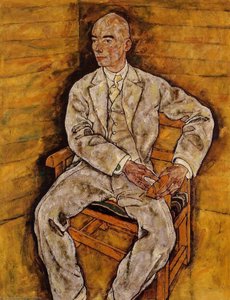
Boy (Ragazzo)
Dimensiune reproducere
Egon Schiele's “Boy (Ragazzo),” painted in 1910, isn’t merely a depiction of youth; it’s a raw, intensely personal exploration of vulnerability and the precarious nature of existence. The drawing, rendered with Schiele’s signature agitated lines and unsettlingly direct gaze, captures a young boy seated on a simple wooden chair – an arrangement that immediately evokes a sense of quiet contemplation, yet simultaneously hints at underlying unease. The subject, though youthful in appearance, possesses a profound stillness, almost as if he's holding his breath, bracing himself against an unseen force. This isn’t the idealized portraiture of the era; instead, Schiele presents us with an honest, unvarnished glimpse into the psyche of a young man grappling with something deeply felt.

Schiele’s technique is immediately arresting. He employs a rapid, almost frantic application of charcoal – or perhaps crayon, given its texture – to build up the form. The lines aren't smooth or polished; they are jagged, broken, and imbued with an urgent energy. Notice how he uses hatching and cross-hatching to create depth and volume, particularly in the boy’s jacket, which adds a layer of complexity to the composition. The shadows are not gentle gradations but rather sharp, defined areas that heighten the sense of drama and isolation. The boy's face is rendered with an almost skeletal quality, emphasizing his youth and vulnerability. This deliberate roughness reflects Schiele’s Expressionist approach – he wasn’t interested in replicating reality; he sought to convey feeling, emotion, and psychological truth.
To understand “Boy (Ragazzo),” it's crucial to consider the context of Egon Schiele’s life. Born in Vienna in 1890, his early years were marked by illness, loss, and a profound sense of instability. The death of his father from syphilis at the age of fourteen deeply impacted him, fueling an obsession with mortality and the fragility of human existence – themes that permeate much of his work. The boy depicted here isn’t simply a portrait; it's a projection of Schiele’s own anxieties and fears, a visual manifestation of the emotional turmoil he experienced throughout his life. The drawing can be interpreted as a meditation on childhood innocence lost, or perhaps a premonition of the hardships to come.
The simple wooden chair itself is significant. It’s an ordinary object, yet it provides a grounding element within the otherwise unsettling composition. It suggests a moment of respite, a brief pause in the boy's internal struggles. The boy’s posture – slightly hunched, with his hands clasped loosely – conveys a sense of introspection and perhaps even apprehension. His gaze is averted, suggesting a reluctance to confront whatever burdens he carries. Schiele masterfully uses these subtle details to create an image that resonates deeply with the viewer, evoking feelings of empathy, sadness, and a poignant awareness of human vulnerability. The drawing’s power lies not in its literal representation but in its ability to tap into universal emotions – loneliness, fear, and the yearning for connection.
For a high-quality reproduction of “Boy (Ragazzo),” visit Most-Famous-Paintings.com to experience this emotionally charged masterpiece in stunning detail.

1890 - 1918 , Austria

Explore the profound emotional depth of Expressionist portraiture. From Edvard Munch to Francis Bacon, discover how masters used distortion and color to reveal inner truths. Learn about this pivotal movement and find museum-quality oil reproductions for your collection.


Rămâneți la curent cu cele mai recente știri din lumea artei, ofertele noastre exclusive și ideile de decor.
Spuneți-ne despre proiectul dumneavoastră, iar experții noștri în artă vă vor oferi 3 sugestii personalizate.
Vom selecta 3 opțiuni special pentru tine – Gratuit!


 Previzualizare
 Trimite
 Distribuie
 Detalii despre lucrare

 Descarcă
 Produse similare
 Radiografie
 Diapozitive automate

 Vezi mai mult







 Opțiunea cu sticlă este disponibilă doar pentru dimensiuni de sub 110 cm