Lista de dorințe Coș de cumpărături Cart
PrevizualizarePrevizualizare Previzualizare ARPrevizualizare AR Comandă pictură lucrată manual Comandă pictură lucrată manualCumpără imaginea Cumpără imaginea TrimiteTrimite
Detalii despre lucrareDetalii despre lucrare Adaugă la favorite Adaugă la favorite DescarcăDescarcă Produse similareProduse similare RadiografieRadiografie Diapozitive automateDiapozitive automate

In the Rain

Experience the vibrant world of Franz Marc's 'In the Rain' (1912). This cubist masterpiece, featuring simplified forms and bold colors, captures a moment of connection between humans and animals. Own a stunning hand-painted reproduction today!

Franz Marc (1880-1916): pictor german expresionist, renumit pentru operele sale cu animale simbolice și culori vibrante. Descoperă spiritualitatea dincolo de realitate prin arta sa!

Giclée / Imprimare artistică

Printuri giclée sau pe canvas de calitate muzeală, cu proces de producție rapid și opțiuni flexibile de finisare. (Comandă pictură lucrată manual Comandă pictură lucrată manualCumpără imaginea Cumpără imaginea)

P118B $10
P118H $10
P118W $10
P438Z $10
P508JH $12
P508YH $12
P805H $10
P805Z $10
P919BZ $10
P919G $10
P919XJ $10
P959ZH $10
P968JZ $12
W106C $8
W218G $10
W218JH $8
W218Y $10
W307PJ $10
W316G $10
W316PJ $8
W316Y $10
W398PJ $8
W4111J $10
W500HY $15
W500JH $15
W692G $12
W849H $8
W940BG $15
W953PJ $8

Standard
custom
CM
INCH

Alegeți dintre dimensiunile noastre prestabilite, care respectă proporțiile originale ale operei de artă.

lățime
înălțime

Puteți introduce propriile dimensiuni pentru a se potrivi unui anumit cadru sau spațiu. Dacă dimensiunea selectată nu corespunde proporțiilor imaginii originale, vom decupa lucrarea de artă sau vom extinde imaginea cu margini oglindite sau cu o culoare uniformă. Un mockup digital va fi trimis pentru aprobarea dumneavoastră înainte de începerea producției.
Vă rugăm să rețineți că previzualizarea de pe ecran nu reflectă decuparea sau extinderea reală. Doar mockup-ul va arăta cu exactitate compoziția finală.
Deși dimensiunile personalizate sunt disponibile, vă recomandăm să selectați o dimensiune din lista predefinită pentru a păstra proporțiile originale.

Livrare în întreaga lume () în 2 săptămâni, în loc de cele 4/5 săptămâni standard. (23 August)

why_choose_icon
Livrare expres gratuită la nivel mondial
why_choose_icon
Pânză de in de înaltă calitate
why_choose_icon
Asigurare completă pentru transport
why_choose_icon
Garanție de rambursare a taxelor vamale
why_choose_icon
Garanția fidelității culorilor
why_choose_icon
Politica de retur în 60 de zile (doar pentru defecte)
why_choose_icon
Garanție de rambursare 100%
why_choose_icon
Ofertă pentru comenzi multiple

Preț total

$ 68

reproduction

In the Rain

Giclée / Imprimare artistică

Dimensiune reproducere

-

Preț total calculat

$ 68

Informații rapide

  • Notable elements: Simplified forms, red/white
  • Dimensions: 81 x 106 cm
  • Subject or theme: Animals, Landscape
  • Influences:
    • Picasso
    • Braque
  • Title: In the Rain
  • Artist: Franz Marc
  • Location: Staedtische Galerie Lenbachhaus

Test de cultură artistică

Fiecare întrebare are un singur răspuns corect.

Întrebare 1:
Franz Marc’s ‘In the Rain’ is primarily associated with which artistic movement?
Întrebare 2:
The prominent red background in ‘In the Rain’ is most likely intended to evoke which emotion or concept?
Întrebare 3:
Which of the following best describes Franz Marc’s artistic style as exemplified in ‘In the Rain’?
Întrebare 4:
‘In the Rain’ is currently housed in which museum?
Întrebare 5:
What artistic influence is most evident in Marc’s use of fragmented forms and geometric shapes, as seen in ‘In the Rain’?

Descriere obiect de colecție

A Symphony in Red and White: Unveiling Franz Marc’s “In the Rain”

Franz Marc's "In the Rain," painted in 1912, isn’t merely a depiction of dogs beneath a storm; it’s a profound meditation on spirituality, instinct, and the elusive connection between humanity and the natural world. This captivating work, currently residing within the Staedtische Galerie im Lenbachhaus in Germany, exemplifies Marc's pivotal role as a bridge between Impressionism and the burgeoning Expressionist movement. The painting immediately draws the eye with its bold palette – a striking juxtaposition of vibrant reds and stark whites – creating an atmosphere both dynamic and deeply contemplative. It’s a visual poem that speaks to the primal rhythms of life and the yearning for something beyond the purely rational.

Cubist Echoes and Spiritual Seeking

While often categorized as Expressionist, “In the Rain” reveals a significant debt to Cubism. Marc’s simplification of forms – the dogs rendered with geometric planes and fragmented edges – echoes the pioneering work of Picasso and Braque. However, Marc doesn't simply replicate Cubist techniques; he imbues them with his own intensely personal vision. The flattened perspective and overlapping shapes aren’t about dissecting reality but rather suggesting a simultaneous existence of multiple viewpoints, mirroring the complex interplay between observation and intuition that characterizes Marc’s artistic philosophy. This stylistic choice serves to heighten the emotional impact of the scene, pushing beyond mere representation towards an exploration of inner experience.

The Language of Animals: Symbolism and Intuition

Franz Marc's lifelong fascination with animals was central to his art. In “In the Rain,” the dogs aren’t simply pets; they embody a deeper symbolic resonance. They represent instinct, primal energy, and a connection to the earth – qualities that Marc believed were often obscured by modern society. The placement of the figures within the rain suggests vulnerability and a shared experience, fostering a sense of unity between humans and animals. The solitary figure in the center, partially obscured, could be interpreted as an observer, perhaps contemplating this primal connection or seeking solace in nature’s power. The white dog on the right, bathed in light, might symbolize purity or spiritual insight – a beacon amidst the storm.

Color and Emotion: Marc's Expressionist Palette

Marc’s masterful use of color is paramount to understanding “In the Rain.” The dominant reds aren’t simply descriptive; they evoke feelings of passion, energy, and perhaps even a touch of danger. The interplay between warm and cool tones creates a dynamic tension within the composition. The rain itself isn't rendered in realistic detail but rather as washes of color, suggesting movement and atmosphere. This deliberate abstraction allows Marc to convey emotion directly – a feeling of being immersed in nature’s raw power, experiencing both exhilaration and vulnerability. The overall effect is profoundly moving, inviting viewers to connect with the painting on an emotional level.

Most-Famous-Paintings offers exquisite, hand-painted reproductions of Franz Marc's "In the Rain," meticulously crafted to capture the original artwork’s vibrancy and depth. These reproductions are available in a range of sizes to suit any interior design scheme, allowing you to bring this iconic masterpiece into your home or office. Explore our collection today and experience the enduring power of Marc’s vision.

Biografie artist

A Life Immersed in Color and Spirit

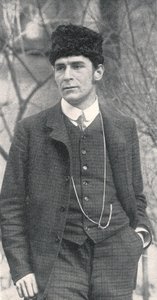
Franz Moritz Wilhelm Marc, born in Munich in 1880, was a painter whose brief but intensely focused career irrevocably altered the course of German Expressionism. His story is one of profound spiritual seeking translated into a vibrant visual language, a quest to understand the essence of life through the purity he found in the natural world—particularly within the animal kingdom. Initially influenced by his father, Wilhelm Marc, a landscape painter, young Franz’s artistic path wasn't immediately certain. He briefly considered theology, grappling with questions of faith and existence before ultimately dedicating himself to art at the Academy of Fine Arts in Munich. These early explorations into religious thought would remain deeply embedded within his work, shaping his belief that art could be a conduit for spiritual experience. His academic training provided him with technical foundations, but it was encounters with the works of Vincent van Gogh during visits to Paris that truly ignited his artistic vision. Van Gogh’s emotive use of color and raw expression resonated profoundly with Marc, liberating him from conventional techniques and setting him on a path toward a more subjective and emotionally charged style.

The Blue Rider and a New Artistic Vision

Marc's artistic development wasn’t solitary; it flourished within the dynamic context of early 20th-century Munich. He experimented with various artist groups, including the Neue Künstlervereinigung München, before co-founding *Der Blaue Reiter* (The Blue Rider) in 1911 alongside Wassily Kandinsky. This wasn’t merely a group or an exhibition series; it was a philosophical and artistic revolution. *Der Blaue Reiter* sought to move beyond mere representation, aiming instead to express inner spiritual truths through abstraction and symbolic color. The journal of the same name became a platform for disseminating these ideas, showcasing not only their own work but also that of other forward-thinking artists and exploring diverse cultural influences from folk art to primitive sculpture. Marc’s contributions during this period were pivotal. He moved away from depicting landscapes as static scenes, instead focusing on animals—horses, deer, foxes—as vessels of spiritual energy. These weren't simply animal portraits; they were symbolic representations of innocence, harmony, and a connection to the natural world that he believed humanity had lost. The influence of Robert Delaunay’s exploration of abstract forms and vibrant colors further propelled Marc toward simplification and heightened emotional expression in his work. Paintings like *The Tiger* (1912) and *Red Deer* (1912) exemplify this shift, showcasing bold color choices and a growing focus on the inherent qualities of his subjects rather than realistic depiction.

Symbolism, Color, and the Essence of Being

Marc’s artistic style is immediately recognizable for its distinctive use of color and form. He didn't employ color descriptively; instead, he imbued it with symbolic meaning. Blue represented spirituality and masculinity, yellow signified joy and femininity, and red embodied violence and materiality. These weren’t arbitrary choices but a carefully constructed system designed to convey specific emotional and philosophical ideas. His animals aren’t merely subjects; they are embodiments of these concepts. The simplification of forms—reducing figures to their essential shapes—further emphasized the underlying spiritual essence he sought to capture. *The Tower of Blue Horses* (1913), sadly lost during World War II, is perhaps the most iconic example of this approach, a powerful and evocative composition that encapsulates his artistic vision. He believed animals possessed an inherent purity and connection to nature that humans had forfeited through societal constraints and intellectualization. By portraying them with such reverence and symbolic weight, Marc sought to remind viewers of this lost harmony and inspire a deeper appreciation for the natural world. His work wasn’t about depicting *what* he saw but rather *how* he felt—a deeply personal and spiritual response to his surroundings.

Key Works and Influences

Marc's oeuvre is characterized by a remarkable consistency in subject matter and stylistic approach, despite evolving techniques. Early works like *The Yellow Cow* (1909) demonstrate his initial exploration of simplified forms and vibrant colors, heavily influenced by Van Gogh’s expressive brushwork. His later paintings, such as *The Tower of Blue Horses*, showcase a more complex use of symbolism and abstraction, reflecting his engagement with Kandinsky's theories on spirituality in art. The influence of Paul Gauguin is also evident in Marc’s interest in primitive cultures and the depiction of non-Western subjects. He was deeply moved by the art of indigenous peoples, particularly their symbolic representations of animals and spirits. Furthermore, Marc’s time in Paris exposed him to the innovations of Cubism, which he incorporated into his work through fragmented forms and multiple perspectives. The impact of these diverse influences is evident throughout his career, creating a unique artistic language that continues to fascinate viewers today.

A Tragic End and Lasting Legacy

The outbreak of World War I in 1914 dramatically altered Marc's life and artistic trajectory. Despite seeking exemption due to his status as an artist, he was drafted into the German army, serving as a cavalryman. The horrors of war deeply affected him, yet even amidst the chaos, he continued to paint, finding solace and meaning in his art. Tragically, Franz Marc died on March 4, 1916, at the Battle of Verdun, a devastating loss for the art world. His untimely death cut short a career brimming with potential, but it also cemented his place as a pivotal figure in modern art history. His work continues to resonate today, influencing generations of artists and captivating audiences with its emotional depth and spiritual resonance. Marc’s paintings are exhibited in major museums worldwide, including the Lenbachhaus in Munich, which holds an extensive collection of his work. He is remembered not only as a pioneer of German Expressionism but also as a visionary artist who dared to explore the profound connection between art, spirituality, and the natural world—a legacy that continues to inspire awe and contemplation. His artistic vision remains a testament to the power of art to transcend the material realm and touch upon something deeper within the human spirit.
Franz Marc

Franz Marc

1880 - 1916 , Germania

Detalii rapide

  • Artistic Movement Or Style: Expresionism German
  • Artists Or Movements Influenced By This Artist:
    • Expresionism
    • Der Blaue Reiter
  • Artists Who Influenced This Artist:
    • Van Gogh
    • Delaunay
  • Date Of Birth: 8 Feb 1880
  • Date Of Death: 4 Mar 1916
  • Full Name: Franz Moritz Wilhelm Marc
  • Nationality: German
  • Notable Artworks:
    • Calărețul albastru
    • Caii roșii
    • Coiul roșu
  • Place Of Birth: Munich, Germania
Explorați opere de artă organizate pe teme, stiluri și caracteristici.