Lista de dorințe Coș de cumpărături Cart
PrevizualizarePrevizualizare Previzualizare ARPrevizualizare AR Comandă printul Comandă printulCumpără imaginea Cumpără imaginea TrimiteTrimite
Detalii despre lucrareDetalii despre lucrare Adaugă la favorite Adaugă la favorite DescarcăDescarcă Produse similareProduse similare RadiografieRadiografie Diapozitive automateDiapozitive automate

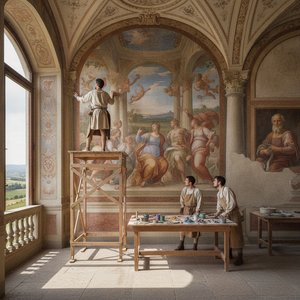
Sala del Cinquecento

Explore the Sala del Cinquecento in Florence's Palazzo Vecchio – a masterpiece of Renaissance art featuring monumental frescoes and historical significance.

"meta_description": "Giorgio Vasari (1511-1574): pictor, arhitect și istoric de artă italian, cunoscut pentru \"Viețile artiștilor\", o lucrare fundamentală a artei renascentiste, și pentru designul Palatului Uffizi."

Reproducere pictată manual în ulei

Pictură în ulei pe pânză, realizată manual de artiștii noștri la dimensiunea și ramele dorite de dumneavoastră, pe comandă. (Comandă printul Comandă printulCumpără imaginea Cumpără imaginea)

P118B $10
P118H $10
P118W $10
P438Z $10
P508JH $12
P508YH $12
P805H $10
P805Z $10
P919BZ $10
P919G $10
P919XJ $10
P959ZH $10
P968JZ $12
W106C $8
W218G $10
W218JH $8
W218Y $10
W307PJ $10
W316G $10
W316PJ $8
W316Y $10
W398PJ $8
W4111J $10
W500HY $15
W500JH $15
W692G $12
W849H $8
W940BG $15
W953PJ $8

Standard
custom
CM
INCH

Alegeți dintre dimensiunile noastre prestabilite, care respectă proporțiile originale ale operei de artă.

lățime
înălțime

Puteți introduce propriile dimensiuni pentru a se potrivi unui anumit cadru sau spațiu. Dacă dimensiunea selectată nu corespunde proporțiilor imaginii originale, vom decupa opera de artă sau vom extinde pictura cu elemente suplimentare pictate manual. O simulare digitală vă va fi trimisă pentru aprobare înainte de începerea producției.
Vă rugăm să rețineți că previzualizarea de pe ecran nu reflectă decuparea sau extinderea reală. Doar macheta va arăta cu exactitate compoziția finală.
Deși sunt disponibile dimensiuni personalizate, vă recomandăm să selectați o dimensiune din lista predefinită pentru a păstra proporțiile originale.

Exemple de elemente ce pot fi personalizate: Înlocuiți fața cu fotografia clientului; Adăugați un animal de companie (de exemplu, înlocuiți pisica cu un câine); Includeți un mesaj ascuns în fundal; Schimbați peisajul sau elementele din fundal.
După plasarea comenzii, echipa Most-Famous-Paintings.com va contacta clientul prin e-mail pentru instrucțiuni și îi va furniza o previzualizare a machetei

Livrare în întreaga lume () în 3-4 săptămâni, în loc de cele 5 săptămâni standard. (23 August). Fără compromisuri în ceea ce privește calitatea.

why_choose_icon
Livrare expres gratuită la nivel mondial
why_choose_icon
Pânză de in de înaltă calitate
why_choose_icon
Asigurare completă pentru transport
why_choose_icon
Garanție de rambursare a taxelor vamale
why_choose_icon
Garanția fidelității culorilor
why_choose_icon
Politica de retur în 60 de zile (doar pentru defecte)
why_choose_icon
Garanție de rambursare 100%
why_choose_icon
Ofertă pentru comenzi multiple

Preț total

$ 272

reproduction

Sala del Cinquecento

Tehnică de reproducere

Dimensiune reproducere

-

Preț total calculat

$ 272

Informații rapide

  • Dimensions: 54m x 23m x 18m
  • Artist: Giorgio Vasari
  • Movement: High Renaissance
  • Artistic style: Mannerism
  • Medium: Fresco
  • Year: 1555-1572
  • Subject or theme: Florentine History

Test de cultură artistică

Fiecare întrebare are un singur răspuns corect.

Întrebare 1:
What is the primary purpose of the Sala del Cinquecento?
Întrebare 2:
Which two famous artists were originally commissioned to create frescoes depicting battles for the Sala del Cinquecento?
Întrebare 3:
What unfortunate event led to the loss of much of Leonardo da Vinci's planned fresco for the Sala del Cinquecento?
Întrebare 4:
Who designed the overall architectural layout and decoration of the Sala del Cinquecento as it exists today?
Întrebare 5:
The Sala del Cinquecento is located within which Florentine palace?

Descriere operă de artă

Introduction

The Sala del Cinquecento, located in the Palazzo Vecchio in Florence, Italy, is a masterpiece of Florentine Renaissance art. This room was commissioned by Cosimo I de' Medici and designed by Giorgio Vasari between 1555 and 1572. The Sala del Cinquecento is a testament to the artistic and cultural achievements of the Florentine Renaissance, showcasing some of the most impressive frescoes and architectural elements of the period.

Giorgio Vasari: A Master Artist of the Florentine Renaissance

Giorgio Vasari (1511-1574) was an Italian painter, architect, and historian who played a crucial role in shaping the course of Florentine Renaissance art. He is best known for his biographies of Italian artists, which were published in 1550 as "Le Vite de' più eccellenti pittori, scultori e architettori." Vasari was also a prolific artist, creating numerous masterpieces throughout his career.

The Sala del Cinquecento: A Masterpiece of Florentine Renaissance Art

The Sala del Cinquecento is a stunning example of Florentine Renaissance art, featuring some of the most impressive frescoes and architectural elements of the period. The room measures 54 meters long, 23 meters wide, and 18 meters high, making it one of the largest and most impressive rooms in the Palazzo Vecchio. The Sala del Cinquecento features two large frescoes on its walls: "The Battle of Marciano" and "The Battle of Anghiari." These frescoes were painted by Vasari and his assistants, and they depict some of the most important military victories of the Medici family.

The Battle of Marciano

The Battle of Marciano is a stunning fresco that covers the entire north wall of the Sala del Cinquecento. The fresco depicts the Battle of Marciano, which took place in 1554 between the Medici forces and the Florentine Republic. The fresco features numerous figures, including Cosimo I de' Medici, who is depicted on horseback at the center of the composition.

The Battle of Anghiari

The Battle of Anghiari is a stunning fresco that covers the entire south wall of the Sala del Cinquecento. The fresco depicts the Battle of Anghiari, which took place in 1440 between the Florentine Republic and the Milanese forces. The fresco features numerous figures, including Leonardo da Vinci, who is depicted at the center of the composition.

Conclusion

The Sala del Cinquecento is a stunning example of Florentine Renaissance art, featuring some of the most impressive frescoes and architectural elements of the period. This room is a testament to the artistic and cultural achievements of the Florentine Renaissance, showcasing the work of some of the most important artists of the period, including Giorgio Vasari, Leonardo da Vinci, and Michelangelo. If you are interested in learning more about Florentine Renaissance art or purchasing hand-made oil painting reproductions of your favorite works, please visit our website at https://Most-Famous-Paintings.com. We offer a wide range of reproductions, including those of the Sala del Cinquecento, that are sure to enhance any art collection.

Biografie artist

A Life Woven into the Renaissance Fabric

Giorgio Vasari, born in Arezzo, Tuscany, on July 30, 1511, was more than simply a painter; he was a quintessential embodiment of the Italian Renaissance spirit. His life unfolded as a vibrant tapestry woven with threads of artistic creation, architectural innovation, insightful historical writing, and an unwavering dedication to celebrating the masters who came before him. From his earliest training under Guglielmo da Marsiglia, a skilled artisan in stained glass, young Giorgio’s path was steered towards visual artistry. However, it was his move to Florence at sixteen that truly ignited his potential. Immersing himself within the dynamic circle of Andrea del Sarto and absorbing the influences of Rosso Fiorentino and Jacopo Pontormo, Vasari began a journey that would see him become one of the most influential figures of his era. His formative years were also deeply marked by the patronage and friendship of the powerful Medici family, a relationship that would shape both his career and his perspective on art’s role in society.

The Artist's Hand and Eye

Vasari’s artistic style is often categorized as Mannerist, reflecting the prevailing aesthetic trends of the mid-16th century. His paintings are characterized by elongated figures, dynamic compositions, and a sophisticated use of color—qualities highly admired during his lifetime. While perhaps not achieving the same level of enduring fame as some of the artists he chronicled, Vasari’s skill was undeniable. Notable works such as *The Studio of the Painter*, a fresco housed in Casa Vasari in Arezzo, offer a fascinating glimpse into the artistic practices of the time. The sheer scale and ambition of his frescoes for the Palazzo Vecchio in Florence, undertaken between 1555 and 1572, demonstrate his mastery of large-scale decorative schemes. His final monumental undertaking, *The Last Judgement*, adorning the cupola of Florence Cathedral—completed after his death by Federico Zuccari—stands as a testament to his unwavering commitment to grand artistic visions. Beyond painting, Vasari’s architectural contributions were equally significant. He designed the elegant loggia of the Palazzo degli Uffizi, transforming it into a public piazza and creating a vital link within Florence's urban landscape. Perhaps most famously, he conceived and oversaw the construction of the Vasari Corridor, a secret passageway connecting the Uffizi Gallery with the Palazzo Pitti—a feat of engineering and architectural ingenuity that continues to captivate visitors today.

A Historian Forging a Legacy

However, it is arguably as an art historian that Giorgio Vasari secured his most lasting legacy. His monumental work, *Lives of the Most Excellent Painters, Sculptors, and Architects*, published in 1550 (with a revised edition in 1568), revolutionized the way art was understood and appreciated. This groundbreaking text wasn’t merely a collection of biographies; it established a narrative framework for the development of Italian Renaissance art, tracing its evolution from the early masters like Cimabue and Giotto to his contemporaries Michelangelo and Raphael. Vasari's work introduced the very concept of the “Renaissance” – a rebirth of classical ideals—and laid the foundation for modern art history as a discipline. While acknowledging that Vasari’s accounts are not without their biases and inaccuracies, particularly concerning artists predating his own time, the impact of *Lives* remains profound. It provided a crucial historical context for artistic creation, elevating the status of artists from skilled craftsmen to intellectual figures worthy of scholarly attention.

Influences and Enduring Significance

Vasari’s artistic development was profoundly shaped by his exposure to the works of Renaissance masters. His visit to Rome in 1529, where he studied the art of Raphael and other High Renaissance artists, proved pivotal. He absorbed their principles of composition, anatomical accuracy, and idealized beauty, incorporating them into his own style. Michelangelo, whom Vasari greatly admired, exerted a particularly strong influence on both his painting and architecture. The grandeur and dynamism characteristic of Michelangelo’s work are evident in many of Vasari’s projects. Beyond specific artists, the broader intellectual currents of the Renaissance—humanism, classical learning, and a renewed interest in empirical observation—also informed Vasari's approach to art and history. Giorgio Vasari died on June 27, 1574, in Florence, leaving behind a multifaceted legacy that continues to resonate today. He was not only a talented artist and architect but also a pioneering historian whose writings shaped our understanding of one of the most transformative periods in Western art history. His work remains essential for anyone seeking to explore the rich cultural heritage of the Italian Renaissance.

Major Works

  • The Studio of the Painter (1563): A monumental fresco located in Casa Vasari, Arezzo, offering a detailed depiction of an artist’s studio and serving as a visual treatise on artistic techniques.
  • Lives of the Most Excellent Painters, Sculptors, and Architects (1550 & 1568): Vasari's magnum opus, a biographical survey of Italian artists from the early Renaissance to his own time, establishing a framework for art historical study.
  • Frescoes in Palazzo Vecchio (1555-1572): A series of large-scale decorative frescoes adorning the Salone dei Cinquecento, showcasing Vasari’s mastery of monumental painting and narrative composition.
  • The Last Judgement (1573): A grand fresco on the cupola of Florence Cathedral, completed after Vasari's death by Federico Zuccari, representing a culmination of his artistic ambitions.
  • Vasari Corridor (1564-1569): An architectural marvel connecting the Uffizi Gallery with the Palazzo Pitti, demonstrating Vasari’s innovative design skills and strategic thinking.

Legacy

Vasari's legacy extends far beyond his individual artistic achievements. He is widely considered the “father of art history,” having pioneered a systematic approach to studying and documenting the lives and works of artists. His *Lives* provided an invaluable source of information for subsequent generations of art historians, shaping our understanding of the Renaissance and influencing the development of the discipline. Furthermore, Vasari’s architectural designs—particularly the Palazzo degli Uffizi and the Vasari Corridor—continue to be admired for their elegance, functionality, and historical significance. His work stands as a testament to his versatility, intellectual curiosity, and enduring contribution to Italian culture.
Giorgio Vasari

Giorgio Vasari

1511 - 1574 , Italia

Detalii rapide

  • Artistic Movement Or Style: Mannerism
  • Artists Or Movements Influenced By This Artist: ['Renaissance art history']
  • Artists Who Influenced This Artist:
    • Michelangelo
    • Andrea del Sarto
  • Date Of Birth: 30 iulie 1511
  • Date Of Death: 27 iunie 1574
  • Full Name: Giorgio Vasari
  • Nationality: Italian
  • Notable Artworks:
    • Studio Pict.
    • Ultima Judecată
  • Place Of Birth: Arezzo, Italia
Explorați opere de artă organizate pe teme, stiluri și caracteristici.