


x


 Comandă reproducere pictată Cumpără imaginea
 Trimite
 Detalii despre lucrare
 Adaugă la favorite
 Descarcă
 Similare
 Radiografie
 Diaporama
 Nihonga
 104.0 x 34.0 cm
Print giclée sau pe canvas de calitate muzeală, cu producție rapidă și opțiuni flexibile de finisare.
Alegeți dintre dimensiunile noastre prestabilite, care respectă proporțiile originale ale operei de artă.

Puteți introduce propriile dimensiuni pentru a se potrivi unui anumit cadru sau spațiu. Dacă dimensiunea selectată nu corespunde proporțiilor imaginii originale, vom decupa lucrarea de artă sau vom extinde imaginea cu margini oglindite sau cu o culoare uniformă. Un mockup digital va fi trimis pentru aprobarea dumneavoastră înainte de începerea producției.
Vă rugăm să rețineți că previzualizarea de pe ecran nu reflectă decuparea sau extinderea reală. Doar mockup-ul va arăta cu exactitate compoziția finală.
Deși dimensiunile personalizate sunt disponibile, vă recomandăm să selectați o dimensiune din lista predefinită pentru a păstra proporțiile originale.
Livrare în întreaga lume () în 2 săptămâni, în loc de cele 4/5 săptămâni standard. (22 Iulie)


Sparrow Hovering
Dimensiune reproducere

In the heart of Kyoto’s vibrant textile district, a legacy was born that would forever alter the trajectory of Japanese painting. Takeuchi Tsunekichi, known to the world by his artistic name Takeuchi Seihō, emerged from the Meiji era not merely as a painter, but as a bridge between two worlds. His journey began amidst the rhythmic looms and intricate patterns of his family’s restaurant and textile connections, an upbringing that instilled in him a profound sensitivity to texture, color, and form. As he transitioned from a student of Chinese literature and temple arts to a dedicated pupil of the renowned Kōno Bairei, Seihō began to master the Shijō school's essence—a style defined by its delicate realism and an almost spiritual connection to the natural world.
The evolution of Seihō’s artistry is a testament to his courage in the face of cultural transformation. While many of his contemporaries clung strictly to the traditions of the past, Seihō looked toward the horizon. His pivotal journey to Paris during the 1900 Exposition Universelle served as a transformative encounter with the avant-garde. Immersed in the atmospheric light of Impressionism and the dreamlike depths of Symbolism, he returned to Japan with a vision that was uniquely his own. He did not abandon the traditional Nihonga techniques; instead, he breathed new life into them by synthesizing the meticulous brushwork of Japanese masters with the luminous, spatial depth found in the works of Western legends like Turner and Corot.
The true brilliance of Seihō lies in his ability to capture the ephemeral soul of nature through a sophisticated technical duality. His work often oscillates between the minimalist tranquility of sumi-e ink wash and a robust, textured realism. In masterpieces such as "Sparrow Hovering," one can witness the breathtaking simplicity of Japanese aesthetics, where every stroke of ink conveys a sense of weightless motion and profound stillness. Conversely, his larger landscapes and seascapes demonstrate a mastery of light and atmosphere that feels remarkably modern, utilizing subtle gradations to evoke the salt spray of a "Seascape" or the shifting mists of a mountain morning.
His subject matter—ranging from the intimate details of small animals to the sweeping grandeur of the Japanese landscape—serves as a canvas for his exploration of life's fleeting moments. Through his brush, the following elements often converge:
Takeuchi Seihō’s impact on the art world extends far beyond the borders of Japan. By successfully navigating the tension between the preservation of heritage and the necessity of innovation, he provided a blueprint for modern Japanese art. He proved that tradition is not a static relic to be guarded, but a living, breathing entity capable of absorbing new influences without losing its fundamental identity. His life, spanning the transformative Meiji and early Shōwa periods, mirrors the very evolution of Japan itself—a nation moving from isolation into a complex, interconnected global stage.
Today, his works remain cherished symbols of cultural synthesis. To view a Seihō painting is to experience a moment of profound equilibrium: the stillness of ancient Kyoto meeting the dynamic energy of a modernizing world. He remains a titan of Nihonga, an artist whose name continues to evoke the delicate balance of light, line, and the eternal beauty of the natural world.

1864 - 1942 , Japan
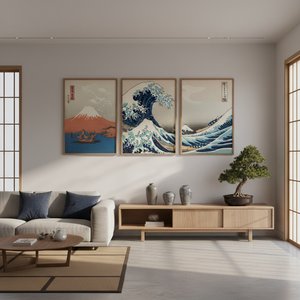
Descoperă cele mai frumoase 25 de opere de artă semnate de Katsushika Hokusai, maestru ukiyo-e. Explorează istoria valului Kanagawa și a picturilor japoneze iconice. Reproduceri de calitate muzeală pentru decorul casei tale pe Most-Famous-Paintings.com!

Elevate your interiors with impactful statement walls! Expert guide on scaling artwork for perfect proportions & design harmony. Custom solutions & free consultations at Most-Famous-Paintings.

Explore the captivating world of ink wash painting – from its ancient origins to contemporary masters. Discover techniques, symbolism & conservation insights with Most-Famous-Paintings.com.

Explore the captivating world of Tōshūsai Sharaku, the enigmatic Edo period ukiyo-e master. Discover his iconic Kabuki actor portraits and unravel the mystery behind this fleeting artistic genius. Learn about his unique style & lasting legacy.

Explore the captivating world of Ukiyo-e – Japan's iconic woodblock prints! Discover masters like Hokusai & Hiroshige, learn about Edo period culture, and find expert art collecting guidance at Most-Famous-Paintings.


Rămâneți la curent cu cele mai recente știri din lumea artei, ofertele noastre exclusive și ideile de decor.
Spuneți-ne despre proiectul dumneavoastră, iar experții noștri în artă vă vor oferi 3 sugestii personalizate.
Vom selecta 3 opțiuni special pentru tine – Gratuit!


 Distribuie

 Vezi mai mult




































 Opțiunea cu sticlă este disponibilă doar pentru dimensiuni de sub 110 cm


