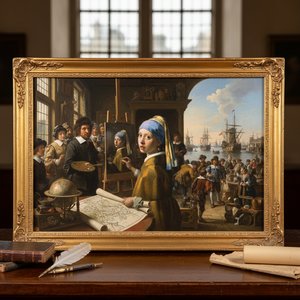
Jan Antonisz van Ravesteyn: A Master of Dutch Portraiture
Jan Antonisz van Ravesteyn, born in The Hague around 1572 and passing away in 1657, stands as a pivotal figure in the rich tapestry of Dutch Golden Age art. More than simply a portrait painter, he was a keen observer of human character, a master of capturing not just physical likeness but also the very essence of his subjects – nobility, wealth, and social standing. His career spanned over six decades, during which he established himself as one of the most sought-after artists in the Netherlands, leaving behind a legacy that continues to fascinate art historians and enthusiasts alike.
- Early Life and Training: Details surrounding Van Ravesteyn’s early artistic training remain somewhat shrouded in mystery. While it's widely accepted that he followed in the footsteps of Michiel Jansz van Mierevelt, a renowned Delft painter known for his dignified and insightful portraits, the precise nature of his initial instruction is not fully documented. This lack of definitive information adds to the allure surrounding this talented artist.
- Guild Membership and Early Career: In 1598, Van Ravesteyn formally joined the Guild of St. Luke in The Hague, marking a significant step in establishing himself within the established artistic community. From this point forward, he dedicated his life to capturing the likenesses of those who shaped Dutch society, quickly gaining recognition for his skill and discerning eye.
The Courtly Portraitist: Commissions and Artistic Style
Van Ravesteyn’s career truly flourished during his time as a court painter, particularly for the House of Nassau. He became exceptionally productive, fulfilling numerous commissions that adorned the residences of royalty and high-ranking officials – a testament to his popularity and artistic ability. His style was characterized by a remarkable balance between realism and idealization; he presented his subjects in a manner that celebrated their individual characteristics while simultaneously conveying their social status and importance. His portraits are immediately recognizable for their refined brushwork, subtle use of light and shadow, and an acute understanding of human anatomy – elements that contributed significantly to the depth and psychological resonance of his work. The *Portrait of Gaspard de Coligny III*, Count of Châtillon sur Loing, part of the Leeuwarden series, exemplifies this skill perfectly, showcasing not just a likeness but also a sense of character and presence. The meticulous attention to detail – from the fabrics worn by the subjects to the expressions on their faces – speaks volumes about Van Ravesteyn’s dedication to his craft.
- Symbolic Elements: Beyond mere representation, Van Ravesteyn skillfully employed symbolic elements within his portraits. The choice of clothing, jewelry, and background details served not only as decorative features but also as visual cues conveying wealth, power, and social standing.
- Influence of Mierevelt: The influence of Michiel Jansz van Mierevelt is readily apparent in Van Ravesteyn’s work, particularly in his emphasis on dignified portraits and a nuanced understanding of human character. However, Van Ravesteyn developed his own distinct style, incorporating elements of Mannerism to create a unique artistic voice.
Beyond Likeness: Technique and Influences
Van Ravesteyn's technical prowess extended far beyond the simple replication of features. He was a master of manipulating light, color, and composition to achieve a desired effect – whether it was to emphasize the grandeur of a noble subject or to convey a sense of intimacy and connection. He experimented with different formats, including the *tondo* (a circular format), demonstrating an openness to artistic innovation and a willingness to draw inspiration from diverse sources. The incorporation of Renaissance influences, such as the use of dramatic lighting and stylized facial features, further enriched his artistic vocabulary. His work reflects not just technical skill but also a deep understanding of the principles of composition and visual storytelling.
- The Role of Light: Van Ravesteyn’s masterful manipulation of light is particularly evident in portraits like *Portrait of Maurice of Nassau*, where he uses chiaroscuro to create a sense of depth, drama, and psychological intensity.
- Compositional Balance: He carefully balanced the elements within his compositions – the placement of figures, the use of color, and the overall arrangement of details – to achieve a harmonious and visually compelling effect.
A Legacy Continued: Teaching and Artistic Lineage
Van Ravesteyn’s impact extended far beyond his own artistic output. He was a dedicated teacher who nurtured the talents of numerous pupils, ensuring the continuation of his artistic lineage. Among those he mentored were Dirck Abrahamsz., Leendert Barthouts, Adriaen Hanneman, and Johannes Harmensz Borsman – all of whom went on to establish successful careers as portrait painters in their own right. His influence can be seen in the works of these artists, who carried forward his commitment to realism, technical skill, and insightful characterization. Furthermore, he was a member of the *Confrerie Pictura*, a group of artists dedicated to artistic innovation and collaboration, demonstrating a continued passion for pushing the boundaries of art throughout his long career.
- Notable Pupils: The students who studied under Van Ravesteyn went on to become prominent figures in the Dutch art world, carrying forward his techniques and stylistic influences.
- The Confrerie Pictura: His involvement with this influential artistic group highlights his commitment to innovation and collaboration within the broader artistic community.
Enduring Significance: Van Ravesteyn’s Place in Dutch Art History
Jan Antonisz van Ravesteyn occupies a significant position within the pantheon of Dutch Golden Age portraitists. His ability to capture not only the physical likeness but also the inner character and social standing of his subjects made him a favorite among the nobility and elite members of society. His works provide invaluable insights into the lives, values, and aspirations of this transformative period in Dutch history. Today, his paintings can be found in prestigious museums such as the Mauritshuis in The Hague, serving as enduring reminders of his artistic legacy. Through his own creations and the influence he exerted on subsequent generations of artists, Van Ravesteyn left an indelible mark on the landscape of Dutch art, solidifying his place as a master portraitist of the 17th century.