The Dual Vision of Edward John Russell
In the annals of British history, few figures possess a legacy as uniquely bifurcated as Sir Edward John Russell. Born in the serene surroundings of Frampton-on-Severn in 1872, his life was defined by a rare synthesis of meticulous scientific inquiry and a profound, emotive connection to the natural world. While the world would come to know him as a titan of agricultural science, his soul resided within the rolling hills and verdant pastures of the English countryside, captured through the delicate lens of a landscape painter. His journey began not in an art studio, but in the rigorous laboratories of chemistry, where a fascination with molecular structures laid the groundwork for a lifetime of observation—an observation that would eventually transcend the microscope to encompass the vastness of the horizon.
The Alchemy of Soil and Canvas
Russell’s scientific ascent was nothing short of extraordinary. As the Director of the Rothamsted Experimental Station from 1912 to 1943, he transformed the study of agriculture by pioneering the field of pedology. To Russell, soil was not merely dirt, but a complex, living architecture that required deep, analytical understanding. This scientific rigor, however, did not stifle his artistic impulse; rather, it informed it. His ability to dissect the chemical composition of earth allowed him to perceive the landscape with an unparalleled depth. When he stood before a canvas, he brought with him the knowledge of what lay beneath the surface, allowing his paintings to resonate with a structural truth that few other artists could claim. He possessed a unique capacity to translate the invisible nutrients and mineral complexities of the earth into visible, evocative textures of light and color.
A Lasting Impression of Rural England
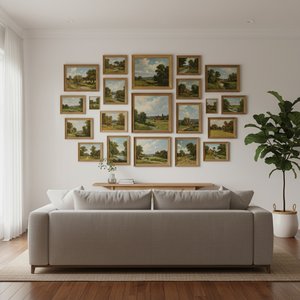
Beyond the laboratory, Russell’s artistic output served as a vital record of a vanishing era of English pastoral life. His paintings were more than mere depictions; they were evocations of a landscape shaped by centuries of agricultural tradition. Through his brush, the light of the Gloucestershire countryside was given a permanent, luminous form. Even as he navigated the complexities of international agricultural exchange and the establishment of the Imperial Agricultural Bureaux, his heart remained tethered to the quiet beauty of the fields he studied. Today, the legacy of Edward John Russell remains a testament to the idea that science and art are not opposing forces, but two different languages used to describe the same magnificent reality. He taught us that to truly see a landscape, one must understand both the light that touches its surface and the very earth upon which it rests.