Prodajajte svojo umetnost
Lista želja Nakupovalni košarica Cart
PredogledPredogled AR predogledAR predogled Kupi ročno naslikano sliko Kupi ročno naslikano slikoKupi digitalno sliko Kupi digitalno sliko PošljiPošlji
Podrobnosti o deluPodrobnosti o delu Dodaj v priljubljene Dodaj v priljubljene PrenesiPrenesi Podobni izdelkiPodobni izdelki Rentgenski posnetekRentgenski posnetek Predvajaj diaporamaPredvajaj diaporama

Improvisation 26

Wassily Kandinsky je revolucionarni ruskega umetnika, ki je spremenil svetovno umetnost z inovativnim abstraktnim slogom in izrazem globokih čutnih idej. Znani so po velikanskemu delu "Kompozicija VII", kjer uporabljajo intenzivne barve in geometrijske oblike za prikazovanje notranjih svetovnosti.

Giclée tisk / Umetniški tisk

Giclée ali platnati odtis muzejske kakovosti z hitro proizvodnjo in prilagodljivimi možnostmi končne obdelave. (Kupi ročno naslikano sliko Kupi ročno naslikano slikoKupi digitalno sliko Kupi digitalno sliko)

P118B $10
P118H $10
P118W $10
P438Z $10
P508JH $12
P508YH $12
P805H $10
P805Z $10
P919BZ $10
P919G $10
P919XJ $10
P959ZH $10
P968JZ $12
W106C $8
W218G $10
W218JH $8
W218Y $10
W307PJ $10
W316G $10
W316PJ $8
W316Y $10
W398PJ $8
W4111J $10
W500HY $15
W500JH $15
W692G $12
W849H $8
W940BG $15
W953PJ $8

Standard
custom
CM
INCH

Izberite eno od naših vnaprej določenih velikosti, ki ustrezajo prvotnim proporcijam umetničkega dela.

širina
višina

Svoje dimenzije lahko vnesete sami, da bodo ustrezne za določen okvir ali prostor. Če izbrana velikost ne bo skladna z razmerji izvirne slike, bomo umetniško delo orezali ali podaljšali s pomočjo ogledalnega odraza ali barvno polnega roba. Pred začetkom proizvodnje vam bomo poslali digitalni predogled za potrditev.
Upoštevajte, da predogled na zaslonu ne prikazuje dejanskega orezovanja ali podaljševanja. Le digitalni predogled bo natančno prikazal končno kompozicijo.
Čeprav so na voljo prilagojene velikosti, priporočamo izbiro dimenzije s predhodno določenega seznama, da ohranite prvotna razmerja.

Globalna dostava () v 2 tednih namesto standardnih 4/5 tednov. (17 avgust)

why_choose_icon
Brezplačna ekspresna dostava po vsem svetu
why_choose_icon
Visokokakovostno laneno platno
why_choose_icon
Popolno zavarovanje pošiljke
why_choose_icon
Garancija povračila carine in uvoznih davkov
why_choose_icon
Garancija popolnega ujemanja barv
why_choose_icon
60-dnevna politika vračanja (le v primeru napak)
why_choose_icon
Garancija 100% povračila denarja
why_choose_icon
Popust pri večjem naročilu

Skupna cena

$ 68

reproduction

Improvisation 26

Giclée tisk / Umetniški tisk

Velikost reprodukcije

-

Skupna končna cena

$ 68

Ključni podatki

  • Subject or theme: Composition
  • Dimensions: 97 x 107.5 cm
  • Movement: Expressionism
  • Artistic style: Abstract art
  • Artist: Wassily Kandinsky
  • Medium: Oil on canvas
  • Title: Improvisation 26

Umetniški kviz

Pri vsakem vprašanju je na voljo le eden pravilen odgovor.

Vprašanje 1:
What art movement is Improvisation 26 primarily associated with?
Vprašanje 2:
The painting prominently features a yellow circle. What does this element symbolize in Kandinsky's work?
Vprašanje 3:
Which artist is known for similar abstract paintings that explore color and form?
Vprašanje 4:
What technique did Kandinsky employ in Improvisation 26?
Vprašanje 5:
Improvisation 26 exemplifies the core principles of abstract art. What is its primary aim?

Opis zbirateljskega predmeta

Improvisation 26

Wassily Kandinsky’s “Improvisation 26” stands as an emblem of his groundbreaking approach to abstraction—a pivotal moment in the history of art that irrevocably shifted its trajectory toward a realm unbound by representational constraints. Painted in 1912 during his time in Munich, alongside fellow artist Gabriele Münter and within the influential circle of Der Blaue Reiter, this oil painting embodies the spirit of Expressionism while simultaneously pioneering the very concept of pure abstraction. It’s more than just pigment on canvas; it's a deliberate attempt to translate emotion into visual form—a quest for artistic truth that transcends mere imitation of nature.

Composition and Style: Geometric Harmony

The artwork immediately captivates with its bold chromatic palette dominated by vibrant yellows and deep blues, interwoven with intricate geometric shapes. At the core lies a prominent yellow circle, radiating outwards like a beacon of energy and luminosity—a deliberate choice reflecting Kandinsky’s fascination with circular forms as symbols of unity and cosmic harmony. Surrounding this central element are numerous smaller circles, squares, and triangles, arranged in dynamic patterns that create an illusion of movement and visual tension. These shapes aren't merely decorative; they represent fundamental building blocks of Kandinsky’s artistic vision—elements he believed could convey psychological states and spiritual ideas. The artist meticulously considered the interplay between color and form, recognizing their inextricable connection in achieving expressive effect.

Historical Context: Expressionism and Beyond

“Improvisation 26” emerged during a period of intense artistic experimentation and intellectual ferment—the height of Expressionist fervor. Artists like Kandinsky were grappling with profound questions about the role of art in conveying human experience, rejecting traditional academic conventions in favor of subjective interpretation. Der Blaue Reiter, established by Kandinsky and Münter, championed this radical aesthetic stance, advocating for a fusion of art and spirituality. The painting’s influence extends beyond Expressionism, foreshadowing developments in Surrealism and other avant-garde movements that would further explore the subconscious mind and challenge conventional perceptions of reality. It represents a decisive break from representational art, prioritizing emotional resonance over literal depiction—a legacy that continues to inspire artists today.

Similar Artists and Styles: Exploring Parallel Visions

To appreciate “Improvisation 26” fully, it’s worthwhile examining the work of contemporaries who shared Kandinsky's commitment to abstraction. Karol Hiller’s “Heliographic composition (XXIX)” demonstrates a similar preoccupation with geometric forms and color harmonies—a stylistic kinship rooted in a common desire to liberate art from representational limitations. Furthermore, Volodymyr Loboda’s Ukrainian paintings exemplify the spirit of Soviet Nonconformist Art, reflecting a broader artistic movement that resisted official dogma and pursued independent creative expression. These artists engaged in dialogues about how to express emotion and explore spiritual ideas through visual media—a conversation that continues to resonate with modern art practitioners.

Resources for Further Exploration

For those eager to delve deeper into Kandinsky’s oeuvre or similar artistic explorations, The Museum Rugby Art Gallery and Museum offers a curated collection showcasing diverse styles and periods. You can find more prominent pieces of abstract at WikiArt.org – best visual art database. And don't miss the opportunity to acquire a high-quality reproduction from /art/list/?Filter=8EWL4J-Wassily-Kandinsky-In-the-Blue and /art/list/?Filter=8XZ6PY-Wassily-Kandinsky-Compensation-rose – offering exceptional artistic quality at competitive prices!

Biografija umetnika

A Life Immersed in Color and Spirit

Wassily Wassilyevich Kandinsky, born December 4, 1866, in Moscow, Russia, was a revolutionary figure who irrevocably altered the course of modern art. His journey wasn’t one of immediate artistic calling; initially destined for a career in law and economics at the University of Moscow, it was a profound encounter with Impressionist painting – specifically Claude Monet's “Haystacks” – and a deeply moving experience witnessing Wagner’s opera "Lohengrin" that ignited within him an irrepressible desire to pursue art. This pivotal moment, occurring around age thirty, marked not merely a career change but a complete transformation of perspective, setting him on a path toward pioneering abstraction. He soon relocated to Munich, enrolling at the prestigious Academy of Fine Arts and studying under Franz von Stuck, though even within formal training, Kandinsky’s spirit yearned for exploration beyond conventional boundaries. Early influences included Russian folk art, gleaned from an ethnographic expedition to the Vologda region in 1889, which instilled a fascination with vibrant color palettes and symbolic imagery. This foundation would prove crucial as he began to develop his unique artistic language. These early explorations weren’t simply about aesthetic preference; they were rooted in a deep cultural connection and a burgeoning understanding of how art could communicate beyond the literal. He experimented with landscapes and portraits, demonstrating considerable skill but always feeling constrained by representational limitations.

The Dawn of Abstraction: From Expressionism to Inner Necessity

Kandinsky’s early works reveal a strong expressionistic bent, characterized by bold colors and emotional intensity – pieces like “Papeln (Poplars)” from 1902 exemplify this period. However, he wasn't content with merely representing the external world; he sought to express inner realities, spiritual truths that transcended mere visual depiction. This quest led him gradually away from representational art and toward a revolutionary exploration of color, form, and their emotional resonance. He believed that colors possessed inherent psychological effects, capable of evoking specific feelings and sensations in the viewer. This conviction was deeply intertwined with his burgeoning interest in Theosophy, a spiritual movement emphasizing esoteric knowledge and universal brotherhood. As he delved deeper into these ideas, Kandinsky’s paintings became increasingly non-objective, shedding recognizable forms in favor of abstract compositions driven by an “inner necessity.” This wasn't simply about abandoning representation; it was about discovering a new visual language capable of expressing the intangible realms of emotion and spirituality. He sought to create a visual equivalent of music, where color and form harmonized to evoke profound emotional responses.
  • Notable Early Works: “Papeln (Poplars),” “Fruitful Tree,” “Moscow Landscape”
  • Influences: Impressionism (Monet), Russian Folk Art

Geometric Harmony and Spiritual Resonance

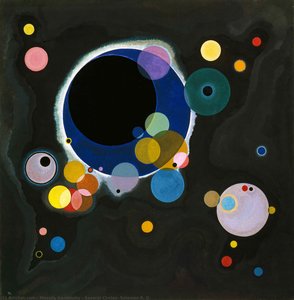
The period following his involvement with the influential artist group Der Blaue Reiter (The Blue Rider), which he co-founded in Munich in 1911, saw a further evolution in Kandinsky’s style. While earlier works often featured fluid, organic shapes, he began to explore geometric abstraction, focusing on the interplay of circles, triangles, and squares. “Several Circles” (140 x 140 cm) stands as a prime example of this phase – a dynamic composition where color and form interact in a harmonious yet energetic dance. He theorized extensively about the relationship between art and spirituality, arguing that true artistic expression required overcoming the limitations of visual perception and accessing realms beyond the observable world.
  • The Blaue Reiter Group: Collaboration with Franz Marc and other artists
  • Theoretical Writings: “Concerning the Spiritual in Art” (1911)

Bauhaus Influence and Lasting Legacy

The outbreak of World War I forced Kandinsky's return to Russia in 1914, but following the Russian Revolution, he found himself increasingly at odds with the prevailing artistic climate. In 1920, he accepted a teaching position at the Bauhaus school in Germany, where he profoundly influenced generations of artists with his theories on color, form, and abstraction. The Bauhaus provided an ideal environment for Kandinsky to further develop his ideas and explore new creative avenues. He continued to experiment with geometric forms and vibrant colors, often incorporating layered impasto techniques to create textured surfaces that added depth and complexity to his compositions – as seen in later works like “An Intimate Party” (1942). After the closure of the Bauhaus by the Nazi regime in 1933, Kandinsky moved to France, where he remained for the rest of his life. His impact on modern art is immeasurable; he is widely recognized as a pioneer of abstract expressionism and a key figure in the development of non-representational painting. His works are held in major museums worldwide, including the Tretyakov Gallery in Moscow, which houses his monumental “Composition VII,” a testament to his artistic vision and enduring legacy. He died December 13, 1944, in Neuilly-sur-Seine, France.
  • Major Achievements: Bauhaus Teaching Position, Development of Geometric Abstraction
  • Notable Later Works: “Composition VII,” “An Intimate Party”
Vasiliy Vasil'Evič Kandinskij

Vasiliy Vasil'Evič Kandinskij

1866 - 1944 , Rusija

Hitri podatki

  • Artistic Movement Or Style: Abstraktna umetnost, Ekspresionizem
  • Artists Or Movements Influenced By This Artist: ['Abstraktna ekspresija']
  • Artists Who Influenced This Artist:
    • Claude Monet
    • Richard Wagner
  • Date Of Birth: 1866
  • Full Name: Wassily Wassilyevich Kandinsky
  • Nationality: Ruski
  • Notable Artworks: ['Kompozicija VII']
  • Place Of Birth: Moscow, Russia
Raziščite umetniška dela, razvrščena po temah, slogih in značilnostih.