


x

Ručno oslikano uljanim bojama na platnu u dimenzijama i okviru po vašem izboru, izrađeno po porudžbini od strane naših umetnika. ( Pređi na štampu Prebacite na sliku)
Izaberite jednu od naših unapred definisanih veličina koje odgovaraju originalnim proporcijama umetničkog dela.

Можете унети сопствене димензије како бисте прилагодили дело одређеном оквиру или простору. Ако одабрана величина не одговара пропорцијама оригинала, слика ће бити исечена или проширена додатним елементима који се ручно насликавају. Дигитални prikaz ће вам бити послат на одобрење пре почетка производње.
Имајте на уму да преглед на екрану не одражава стварно исецање или проширење. Само приказ (mockup) ће тачно приказати коначну композицију.
Иако су доступне прилагођене величине, препоручујемо да одаберете димензију из дефинисане листе како бисте сачували оригиналне пропорције.
Isporuka širom sveta () za 3/4 nedelje umesto uobičajenih 5 nedelja. (9 август). Bez kompromisa po pitanju kvaliteta.


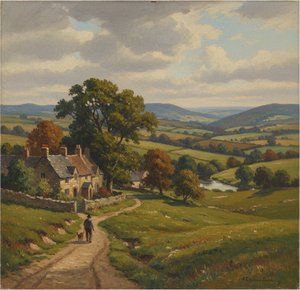
A Landscape
Dimenzije reprodukcije

In the golden light of the seventeenth century, amidst the bustling canals and thriving commerce of Haarlem, a master of subtle atmosphere was quietly at work. Cornelis Gerritsz Decker, born in 1618, did not seek the thunderous fame of Rembrandt or the sweeping drama of Rubens; instead, he dedicated his brush to the delicate, often overlooked nuances of the Dutch countryside. His life and work serve as a profound window into the soul of the Dutch Golden Age, capturing a world where the shifting clouds and the gentle sway of rural life were worthy of eternal preservation. As a member of the prestigious Haarlem Guild of St. Luke since 1643, Decker was deeply embedded in the very fabric of his city's artistic excellence, contributing to a legacy that celebrates the serene beauty of the Netherlands.
The essence of Decker’s artistry lies in his profound ability to translate the ephemeral into the enduring. His canvases are not merely depictions of land and sky, but emotional landscapes that breathe with the moisture of the Low Countries. To look upon a Decker landscape is to experience the weight of a heavy mist or the sudden, piercing clarity of sunlight breaking through a storm. This mastery of tonal modulation allowed him to create an incredible sense of depth, guiding the viewer's eye from the textured foreground into the hazy, infinite horizons of the distance. His work often features a sophisticated use of staffage—small, lively figures that populate his scenes—which lend a human pulse to the vastness of nature.
The development of Decker’s style was far from an isolated endeavor; it was a continuation of a grander tradition. He was deeply influenced by the monumental landscapes of Jacob van Ruisdael, whose dramatic approach to nature provided a foundational blueprint for Decker's own explorations. While Ruisdael often leaned toward the heroic and the turbulent, Decker found his strength in a more restrained, atmospheric elegance. He also drew inspiration from the works of Jan Wynants and Philips Wouwerman, integrating their meticulous attention to detail and lively characterizations into his broader vistas. This synthesis of influences allowed him to create works that felt both grounded in local tradition and elevated by a sophisticated painterly technique.
There is also a fascinating layer of familial connection within his biography that hints at the interconnected nature of the Haarlem art scene. It has been suggested that Decker may have been related to David Decker, a fellow pupil of Gerrit Claesz Bleker. This shared lineage of training under the same guild masters suggests a cohesive artistic community where techniques and aesthetic values were passed down like precious heirlooms. Through these connections, Decker’s work became part of a larger dialogue regarding how light, shadow, and landscape could be used to express the prosperity and the quiet piety of the Dutch people.
Though his name may not resonate with the same immediate recognition as the titans of his era, the historical significance of Cornelis Gerritsz Decker remains undeniable. His contribution to the genre of landscape painting helped define the visual identity of a nation. He mastered the art of the subtle transition, proving that greatness could be found in the softest gradations of grey and green. His paintings remain vital pieces of cultural heritage, held in esteemed collections such as the British Museum, where they continue to offer scholars and art lovers alike a glimpse into the meticulous observation of a bygone era.
The enduring appeal of Decker’s work lies in its honesty. He did not need to invent grand allegories; he found enough wonder in the way light hit a muddy path or how a distant tree silhouetted against a twilight sky. His life's work stands as a testament to the power of the landscape to reflect the human condition—a quiet, persistent observation of the world that continues to captivate the modern imagination.

1615 - 1678 , Netherlands

Explore the serene landscapes of John Fulleylove (1845-1908), a celebrated English artist. Discover his charming watercolours & oils, evocative travel illustrations, and lasting legacy. Learn about his life, exhibitions, and artistic style.

Explore the rich history of rural landscape painting with Most-Famous-Paintings. Discover Impressionist masterpieces, key artists & movements. Find your perfect serene artwork and bring nature's beauty home.
Explore the captivating landscapes & portraits of Brian Hatton (1887-1916), a promising British artist lost too soon. Discover his unique style, Herefordshire roots, and lasting legacy in early 20th-century art.

Explore the captivating world of John Augustus Atkinson (1775-1830), a key figure in British Romanticism and genre painting. Discover his stunning Russian history scenes, naval art & delicate watercolors. Learn about his legacy at Most-Famous-Paintings.

Explore the rich history of rural life in painting! Discover Impressionist masterpieces, Italian Macchiaioli scenes & the enduring appeal of pastoral landscapes. Find your perfect artwork at Most-Famous-Paintings.


Budite u toku sa najnovijim vestima o umetnosti, ekskluzivnim ponudama i idejama za dekoraciju.
Recite nam o vašem projektu i naši stručnjaci za umetnost će vam pružiti 3 personalizovana predloga umetničkih dela.
Dozvolite nam da odaberemo 3 opcije specijalno za Vas - Besplatno!


 Pregledaj u prostoru
 Pošalji
 Podeli
 Detalji o delu

 Преузми
 Slični predmeti
 Rendgenski snimak
 Slajdovi
 Pročitaj više




































 Opcija sa staklom dostupna je samo za dimenzije manje od 110 cm


