


x

Ručno oslikano uljanim bojama na platnu u dimenzijama i okviru po vašem izboru, izrađeno po porudžbini od strane naših umetnika. ( Pređi na štampu Prebacite na sliku)





























Izaberite jednu od naših unapred definisanih veličina koje odgovaraju originalnim proporcijama umetničkog dela.

Можете унети сопствене димензије како бисте прилагодили дело одређеном оквиру или простору. Ако одабрана величина не одговара пропорцијама оригинала, слика ће бити исечена или проширена додатним елементима који се ручно насликавају. Дигитални prikaz ће вам бити послат на одобрење пре почетка производње.
Имајте на уму да преглед на екрану не одражава стварно исецање или проширење. Само приказ (mockup) ће тачно приказати коначну композицију.
Иако су доступне прилагођене величине, препоручујемо да одаберете димензију из дефинисане листе како бисте сачували оригиналне пропорције.
Isporuka širom sveta () za 3/4 nedelje umesto uobičajenih 5 nedelja. (5 август). Bez kompromisa po pitanju kvaliteta.


Sir John Robinson, Lord Mayor
Dimenzije reprodukcije

In the grand, sweeping tapestry of the seventeenth century, few threads are as intricately woven as those belonging to John Michael Wright. A painter whose life spanned the tumultuous transitions of the English Baroque, Wright was far more than a mere chronicler of faces; he was a bridge between worlds. His journey, stretching from the rugged artistic landscapes of Scotland to the sun-drenched, classical splendor of Rome, allowed him to synthesize a style that was uniquely his own—a delicate marriage of Northern meticulousness and Mediterranean drama. To look upon a Wright portrait is to witness a profound dialogue between the realism of the British tradition and the chiaroscuro mastery of the Italian masters.
Born in London around 1617, Wright’s early years were marked by a fascinating duality. While his baptismal records place him firmly in the heart of London's Shoe Lane district, the echoes of a Scottish upbringing resonate through much of his biographical narrative. This period of formative growth saw him under the tutelage of George Jamesone in Edinburgh, a master who laid the groundwork for Scottish portraiture. From Jamesone, Wright inherited an unwavering devotion to detail and an ability to capture the subtle textures of fabric and skin, traits that would later allow him to navigate the demanding expectations of the European aristocracy with unparalleled grace.
The true metamorphosis of Wright’s artistry occurred during his transformative sojourn in Rome around 1655. It was within this vibrant, intellectual crucible that the artist truly found his voice. By enrolling at the Accademia di San Luca, Wright immersed himself in a world where the shadows of Caravaggio still loomed large and the classical ideals of antiquity were breathed into every canvas. He moved among the luminaries of the papal court, absorbing the techniques of Pietro Testa and Giovanni Battista Gaulli. This exposure to the dramatic interplay of light and dark—the chiaroscuro—infused his work with a newfound emotional depth and compositional complexity.
This Roman period was not merely an academic exercise but a spiritual and professional awakening. The influence of the Italian Baroque provided him with the tools to elevate portraiture from simple likeness to profound psychological study. He learned to use light not just to illuminate, but to sculpt, creating figures that seemed to emerge from the darkness with a palpable, breathing presence. This period of intense development ensured that when he eventually returned to the British Isles, he brought with him a sophisticated, continental elegance that set him apart from his more localized contemporaries.
Upon his return to England, Wright’s reputation flourished as he became a sought-after figure within the opulent circles of the Stuart Court. His ability to capture the dignity and status of the era's elite made him a favored painter for figures such as Charles II and James II. Unlike the more flamboyant and often idealized works of Sir Peter Lely, Wright’s approach leaned toward a dignified realism. He possessed a rare talent for rendering the weight of velvet, the shimmer of silk, and the stoic character of his subjects, making his portraits enduring historical documents of 17th-century prestige.
His achievements extend beyond the mere execution of beautiful images; he was an artist-scholar who understood the cultural weight of his craft. His work stands as a testament to a period of immense political and social upheaval, capturing the faces of an era that was constantly redefining itself. Today, the significance of John Michael Wright lies in this very synthesis:

1617 - 1694 , United Kingdom

Journey through 17th century art with masterpieces by Rembrandt, Vermeer & Caravaggio. Explore Baroque paintings, Dutch Golden Age techniques & timeless beauty. Find museum-quality reproductions and elevate your home decor on Most-Famous-Paintings.com.

Explore the life & legacy of Sir Anthony van Dyck, the leading court painter of his era. Discover his innovative portraiture, Baroque masterpieces, and investment potential for discerning collectors. Learn more at Most-Famous-Paintings.

Explore the dramatic world of Baroque Realism! Discover iconic artists like Caravaggio & Rubens, their techniques, and the movement's lasting impact on art history. Expert insights for collectors & enthusiasts.

Explore the captivating portraits of Sir John Watson Gordon, a leading Scottish master. Discover his evolution from neoclassical style to atmospheric Tonalism and influence on 19th-century British art. Learn about his iconic sitters & legacy.
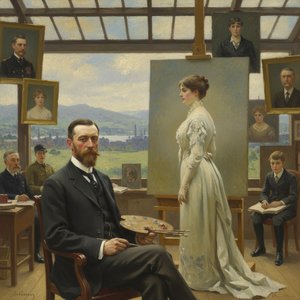
Explore the life & art of Sir John Lavery, a master of Scottish Impressionism and renowned portraitist. Discover his captivating works, Irish heritage, and lasting legacy with Most-Famous-Paintings.


Budite u toku sa najnovijim vestima o umetnosti, ekskluzivnim ponudama i idejama za dekoraciju.
Recite nam o vašem projektu i naši stručnjaci za umetnost će vam pružiti 3 personalizovana predloga umetničkih dela.
Dozvolite nam da odaberemo 3 opcije specijalno za Vas - Besplatno!


 Pregledaj u prostoru
 Pošalji
 Podeli
 Detalji o delu

 Преузми
 Slični predmeti
 Rendgenski snimak
 Slajdovi
 Pročitaj više







 Opcija sa staklom dostupna je samo za dimenzije manje od 110 cm


