x

Giclée- eller canvasprint av museumskvalitet med snabb produktion och flexibla ytbehandlingsalternativ. ( Beställ handmålad reproduktion Köp högupplöst bild)





























Välj bland våra förinställda storlekar som motsvarar konstverkets ursprungliga proportioner.

Du kan ange egna mått för att passa en specifik ram eller yta. Om det valda måttet inte överensstämmer med originalbildens proportioner kommer vi antingen att beskära konstverket eller utöka bilden med en speglad eller enfärgad kant. En digital mockup skickas för ditt godkännande innan produktionen påbörjas.
Vänligen notera att förhandsvisningen på skärmen inte återspeglar den faktiska beskärningen eller utökningen. Endast mockuppen visar den slutgiltiga kompositionen korrekt.
Även om anpassade storlekar är möjliga, rekommenderar vi att du väljer ett mått från den fördefinierade listan för att bevara de ursprungliga proportionerna.
Leverans över hela världen () på 2 veckor istället för standard 4/5 veckor. (15 augusti)


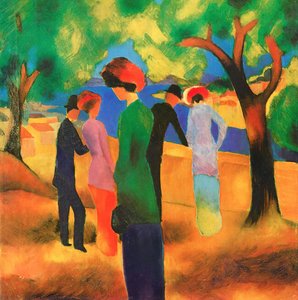
Girls under Trees
Storlek på reproduktion
August Macke's “Girls Under Trees” (1914) isn't merely a depiction of children playing in the woods; it’s a vibrant distillation of early 20th-century optimism and a powerful expression of German Expressionism. Painted just before the artist’s tragically short life, this work captures a fleeting moment of communal joy – a scene brimming with youthful energy and a profound connection to nature. Macke masterfully employs bold color and dynamic brushstrokes to convey not just what he saw, but how he *felt* about it: a sense of unburdened happiness and the simple pleasures of life.
Born in Meschede, Germany, in 1887, August Macke was a pivotal figure within the burgeoning movement of German Expressionism. His artistic journey was marked by rapid experimentation, influenced initially by Impressionist techniques before evolving into a uniquely expressive style. The context of his work is crucial; 1914 represents a period of intense artistic innovation across Europe, with artists grappling with modernity and seeking new ways to represent the human experience. Macke’s membership in “Der Blaue Reiter” (The Blue Rider) – a group dedicated to exploring non-representational art and spiritual themes – highlights his engagement with these avant-garde currents. His brief but impactful career was cut short by the outbreak of World War I, leaving behind a legacy of intensely colored and emotionally charged paintings.
Macke’s technique is immediately striking. He utilizes loose, almost frantic brushstrokes to create a sense of movement and spontaneity. The figures aren't rendered with meticulous detail; instead, they are suggested through blocks of color and simplified forms. This approach aligns perfectly with the Expressionist desire to convey emotion rather than objective reality. Notice how he blends the children’s dresses – greens, blues, yellows – seamlessly into the surrounding foliage, dissolving the boundaries between figure and landscape. The composition itself is dynamic, drawing the viewer's eye across the canvas through a carefully orchestrated arrangement of shapes and colors. This technique reflects Macke's interest in integrating elements of the avant-garde, particularly the influence of Orphism—the use of color to create visual rhythms and harmonies.
"Girls Under Trees" resonates with a powerful sense of nostalgia and innocence. The children’s carefree laughter and joyful interaction evoke a longing for simpler times – a sentiment deeply rooted in the anxieties of a rapidly changing world. The trees themselves, rendered as monumental forms, symbolize strength, stability, and connection to nature—themes central to many Expressionist works. Macke's ability to capture this emotional core through his distinctive style elevates the painting beyond a mere depiction of children; it becomes a timeless meditation on joy, community, and the beauty of the natural world. The painting’s enduring appeal lies in its ability to tap into universal human emotions – a reminder that even amidst chaos and uncertainty, moments of pure happiness can be found.


1887 - 1914 , Tyskland

Explore the visceral power of German Expressionism. From Ernst Ludwig Kirchner to Die Brücke, discover how bold colors and distorted forms unmask raw human emotion in this expert art history guide for collectors and enthusiasts.


Håll dig uppdaterad med de senaste konstnyheterna, exklusiva erbjudanden och inredningsidéer.
Berätta om ditt projekt så kommer våra konstexperter att ge dig 3 personliga konstförslag.
Vi skapar ett urval av 3 alternativ helt anpassat för dig – gratis!


 Förhandsvisa
 Skicka
 Dela
Dela
 Visa detaljer

 Ladda ner
 Liknande objekt
 Röntgen
 Bildspel


 Visa mer







 Glasalternativet är endast tillgängligt i storlekar under 110 cm.