Sälj din konst
Önskelista Varukorg Cart
Beställ tryck Beställ tryckKöp högupplöst bild Köp högupplöst bild SkickaSkicka
Visa detaljerVisa detaljer Lägg till i favoriter Lägg till i favoriter Ladda nerLadda ner Liknande objektLiknande objekt BildspelBildspel

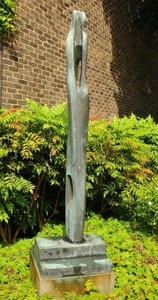
Curved Forms (Pavan)

Curved Forms (Pavan) by Barbara Hepworth is a 1956 sculpture created using metallized plaster on aluminum armature. Inspired by the Pavan dance, it reflects Hepworth's dedication to capturing 'the spiritual inner life' of art through its flowing forms and balanced composition.

Utforska den moderna skulpturen av Dame Barbara Hepworth (1903–1975). En pionjär inom abstrakt konst, Hepworths verk – inklusive 'Oval Form' & 'Two Forms' – blandar surrealism och abstraktion. Upptäck hennes arv på Hepworth Wakefield.

Handgjord oljereproduktion

Handmålad olja på duk i din valda storlek och ram, tillverkad efter beställning av våra konstnärer. (Beställ tryck Beställ tryckKöp högupplöst bild Köp högupplöst bild)

Standard
custom
CM
INCH

Välj bland våra förinställda storlekar som motsvarar konstverkets ursprungliga proportioner.

bredd
höjd

Du kan ange egna mått för att passa en specifik ram eller yta. Om den valda storleken inte matchar originalbildens proportioner kommer vi antingen att beskära konstverket eller utöka målningen med ytterligare handmålade element. En digital skiss skickas till dig för godkännande innan produktionen påbörjas.
Observera att förhandsvisningen på skärmen inte återspeglar den faktiska beskärningen eller utökningen. Endast skissen visar den slutgiltiga kompositionen korrekt.
Även om anpassade storlekar är möjliga, rekommenderar vi att du väljer en dimension från den fördefinierade listan för att bevara originalproportionerna.

Exempel på vad som kan anpassas: Byt ut ansiktet mot ett foto av kunden; Lägg till ett husdjur (t.ex. byt ut en katt mot en hund); Inkludera ett dolt meddelande i bakgrunden; Ändra bakgrundens landskap eller element.
Efter beställning kommer Most-Famous-Paintings.com team att mejla kunden för instruktioner och tillhandahålla en skissförhandsvisning

Leverans över hela världen () på 3–4 veckor istället för standard 5 veckor. (18 augusti). Inga kompromisser med kvaliteten.

why_choose_icon
Fri expressfrakt över hela världen
why_choose_icon
Högkvalitativ linnecanvas
why_choose_icon
Fullständig fraktförsäkring
why_choose_icon
Garantier för återbetalning av tullavgifter
why_choose_icon
Garantier för exakt färgåtergivning
why_choose_icon
60 dagars returrätt (endast vid fabrikationsfel)
why_choose_icon
100% pengarna tillbaka-garanti
why_choose_icon
Mängdrabatt erbjuds

Totalpris

$ 272

reproduction

Curved Forms (Pavan)

Reproduktionsmedium

Storlek på reproduktion

-

Slutgiltigt pris

$ 272

Snabbfakta

  • Artistic style: Abstraction
  • Title: Curved Forms (Pavan)
  • Location: The Hepworth Wakefield
  • Year: 1956
  • Medium: Metallized plaster & metal armature
  • Notable elements or techniques: Carving of hardened plaster surface
  • Subject or theme: Organic forms

Konstquiz

Det finns endast ett korrekt svar på varje fråga.

Fråga 1:
What is the sculpture Curved Forms (Pavan) primarily known for?
Fråga 2:
Barbara Hepworth is recognized as a pioneer in which artistic movement?
Fråga 3:
What material was used to create Curved Forms (Pavan)?
Fråga 4:
According to the description, Hepworth described her sculptural method as...
Fråga 5:
Where can Curved Forms (Pavan) be viewed?

Beskrivning av konstverket

Barbara Hepworth: Exploring Flowing Forms and Spiritual Resonance

Barbara Hepworth (1903–1975) stands as one of the most influential figures in British sculpture of the mid-20th century, a pioneer who championed abstraction and sought to capture the essence of organic forms—particularly those found in nature. Her oeuvre is characterized by monumental sculptures crafted from materials like bronze, stone, and alabaster, yet “Curved Forms (Pavan),” created in 1956, exemplifies her distinctive approach: metallized plaster cast on aluminum armature.

Inspired by the graceful Pavan dance—a stately court dance of Elizabethan England—Hepworth’s sculpture transcends mere imitation. Instead, it embodies her profound fascination with movement and transformation. As Hepworth herself eloquently described, she aimed to “capture ‘the spiritual inner life’ of art,” striving not just for visual representation but for conveying a sense of dynamism and interconnectedness.

Technique and Material Innovation

Hepworth's method was revolutionary for its time. Rejecting the traditional modeling techniques favored by many sculptors, she opted for a process that prioritized resistance—the interaction between sculptor and material. She constructed an aluminum armature – a skeletal framework – providing structural support while allowing her to manipulate the plaster surface with precision.

  • Metallized Plaster: Hepworth coated the armature in metallized plaster, a technique she developed herself. This involved applying a thin layer of metal pigment onto the plaster before casting it, resulting in a pale gray hue that subtly reflects light.
  • Aluminum Armature: The aluminum armature was chosen for its rigidity and ability to maintain shape during the casting process.
  • Carving Technique: Hepworth meticulously carved into the hardened plaster surface using chisels and hammers, painstakingly shaping the ovoid forms until they achieved their final sculptural form.

Symbolism and Aesthetic Vision

"Curved Forms (Pavan)" isn't merely a beautiful object; it’s laden with symbolic significance. The three interconnected ovoids represent Hepworth’s belief in the fundamental unity of existence—the idea that all things are interdependent and constantly evolving. Their flowing curves mirror the movement of water or wind, symbolizing fluidity and adaptability.

Hepworth's aesthetic vision was rooted in a deep appreciation for natural forms and a desire to express their underlying principles. She sought to distill the essence of organic shapes into simplified geometric forms, creating sculptures that evoke contemplation and invite viewers to consider the relationship between form and space.

Legacy and Recognition

"Curved Forms (Pavan)" resides in The Hepworth Wakefield’s collection, a testament to Hepworth's enduring influence on modern sculpture. Its placement alongside other works by Hepworth underscores her commitment to exploring themes of spirituality and materiality—a legacy that continues to inspire artists and collectors alike.

The sculpture’s distinctive monochromatic surface – achieved through careful polishing – enhances its visual impact, emphasizing the texture and contours of the form while creating a serene atmosphere. As Hepworth herself noted, “Curved Forms (Pavan), Version II” embodies "the spiritual inner life" of art—a profound statement that encapsulates her artistic philosophy.


Konstnärsbiografi

Barbara Hepworth: Pioneer of Abstract Sculpture

Barbara Hepworth (1903–1975) stands as one of the most influential figures in twentieth-century British art, recognized for her groundbreaking contributions to modern sculpture and her unwavering dedication to exploring the relationship between form and space. Born Jocelyn Barbara Hepworth in Wakefield, Yorkshire, she possessed an innate fascination with natural forms—particularly pebbles and seashells—which would profoundly shape her artistic vision throughout her prolific career. Her formative years were marked by a deep connection to the rugged landscape of West Yorkshire, fostering a sensitivity for texture and materiality that would become central to her sculptural practice.
  • Early Influences: Hepworth’s artistic journey began with studies at Leeds School of Art in 1920, where she encountered Henry Moore, establishing a collaborative spirit that would endure throughout their lives. This formative period instilled in her an appreciation for geometric abstraction and the exploration of fundamental visual principles.
  • Royal College of Art & Surrealism: Continuing her education at the Royal College of Art from 1921 until she graduated in 1924, Hepworth embraced the burgeoning avant-garde movement of Surrealism, collaborating with Ben Nicholson and Paul Nash. This exposure to surrealist ideas fueled her experimentation with unconventional materials and techniques.

The Unit One Movement & Early Sculptural Innovations

Hepworth’s artistic breakthrough arrived in 1933 with the formation of Unit One, alongside Nicholson, Nash, and others—a collective dedicated to uniting Surrealism and abstraction. This movement championed a radical departure from representational art, prioritizing pure form and exploring its inherent dynamism. Hepworth's early sculptures – notably *Oval Form* (Trezion) – exemplify this aesthetic ethos, characterized by smooth surfaces and subtly curving shapes that defy easy categorization.
  • Material Exploration: Hepworth’s mastery lay in her ability to transform raw materials—primarily stone and bronze—into evocative forms. She meticulously honed her craft, mastering techniques of carving and casting to achieve unparalleled precision and expressive power.
  • Influence of Moore & Nicholson: Hepworth's artistic dialogue with Henry Moore and Ben Nicholson proved invaluable in shaping her aesthetic sensibilities. Their shared commitment to exploring the interplay between organic and geometric forms propelled her creative endeavors forward.

Mature Style & Monumental Commissions

Throughout the 1940s and 1950s, Hepworth’s sculptural output intensified, reflecting a deepening engagement with both landscape and human figure. Her distinctive style—characterized by concentric circles and voids—became synonymous with modern sculpture.
  • Landscape as Inspiration: Hepworth drew inspiration from the Yorkshire countryside, translating its contours and textures into monumental sculptures that captured the essence of natural forms. Pieces like *Two Forms* and *Totem* stand as testament to her ability to convey profound emotional resonance.
  • Public Recognition & Legacy: Hepworth’s work garnered international acclaim, securing prestigious commissions—including Winged Figure for John Lewis—and cementing her place among the foremost sculptors of her time. Her enduring influence continues to inspire artists today.

The Hepworth Wakefield & Continuing Artistic Exploration

Today, Barbara Hepworth’s legacy resides prominently at The Hepworth Wakefield, where a comprehensive collection showcases her oeuvre—spanning from early explorations of abstraction to monumental sculptures that redefine the boundaries of artistic expression.
  • A Singular Vision: Hepworth's unwavering dedication to exploring form and space—coupled with her profound sensitivity for materials—established her as an unparalleled innovator in modern sculpture. Her work remains a beacon of creativity, inviting viewers to contemplate the fundamental questions of art and existence.
Barbara Hepworth

Barbara Hepworth

1903 - 1975 , Storbritannien

Kortfakta

  • Artistic Movement Or Style: Modernism
  • Artists Or Movements Influenced By This Artist: ['Abstraction']
  • Artists Who Influenced This Artist: ['Henry Moore']
  • Date Of Birth: 10 januari 1903
  • Full Name: Barbara Hepworth
  • Nationality: Brittisk
  • Notable Artworks:
    • Oval Form
    • Two Forms
    • Totem
  • Place Of Birth: Wakefield, England
Utforska konstverk sorterade efter tema, stil och egenskaper.