


x

 Renaissance
 1450
1450 25.0 x 16.0 cm
Giclée- eller canvasprint av museumskvalitet med snabb produktion och flexibla ytbehandlingsalternativ. ( Beställ handmålad reproduktion Köp högupplöst bild)





























Välj bland våra förinställda storlekar som motsvarar konstverkets ursprungliga proportioner.

Du kan ange egna mått för att passa en specifik ram eller yta. Om det valda måttet inte överensstämmer med originalbildens proportioner kommer vi antingen att beskära konstverket eller utöka bilden med en speglad eller enfärgad kant. En digital mockup skickas för ditt godkännande innan produktionen påbörjas.
Vänligen notera att förhandsvisningen på skärmen inte återspeglar den faktiska beskärningen eller utökningen. Endast mockuppen visar den slutgiltiga kompositionen korrekt.
Även om anpassade storlekar är möjliga, rekommenderar vi att du väljer ett mått från den fördefinierade listan för att bevara de ursprungliga proportionerna.
Leverans över hela världen () på 2 veckor istället för standard 4/5 veckor. (14 augusti)


De Sphaera
Storlek på reproduktion

Cristoforo de Predis (c. 1440 – c. 1486) remains an enigmatic figure in the annals of Florentine art history, largely obscured by the brilliance of his contemporaries—Leonardo da Vinci and Michelangelo—yet undeniably significant for his contribution to the burgeoning humanist aesthetic of the Quattrocento.
Born deaf and mute in San Vincenzo near Prato, Cristoforo’s early life was marked by profound limitations that paradoxically fostered a unique perspective on artistic creation. His parents, Leonardo de Predis and Margaret Giussani, were prominent figures in Florentine society, fostering an environment where intellectual curiosity thrived—a circumstance that would prove crucial to his formative years.
Despite his disability, Cristoforo’s talent for illumination quickly emerged, attracting the patronage of influential families like the Borromeo. His distinctive style – characterized by meticulous detail and a masterful understanding of color palettes – distinguished him from many other artists of his time. He embraced the humanist ideals championed by Pico della Mirandola and Marsilio Ficino, reflecting these philosophical currents in his artistic endeavors.
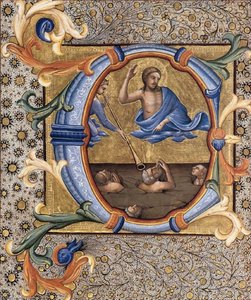
Cristoforo’s oeuvre comprises four extant manuscripts, primarily illuminated Gospels and Psalters, demonstrating a remarkable command of technique and stylistic innovation. Notably, the Borromeo Book of Hours stands as a testament to his skill—a lavishly decorated manuscript featuring intricate floral borders and vibrant pigments that exemplify the artistic fervor of Florence during the Renaissance.
Leonardo da Vinci himself recognized Cristoforo’s exceptional abilities, recounting an encounter where he remarked on the profound wisdom gleaned from individuals devoid of speech. This anecdote underscores the broader humanist preoccupation with sensory experience and intellectual contemplation—themes that resonate throughout Cristoforo’s artistic output.
Cristoforo de Predis's contribution to Renaissance art lies not merely in his technical prowess but also in his embodiment of humanist ideals – a silent witness to an era defined by intellectual exploration and artistic flourishing. His work continues to fascinate scholars today, prompting ongoing debates about the role of disability in fostering creativity and shaping artistic vision.

APS ofrece reproducciones de bellas artes y encargos personalizados desde 2004. Confían en nosotros corporaciones, hoteles y coleccionistas selectos para obras de arte de calidad museística, servicio discreto y soluciones artísticas completas. ¡Póngase en contacto con nosotros para obtener un presupuesto personalizado!
Utforska Goyas 25 mest ikoniska målningar! Fördjupa dig i spansk konsthistoria, romantikens dramatik och mörka färger. Köp museumkvalitativa reproduktioner & inred med tidlösa klassiker på Most-Famous-Paintings.com.

Upptäck vår historia! Vi för in konst i världsklass i ditt liv genom experturval, skräddarsydda lösningar och kostnadsfria förhandsvisningar. Godkänt av privatpersoner och företag sedan år 2000.
Explore the captivating world of Pieter de Hooch, a master of Dutch Golden Age painting. Discover his innovative use of light, intimate domestic scenes, and lasting influence on art history. Learn more at Most-Famous-Paintings.

Explore the revolutionary De Stijl movement & Neo-Plasticism with our expert guide. Discover Piet Mondrian, Theo van Doesburg, and the lasting impact of this influential art style. Learn about collecting & investing in De Stijl masterpieces.


Håll dig uppdaterad med de senaste konstnyheterna, exklusiva erbjudanden och inredningsidéer.
Berätta om ditt projekt så kommer våra konstexperter att ge dig 3 personliga konstförslag.
Vi skapar ett urval av 3 alternativ helt anpassat för dig – gratis!


 Förhandsvisa
 Skicka
 Dela
Dela
 Visa detaljer

 Ladda ner
 Liknande objekt
 Röntgen
 Bildspel
 Visa mer







 Glasalternativet är endast tillgängligt i storlekar under 110 cm.




![Vida De Miguel De Cervantes Saavedra (life Of Miguel De Cervantes Saavedra). Book V Of The Edition Of Don Quixote (biblioteca Nacional De España)\n\n[7] — Martín Fernández De Navarrete Y Ximénez De Tejada, Academic Art](/media/artworks/images/thumbnails/99/f9/99f969c294754562907a5ffd062310fa.jpg)

