x

Giclée- eller canvasprint av museumskvalitet med snabb produktion och flexibla ytbehandlingsalternativ. ( Beställ handmålad reproduktion Köp högupplöst bild)





























Välj bland våra förinställda storlekar som motsvarar konstverkets ursprungliga proportioner.

Du kan ange egna mått för att passa en specifik ram eller yta. Om det valda måttet inte överensstämmer med originalbildens proportioner kommer vi antingen att beskära konstverket eller utöka bilden med en speglad eller enfärgad kant. En digital mockup skickas för ditt godkännande innan produktionen påbörjas.
Vänligen notera att förhandsvisningen på skärmen inte återspeglar den faktiska beskärningen eller utökningen. Endast mockuppen visar den slutgiltiga kompositionen korrekt.
Även om anpassade storlekar är möjliga, rekommenderar vi att du väljer ett mått från den fördefinierade listan för att bevara de ursprungliga proportionerna.
Leverans över hela världen () på 2 veckor istället för standard 4/5 veckor. (19 augusti)


untitled (3371)
Storlek på reproduktion
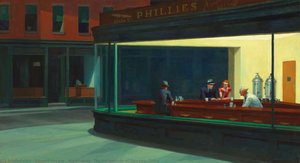
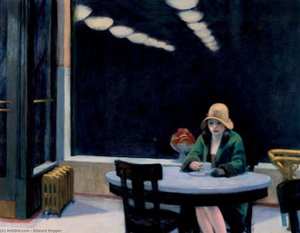
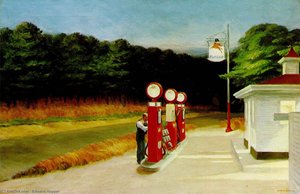
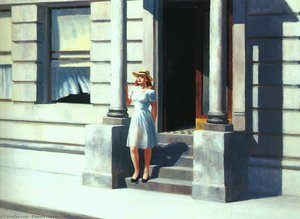
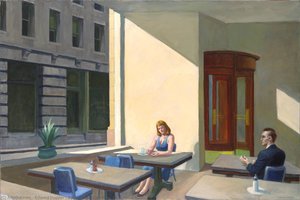
Edward Hopper (1882-1967), born in Nyack, New York, stands as one of the most recognizable figures in American art history. His artistic journey began with a grounding in commercial illustration—a pragmatic path suggested by his parents—yet Hopper swiftly gravitated toward fine art, enrolling at the New York School of Art under William Merritt Chase and Robert Henri.
These formative influences profoundly shaped Hopper’s artistic vision. Chase instilled technical proficiency, while Henri championed expressive realism—a commitment to portraying the world with unflinching honesty. This dedication to capturing the essence of human experience is evident throughout his extensive body of work, cementing his reputation as a chronicler of modern life.
Hopper's distinctive style—characterized by stark contrasts of light and dark, simplified forms, and an almost photographic precision—became synonymous with the mood of the era. He eschewed grand narratives or overtly dramatic gestures, instead focusing on capturing fleeting moments of everyday existence—a deliberate choice that underscores his belief in the power of observation.
Hopper's technique was meticulously honed through years of practice. He favored a restrained palette, primarily utilizing shades of gray and white—a stylistic decision that heightened the impact of his compositions. The artist skillfully manipulated light to sculpt forms and create depth within the canvas, emphasizing the interplay between illumination and darkness.
Detailed brushstrokes—often subtly textured—were employed to render surfaces with remarkable accuracy, capturing the subtle nuances of material texture. This meticulous attention to detail contributes significantly to the artwork’s overall realism and reinforces Hopper's commitment to portraying the world as he perceived it.

1931 - 1967 , USA

Explore the profound history of American Regionalism. Discover how Grant Wood captured the heart of the Midwest through masterpieces like American Gothic. An expert guide to the movement, its cultural impact, and the enduring beauty of American Realism.


Håll dig uppdaterad med de senaste konstnyheterna, exklusiva erbjudanden och inredningsidéer.
Berätta om ditt projekt så kommer våra konstexperter att ge dig 3 personliga konstförslag.
Vi skapar ett urval av 3 alternativ helt anpassat för dig – gratis!


 Förhandsvisa
 Skicka
 Dela
Dela
 Visa detaljer

 Ladda ner
 Liknande objekt
 Röntgen
 Bildspel
 Visa mer







 Glasalternativet är endast tillgängligt i storlekar under 110 cm.