x

Giclée- eller canvasprint av museumskvalitet med snabb produktion och flexibla ytbehandlingsalternativ. ( Beställ handmålad reproduktion Köp högupplöst bild)





























Välj bland våra förinställda storlekar som motsvarar konstverkets ursprungliga proportioner.

Du kan ange egna mått för att passa en specifik ram eller yta. Om det valda måttet inte överensstämmer med originalbildens proportioner kommer vi antingen att beskära konstverket eller utöka bilden med en speglad eller enfärgad kant. En digital mockup skickas för ditt godkännande innan produktionen påbörjas.
Vänligen notera att förhandsvisningen på skärmen inte återspeglar den faktiska beskärningen eller utökningen. Endast mockuppen visar den slutgiltiga kompositionen korrekt.
Även om anpassade storlekar är möjliga, rekommenderar vi att du väljer ett mått från den fördefinierade listan för att bevara de ursprungliga proportionerna.
Leverans över hela världen () på 2 veckor istället för standard 4/5 veckor. (18 augusti)


untitled (3915)
Storlek på reproduktion
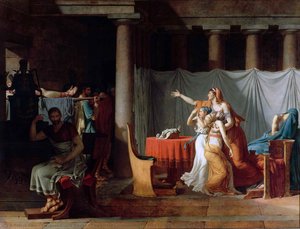
Jacques-Louis David (1748-1825) stands as a monumental figure in the annals of French art history, embodying not merely artistic skill but also the tumultuous spirit of his era – the dawn of the Enlightenment and the explosive upheaval of the French Revolution. His journey from humble beginnings to international acclaim is itself a chronicle of dramatic transformation, mirroring the broader societal shifts that reshaped Europe.
Born in Paris amidst considerable hardship—his father’s untimely death leaving him orphaned at a young age and a facial deformity presenting significant challenges to his speech—David possessed an innate dedication to mastering his craft. Initially apprenticed to François Boucher, David quickly recognized the profound moral resonance of Joseph-Marie Vien's approach to history painting, prioritizing classical ideals and heroic narratives.
Early successes in competitions secured him a place at the Académie Royale de peinture et de sculpture, where he honed his technique under Vien’s tutelage. However, David’s artistic vision swiftly diverged from established conventions, gravitating towards a style characterized by austere clarity and monumental grandeur – Neoclassicism. This stylistic preference wouldn't simply be aesthetic; it would become inextricably linked to the revolutionary fervor gripping France.
David’s artistic philosophy was deeply rooted in the revival of classical antiquity, fueled by humanist scholarship and a fervent belief in reason. Rejecting the ornate excesses of Rococo art, he championed forms reminiscent of Greek and Roman sculpture – idealized figures conveying moral virtue and embodying heroic action. This stylistic choice wasn't accidental; it served as a deliberate rebuke to the perceived decadence of the Bourbon monarchy and an affirmation of republican values.
"Oath of the Horatii," arguably David’s most celebrated masterpiece, exemplifies this Neoclassical ethos. Painted in 1784, it depicts a poignant scene from Roman legend—three brothers pledging allegiance to their father and upholding honor above personal ambition. The composition is meticulously balanced, utilizing geometric precision and dramatic chiaroscuro to heighten emotional impact. More than just an aesthetically pleasing image, the painting functioned as a powerful symbol of civic duty and moral fortitude – sentiments that resonated deeply with the burgeoning republican movement.
"The Death of Marat," completed in 1793 during the height of the Reign of Terror, cemented David’s reputation as a propagandist for the revolution. This unflinching depiction of Jean-Paul Marat—a radical journalist assassinated by Charlotte Corday—captured the visceral horror and moral urgency of the period with remarkable realism. The painting's stark simplicity – bathed in muted light – underscores Marat’s martyrdom, conveying profound sorrow and commemorating his unwavering commitment to republican ideals.
David’s artistic legacy extends far beyond his iconic paintings. He profoundly influenced subsequent generations of artists, shaping the visual language of Romanticism and establishing Neoclassicism as a dominant aesthetic force throughout Europe. His meticulous attention to detail, masterful use of technique—particularly etching—and unwavering commitment to classical ideals continue to inspire admiration and scholarly study today. A testament to artistic brilliance and historical significance, Jacques-Louis David’s oeuvre remains an enduring emblem of the Enlightenment's transformative power.


1748 - 1800 , Frankrike

Explore the profound elegance of Neoclassicism. Discover how Enlightenment ideals, the discovery of Pompeii, and masters like Jacques-Louis David revived the glory of Greek and Roman antiquity through art defined by order, reason, and timeless beauty.

Explore the profound shift of Neoclassicism, from the rejection of Rococo excess to the embrace of Enlightenment reason. Discover how archaeological finds and classical ideals reshaped art, architecture, and sculpture in a timeless return to order and grandeur.

Explore the profound elegance of Neoclassicism. Discover how the Enlightenment era embraced Greek and Roman ideals of order, reason, and symmetry to redefine art history through masters like Mengs and Hamilton. A definitive guide for history lovers and art collectors.


Håll dig uppdaterad med de senaste konstnyheterna, exklusiva erbjudanden och inredningsidéer.
Berätta om ditt projekt så kommer våra konstexperter att ge dig 3 personliga konstförslag.
Vi skapar ett urval av 3 alternativ helt anpassat för dig – gratis!


 Förhandsvisa
 Skicka
 Dela
Dela
 Visa detaljer

 Ladda ner
 Liknande objekt
 Röntgen
 Bildspel
 Visa mer







 Glasalternativet är endast tillgängligt i storlekar under 110 cm.